The writer is an economist, anchor, jurist, geopolitical analyst and the President of All Pakistan Private Schools’ Federation
president@Pakistanprivateschools.com
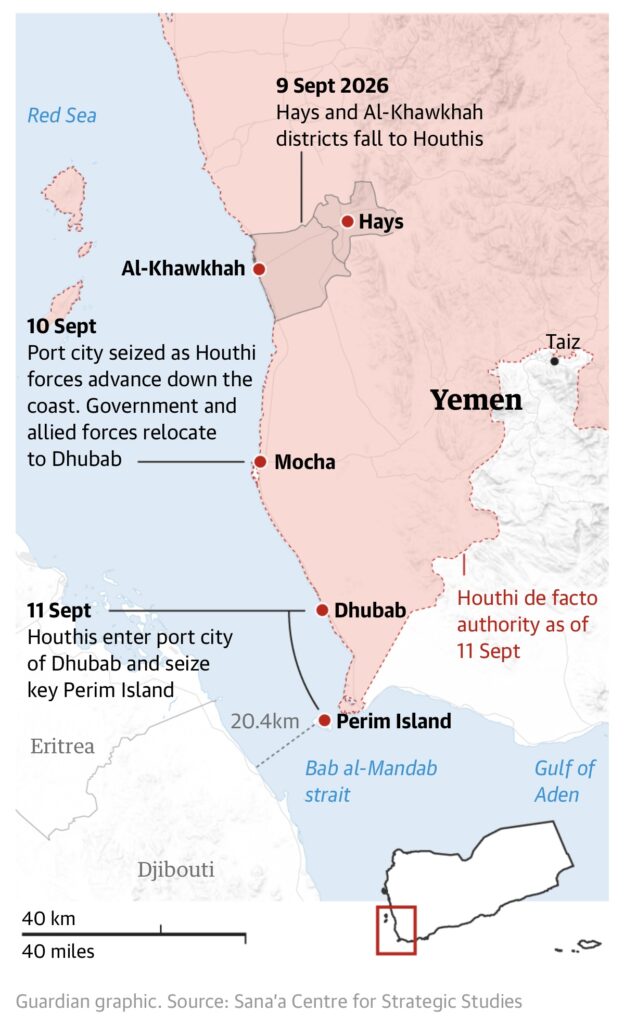
Yemen’s Houthi movement (Ansar Allah) has taken control of the historic Red Sea coastal city and port of Mocha (also known as Mokha or al-Makha), the Red Sea’s most important and strategic coastal city. In a conflict already defined by stalemate and proxy war, this is being called a great and extraordinary achievement — not just militarily, but geopolitically. With the fall of Mocha, the Houthis have not won a town but they have won leverage over the world by taking control of Yemen’s side of the Bab al-Mandab strait and seizing a string of Red Sea islands, consolidating their grip on one of the world’s most important shipping corridors as the wider Middle East war intensifies. The Houthis captured Mayyun Island, also known as Perim, which sits in the middle of the narrow waterway, along with the Greater and Lesser Hanish islands, all territory previously held by government forces along the western coast. Houthi forces applied pressure from multiple axes in western Taiz, southern Hodeidah, and around Mocha itself in the days leading up to the seizure. Fighting has also involved claims of advances toward areas nearer the strait, such as Dhubab, and reported activity around the Hanish Islands. Civilian displacement has been reported, with families fleeing southward. The Houthis’ rapid advance is only the beginning, as we will now face a more serious response to our damaging and contradictory policies in the Middle East and this pointless war against Iran. The Houthis’ capture of key geographical locations and strategic ports on the Red Sea coast is not only a testament to their military capabilities, but also to their ability to win the support of tribes far beyond their traditional strongholds in northern Yemen. The takeover hands the Houthis control of the Yemeni side of Bab al-Mandab, the southern gateway to the Red Sea and the Suez Canal. The capture of Mayyun Island, which divides the strait into two shipping lanes, gives the Houthis a strategically important position overlooking one of the world’s busiest maritime corridors. The waterway connects Asia and Europe through the Red Sea and the Suez Canal and has become even more important since Iran blockaded the Strait of Hormuz, another major energy route, during the wider Middle East conflict. Saudi Arabia, the world’s largest oil exporter, has increasingly relied on Red Sea routes since the Hormuz blockade disrupted shipments through the Gulf. Saudi crude supply fell by 2.3m barrels a day in August, to 6m barrels a day — the lowest level in more than three decades — according to the International Energy Agency, a decline it linked partly to attacks on vessels transiting Bab al-Mandab. The number of vessels passing through Hormuz fell to seven on Thursday, from 11 the day before, according to preliminary ship-tracking data. Before the conflict, the strait typically handled about 125 large commercial vessels a day. Oil prices climbed above $100 a barrel this week, while US diesel prices crossed $6 a gallon for the first time — adding pressure on Donald Trump ahead of November’s midterm elections. In a decisive geopolitical twist, US President Donald Trump, according to Axios, twice rebuffed urgent calls from Crown Prince Mohammed bin Salman for direct American strikes on the advancing Houthis. Iran has described the Houthis as an ally but has denied directing their military operations, saying the group is not a proxy force. Iran has rejected those claims and said the Houthis operate independently. Pakistan’s Chief of Defence Forces and Chief of Army Staff Field Marshal Asim Munir and Iranian Foreign Minister Abbas Araghchi discussed regional tensions, including the Yemen conflict, with discussions focused on the US-Israeli war with Iran, efforts to restore diplomatic talks and the wider security situation in the region and exchanged views on rising tensions and their consequences for regional peace and stability. They also stressed the need for coordination among regional countries and the use of shared capabilities to support lasting peace and security. Multiple sources, confirmed that Houthi forces entered the city after pro-government units, including elements of the National Resistance Forces led by Tareq Saleh, withdrew, which described the seizure as delivering a “significant blow” to Yemen’s internationally recognised government and expanding Houthi influence over the approaches to the Bab al-Mandab Strait. Houthi advances into nearby areas such as Hays (Hais) district. The Houthis declared Red Sea shipping safe for all but Saudi vessels, with politburo member Hazem al-Assad insisting “freedom of navigation and international trade in the Red Sea and Bab al-Mandab are safe and orderly” and that there is “no danger from the Yemeni side,” while military spokesman Yahya Saree announced a total ban on Saudi ships, vowing to “continue to enforce blockade for blockade and escalation for escalation until the aggression stops,” even as Saudi Arabia retaliated with two airstrikes on Mocha airport and six missiles on its port following the Houthis’ seizure of the strategic coastal city and Zuqar Island — an offensive that killed over 500 and displaced 46,000 according to the UN — threatening to reignite Yemen’s civil war that began with the fall of Sanaa in 2014 and survived a Saudi-led coalition war until the 2022 ceasefire, as Yemen’s internationally recognized government now prepares a counter-offensive with weapons and aircraft to purge Houthi militias from routes to Mocha, while Saudi airstrikes and reinforcements from Aden have so far failed to halt Houthi gains. Mocha sits on Yemen’s western Red Sea coast, roughly 50–75 km (about 30–47 miles) north of the Bab al-Mandab Strait—the narrow waterway linking the Red Sea to the Gulf of Aden and one of the world’s most critical maritime chokepoints. Seized a string of Red Sea islands, consolidating their grip on one of the world’s most important shipping corridors. A substantial share of global trade, including oil and energy shipments heading toward the Suez Canal and Mediterranean, transits this route. Bab al-Mandab handles an estimated 10–12% of global trade in typical assessments. Control of Mocha strengthens the Houthis’ ability to monitor, pressure, or potentially disrupt maritime traffic closer to the strait. Previously, the group had launched attacks on shipping from positions farther north. The port’s capture also severs or complicates key supply lines for anti-Houthi forces, including the road linking Mocha to Taiz, and reduces government access to a coastal base that had been held since the Houthis were driven out of the area in 2017.
Simultaneously, external powers, particularly the United States and its allies, should exercise strategic restraint by ending open-ended military interventions and proxy escalations that have repeatedly fueled extremism and regional blowback, recognizing that energy security and freedom of navigation are best preserved through negotiated de-escalation rather than kinetic dominance. Only by confronting the precedent that geography can be held ransom, and by mustering the moral courage to disentangle from cycles of intervention that manufacture new threats, can the world avert further mass suffering in Yemen while restoring a measure of stability to the chokepoints upon which the global order still depends. President Trump and his advisers know that ending America’s wars and unnecessary interventions abroad is in the best interest of the American people; the real question is, do they have the moral courage to do so?
Geostrategically, Mocha sits on Yemen’s southwestern coast, within striking distance of the Bab al-Mandab Strait. This 20-mile-wide chokepoint is the jugular of global commerce. An estimated 12% of all world trade and 30% of global container traffic passes through it. Roughly 6.2 million barrels of oil and oil products transit the strait daily. Whoever controls the Yemeni coastline overlooking Bab al-Mandab controls the ability to threaten, tax, or close the artery that feeds Europe, Asia, and the Gulf. The development occurs amid a wider escalation in Yemen’s long-running conflict, which had been relatively frozen after a 2022 truce but has intensified in the context of broader regional tensions involving Iran. This is crucial, as the majority of these tribes are Sunni, while the Houthis are Zaydi Shiites. Yemen is a tribal society where agreements between opposing tribes and groups are often made before or during the war, and these alliances are not always clear, but now the situation is different; the Houthis are fighting alongside the Iranian Revolutionary Guard Corps (IRGC) as part of an axis of resistance against the United States, Israel, and Saudi Arabia, which has given them far more popular support than any simple tribal agreement or military victory. This does not mean that the Yemeni people are pro-Iran or have any special interest in the Iranians, but rather that in times of war, people unite against their common enemy, and this is human nature. The Yemeni people have seen what the US-backed Saudi war did to their people, and they have also seen what the US-backed Israeli operations did to the people of Gaza; on the other hand, they are also seeing that Iran is resisting them after the US and Israel attacked Iran, so now the Yemenis are uniting and retaliating against their common enemy. The US war on Iran, the simultaneous support of Saudi Arabia for the war in Yemen, and the government’s support for Israel’s operations in Gaza have given the Iranian Islamic Revolution a major boost that is reaching far beyond Iran’s borders. The capture of Mocha therefore means one thing: the Houthis have moved from harassing shipping lanes with drones and missiles to holding the shoreline that dominates them. It is the difference between firing from the mountains and dictating from the coast. This development is clear evidence that the Houthis are evolving. For years they were framed as a mountain insurgency — effective on land, limited at sea. The seizure of Mocha dismantles that narrative. It shows a force that is not only strengthening its grip militarily, but is also advancing deliberately along coastal corridors to become the most dynamic and dominant party in the region’s maritime politics. By securing Mocha, the Houthis now have: Strategic Depth: A port city to project power, resupply, and anchor naval/drone operations deeper into the Red Sea. Economic Leverage: Direct influence over the security calculus of shipping companies, insurers, and naval coalitions. Negotiating Power: A new card to play in any future peace talks. Ceasefires will now have to address who controls Yemen’s coastline, not just its capital. This is no longer just a Yemeni civil war. It is a Red Sea war. The implications extend far beyond Yemen. For global supply chains already battered by inflation and rerouting, a Houthi-held Mocha means higher risk premiums, longer shipping routes around Africa, and renewed pressure on energy prices. For Saudi Arabia and the UAE, it means their southern flank is now more exposed. For the U.S. and its naval allies, it means the mission has shifted from “freedom of navigation patrols” to “containment of a coastal power.” Most importantly, it signals that years of airstrikes, blockades, and diplomatic pressure have failed to break the Houthis. Instead, they have used the war to consolidate — turning tactical gains into strategic territory. The capture of Mocha is not just another city changing hands. It is the moment the Houthis graduated from rebels to a maritime actor. Mocha is historically significant as a former major coffee-exporting port that gave its name to the famous beverage style. In the modern conflict, it has served as a government-aligned logistics and military hub on the Red Sea coast. Houthi forces had controlled it earlier in the war before losing it. Recent weeks saw prior Houthi missile and drone strikes on the port that disrupted operations and caused casualties and infrastructure damage. While the capture enhances the Houthis’ coastal and maritime leverage, full control of the Bab al-Mandab itself remains contested, and government and coalition forces may attempt to regroup or counter. The situation remains fluid, with reports of ongoing repositioning and potential for further Saudi or coalition responses. This advance underscores the Houthis’ continued capacity to project power along Yemen’s Red Sea coastline and influence one of the planet’s most vital trade arteries, raising the stakes for regional security, energy markets, and international shipping. Monitoring of maritime traffic through the southern Red Sea is expected to intensify in the coming days. For a decade, Saudi Arabia has outsourced its war against the Houthis to the people of the south, relying on the Southern Transitional Council and its 80,000-strong force as the backbone of deterrence, and now faces its familiar, existential dilemma: negotiate Yemen’s future with the very enemy it vowed to crush, or attempt to roll back an overstretched but triumphant Houthi army; while the Houthis fight on their own terms, independent of Tehran’s direct orders, their war bleeds Saudi Arabia in a way that perfectly serves Iran — forcing Riyadh to pressure Washington for leniency on Iran itself — even as Western capitals grow increasingly uneasy over whether Saudi airstrikes, carried out with Western weapons, can still be justified as self-defence. The Houthi advance down the Red Sea coast from the port of Hodeidah also strengthens Iran’s hand in trying to reach an agreement with other Gulf states on future control of the Strait of Hormuz, the central dispute between the US and Iran. Iran has reached an agreement on temporary approved routes with Oman, the country sharing the southern coast of the Hormuz Strait. The proposed deal is supposed to be discussed at a meeting of Gulf Cooperation Council (GCC) foreign ministers in the Omani coastal city of Salalah. The deal, including a temporary approved route for shipping largely under Iranian control, would – if agreed by the GCC – put pressure on the US to lift its blockade of Iranian oil ports.
The Yemen civil war began in 2014 when fighting broke out between the Houthis and the Yemeni army after Houthi supporters were shot at during mass protests against fuel subsidy cuts in the capital, Sana’a. A coalition of mostly Arab countries, led by Saudi Arabia, then intervened on behalf of the ousted government, with a mostly aerial campaign that was widely criticised for its deadly impact on the civilians of Yemen. The Houthis promptly seized the capital, and by 2015 had toppled the government. What began in 2014 as bullets fired at protesters in Sana’a over fuel subsidy cuts metastasized into a war that rewrote Yemen’s map: the Houthis seized the capital, toppled the government in 2015, forced it into exile in Aden, and survived a Saudi-led aerial coalition — backed by Emirati-funded proxies like the 80,000-strong STC, foreign mercenaries, and fractured government militias — whose bombs killed civilians more than they broke the deadlock, while al-Qaeda and separatists carved out their own fiefdoms in the east and south; exhausted, the belligerents accepted a UN truce in 2022 that held until Gaza shattered it, for when Israel’s war killed over 70,000 Palestinians in what a UN committee called genocide, the Houthis — claiming solidarity with Gaza — turned their Red Sea coast into a weapon, targeting Israel-bound ships through the Bab al-Mandab, inviting US strikes, winning regional legitimacy, abandoning negotiations, and escalating to the point where an Iranian plane landing in Sana’a in July drew Saudi bombs, the Houthis declared a blockade on Saudi oil after Iran closed Hormuz in March, and the truce collapsed — reigniting a war that has already killed 150,000 in combat, hundreds of thousands more from hunger and disease, displaced 4.5 million, left 18.2 million in dire need, and, with over 1,000 more casualties in the latest offensive alone according to the WHO. The UN peace plan has been strained since the war in Gaza; Israel launched the war that killed about more than 70,000 Palestinians and earned widespread condemnation for what a UN committee said was genocide, drawing the axis of resistance into the fray. The Houthi campaign brought about a US military intervention and strained the truce in Yemen. At the same time, its intervention brought the Houthis support regionally and within the territory they hold. With the Houthis’ position strengthened, the group stopped seriously engaging in negotiations, frustrating Saudi Arabia. In July, an Iranian plane landed at Sana’a airport, despite the protests of the Yemeni government, leading Saudi Arabia to strike the airport. The Houthis then declared a naval blockade of Saudi Arabia in the Red Sea, a key route for Saudi oil since Iran closed the Strait of Hormuz in March. The renewed fighting has further exacerbated humanitarian conditions, which proves that Yemen was never a local civil war but a chokepoint where fuel prices, genocide in Gaza, and global shipping lanes converge to decide who lives and who starves. In a region defined by chokepoints — Hormuz, Suez, Bab al-Mandab — control of the coast is control of the century. In seizing the vital port of Mokha and the commanding islands of Perim (Mayyun), the Hanish group, and the adjacent coastline, the Houthis have transformed a long-simmering Yemeni civil war into a direct lever over one of the world’s most indispensable maritime arteries—precisely when the Strait of Hormuz is already throttled by the US-Israel war on Iran. This dual choke-point reality does more than inflate oil prices or reroute tankers; it exposes the fragility of a globalised economy that has long treated freedom of navigation as an immutable given rather than a contested privilege. By placing forces within artillery range of the narrowest shipping lanes, the advance forces a painful reckoning: energy security, supply-chain resilience, and even the strategic autonomy of major powers now hinge less on distant alliances than on the capacity of non-state actors to hold geography hostage. The Yemeni conflict, far from a contained civil war, has metastasised into a strategic fulcrum where local grievances over fuel subsidies, Saudi-led aerial devastation, Houthi consolidation of power, and the Gaza crisis converge to weaponise the Bab al-Mandab strait, exposing the fragility of global energy arteries already strained by Hormuz disruptions and compelling a painful recognition that non-state actors can now hold the commercial commons hostage. With the Houthis entrenched along the Red Sea coast, controlling ports such as Mokha and islands commanding vital shipping lanes, any durable resolution demands more than renewed truces: the international community must prioritise sustained, verifiable diplomacy that integrates all stakeholders—including the Houthis—into a comprehensive political settlement guaranteeing inclusive governance, immediate large-scale humanitarian corridors free of politicisation, and enforceable security arrangements to demilitarise the maritime approaches. The deeper provocation lies in the precedent—once a militia can dictate passage through Bab al-Mandab, the age of assured commercial commons may be drawing to a close, compelling nations to confront whether they will reassert control through force, diplomacy, or a reluctant acceptance that the seas themselves have become another front in an expanding proxy contest. The Houthis understand this. The question now is whether the international community does. Because a group that holds Mocha does not need to win the war in Yemen. It only needs to hold the sea lane the world cannot afford to lose. The map has changed. The cost of ignoring it has just gone up. As the US-Israel war against Iran drags on, the world will see more of its consequences, especially in Iraq, Lebanon, and possibly Bahrain. The Western policies and military interventions abroad are fueling extremism, which could lead to counterterrorism at home. Simultaneously, external powers, particularly the United States and its allies, should exercise strategic restraint by ending open-ended military interventions and proxy escalations that have repeatedly fueled extremism and regional blowback, recognising that energy security and freedom of navigation are best preserved through negotiated de-escalation rather than kinetic dominance. Only by confronting the precedent that geography can be held ransom, and by mustering the moral courage to disentangle from cycles of intervention that manufacture new threats, can the world avert further mass suffering in Yemen while restoring a measure of stability to the chokepoints upon which the global order still depends. It’s a vicious cycle in which Western policies are creating new threats and ultimately costing more lives. President Trump and his advisers know that ending America’s wars and unnecessary interventions abroad is in the best interest of the American people; the real question is, do they have the moral courage to do so?