The writer is an economist, anchor, jurist, and geopolitical analyst and the President of All Pakistan Private Schools’ Federationpresident@Pakistanprivateschools.com
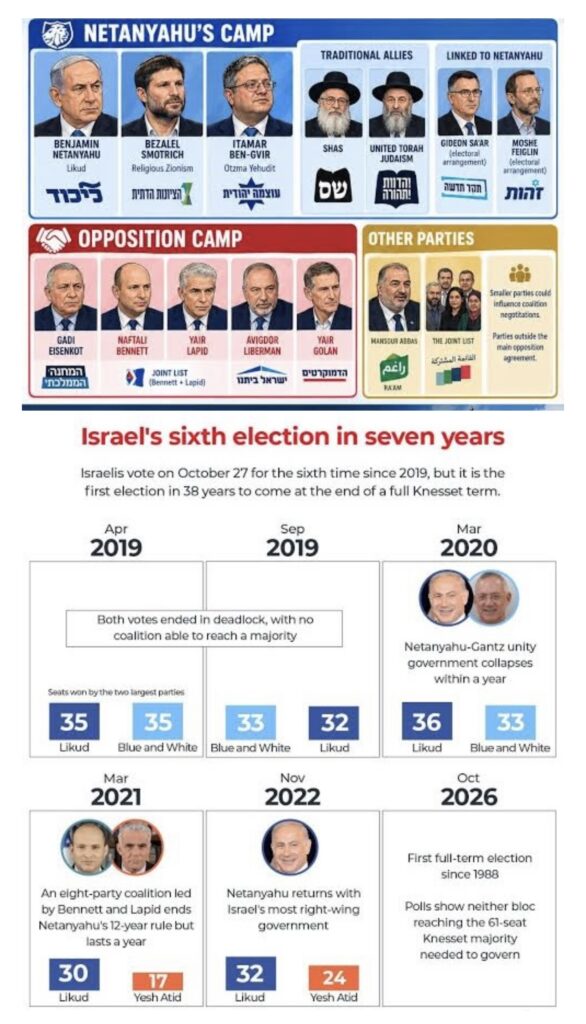
Israel has been plunged back into political paralysis after one of the highest voter turnouts in decades failed to produce a decisive winner in the October 27 polls. Final results from the 120-seat Knesset confirm a familiar stalemate: neither Prime Minister Benjamin Netanyahu’s right-wing Likud-led coalition nor the rival bloc led by centrist Yashar party chief Gadi Eisenkot has reached the 61-seat threshold required to govern. The outcome leaves the country facing weeks, if not months, of limbo. On the other side, US strikes Iran ahead of midterm elections and attacked Iran’s Qeshm Island in the Strait of Hormuz, U.S. officials said, in the latest of a series of limited strikes Washington has secretly carried out against the country in recent weeks as President Trump touted the possibility of a diplomatic deal, so election dramas are at it’s peak. On paper, the arithmetic is simple, but the politics are not. Deep ideological fractures make any stable coalition inherently fragile — even a tenuous alliance that might last little more than a year will be difficult to assemble. The opposition’s most direct numerical path to unseating Netanyahu runs through Jewish-Arab cooperation, and that is precisely its biggest political obstacle. Two key right-wing figures in the opposition bloc — former Prime Minister Naftali Bennett and former Defence Minister Avigdor Liberman — have ruled out any government that relies on the two Arab factions, the Joint List and Ra’am, whether as full coalition partners or as external supporters of a minority government. Both have hardened that position since the Hamas-led attack of October 7, 2023. History shows how precarious that model is. Only once has an Arab party been a full member of an Israeli government — when Ra’am joined the eight-party coalition that ousted Netanyahu in 2021, a government that collapsed after just over a year. Even without forming a government, the opposition could use a combined parliamentary majority to reshape the Knesset itself — replacing the Speaker and key committee chairs — and thereby constrain Netanyahu’s caretaker government. But assembling an alternative government to actually replace him remains highly complicated. A second scenario is a unity government. Under this model, Likud would remain central, retaining some of its current partners and adding at least one party from the opposition bloc. Netanyahu is believed to be willing to drop far-right National Security Minister Itamar Ben-Gvir, but not Finance Minister Bezalel Smotrich or the ultra-Orthodox parties. Eisenkot, however, has categorically ruled out sitting under Netanyahu, and for many Israelis eager to see the end of the ‘Bibi’ era, any reversal would be seen as betrayal. A third scenario is engineered defections. Netanyahu’s bloc is eight seats short of a majority, meaning he would need to peel away at least eight lawmakers. All four opposition leaders — Eisenkot, Bennett, Liberman and Yair Golan — have publicly declared they will not sit with him, making individual defections a high bar. The formal process now shifts to President Isaac Herzog, who will hold public consultations with all party leaders who entered the Knesset. With Arab parties expected to recommend Eisenkot, the Yashar leader may be tasked first. The nominee receives 28 days to form a government, with a possible 14-day extension. If he fails, the President tasks a second leader, who gets 28 days. After that, a majority of MKs can request a third candidate, who has 14 days. If all three attempts fail, Israel heads to another election — no earlier than next spring. That would be the seventh general election in eight years, returning the country to a cycle of chronic political paralysis with no clear exit. Since October 7, 2023, Israel has undergone a profound political and strategic transformation. Which not only reshaped Israeli perceptions of security, but also redefined how Israelis view the country’s place in the wider Middle East and further hardened opposition to Palestinian statehood. As Israel went to the polls on October 27, the central question was therefore twofold: whether Benjamin Netanyahu and his coalition would retain power, and more importantly, what the vote would reveal about the country’s political trajectory after three years of war. The election took place against a broad and unsettled regional landscape — the future of Gaza and the West Bank remains contested, Iran and Lebanon continue to dominate Israel’s security calculations, and Israel’s relationship with the United States has grown more complicated. Yet neither Gaza nor the West Bank emerged as a deciding electoral issue in the election. The reason was not that they are unimportant, but that they represent an area of broad agreement across both major alliances. Instead, the campaign was fought largely on internal fault lines: the power of Israel’s courts and the judicial reform project, whether members of the ultra-Orthodox minority should remain exempt from military service, and whether the government’s alleged culpability in missing the warnings ahead of the October 2023 attack should be formally examined. Those issues were pitched to voters in largely the same terms used by the politicians who enacted the policies. That absence of Gaza from the electoral debate has drawn significant analysis. The problem is not simply that people are uninformed or disengaged. Many Israelis know that Gaza has been devastated, even though they are exposed to a very selective representation of that devastation. But knowing something and recognising its moral and political implications are different things. Ordinary people, who love their families, care for their friends, and consider themselves decent human beings, can participate in or acquiesce to a political order that produces immense suffering for others. What has been at work, the argument goes, is a powerful mechanism of denial — not necessarily denial of the facts, but denial of their meaning. The numbers underscore how divided, and how engaged, the country remains. Roughly 2.38 million Israelis voted to back Netanyahu’s Likud-led coalition, while some 2.21 million cast ballots for the opposition alliance. Between the two blocs, little space was given to the grave accusations now surrounding the war — including allegations that Israeli attacks have killed more than 104,500 people in Gaza and left much of the Strip in ruins, and findings by a United Nations commission of inquiry on Monday that Israel has committed crimes against humanity in the occupied West Bank, including extermination, torture and rape, alongside government complicity in surging settler violence and pogroms. Whether a change in government would alter that trajectory remains uncertain. A new coalition could shift Israel’s approach to the Palestinians and its regional conflicts, but it is unclear whether it would represent a substantive departure from the security and political assumptions that have hardened since October 7. For much of this electorate, the October 27 vote was less a judgment on the government’s conduct of the war than a choice between competing claims to political legitimacy — what Israeli academics have described as a contest over “the heart and soul of democracy” and the future of Jewish and Israeli identity. Security was the central agenda. For Netanyahu’s supporters, the decisive factor for turnout was the understanding, or the belief, that any alternative coalition would be weaker on security. What Netanyahu has been particularly successful in doing is constructing a campaign of fear around that perception — the belief that he is the only leader strong enough to manage this moment, the only prime minister capable of leading Israel through the post-October 7 war and its aftermath. That framing has proven powerful. What will ultimately determine what comes next is not just who wins, but how Israel’s fragmented political landscape — over judicial reform, ultra-Orthodox politics, the power of the settler movement, and the role of Palestinian citizens of Israel — coalesces.
Three questions now define the moment: What does this election reveal about Israel’s changing political landscape? Would a new government signal a real shift in policy toward Gaza, the West Bank, Iran, Lebanon and the broader region, or largely continue the trajectory of recent years against Iran? And what will the outcome mean for Israel’s relations with the Palestinians, Iran, its neighbours, and Washington? The idea that Netanyahu is the indispensable strongman proved wrong and has redefined the election more than any policy debate on Gaza or the West Bank. War and occupation were not presented as choices to be made on the ballot paper. The question now is how Israel breaks its deadlock: through a fragile, ideologically contradictory coalition, a unity arrangement that many voters would see as betrayal, or through a new election that would extend years of political paralysis. Over decades, they have become the prism through which Israelis view security itself, citizenship, and the very meaning of democracy. That is why, in this reading, replacing Netanyahu — important as it may be symbolically — would not by itself resolve the deeper problem. The security paradigm that has shaped Israeli politics since October 7 transcends any single leader. Politically, the country remains deadlocked. Neither Prime Minister Benjamin Netanyahu’s bloc nor the opposition grouping led by Gadi Eisenkot secured the 61-seat majority needed to form a government in the 120-seat Knesset. Both leaders have also publicly ruled out working with the two main electoral lists representing Palestinian citizens of Israel — the United Arab List, Ra’am, and the Joint List. Yet those two Arab lists are expected to recommend Eisenkot for prime minister when consultations begin with President Isaac Herzog. Herzog himself intervened on Sunday, calling on political leaders to accept the election results and demonstrate flexibility in coalition negotiations, warning against entrenchment that could force another election. Israel’s first President, Chaim Weizmann, Herzog emphasised the need for cooperation among party leaders, urging a willingness to consider different proposals and reach agreements. Is Isreal going for a second election possible? Yes. If the process fails, Israeli President Isaac Herzog will be tasked with choosing which candidate has the best chance to form a government. That candidate is then given about 28 days, with a possible extension, to do so. If he fails, the President can choose another. If that second candidate also fails, a 21-day window opens in which 61 members of the Knesset can submit a request to Herzog to assign the task to a third Knesset member. If all of that fails, Israelis return to the polls. Are Arab parties being considered for coalitions? On paper, they are the kingmakers. In political practice, many Israeli leaders have rejected the idea. Netanyahu has ruled out working alongside them and, after his coalition lost its majority, his Likud party accused the Arab-led parties of “stealing” the election. “It is forbidden to form a government with them,” has become a central refrain. Eisenkot’s position is more conditional but equally restrictive. According to a Times of Israel report this week, he has said he would only consider partnering with any party that recognises Israel as a Jewish and democratic state, endorses the values of the Declaration of Independence, and commits to all Israelis performing national service. He has not said whether Ra’am and the Joint List meet those criteria. Where do the Arab parties stand? They have shown considerably more pragmatism than Eisenkot and most of his allies. Against what they describe as a politics of supremacy, racism and exclusion, they have argued that “change comes through Jewish-Arab partnership, a true and equal partnership has indicated it is open to participating in an Eisenkot-led government, while the Joint List has left open the possibility of supporting a minority government from outside the coalition, provided such support delivers meaningful commitments on equality, violent crime in Palestinian communities, home demolitions, and a political pathway for the wider Palestinian question. Can Arab parties break the deadlock? The numbers don’t add up for any side without them, but political will does not. There are rumours that Eisenkot will ask for the support of the Arab parties in a government investiture vote in return for financial investment in their communities. Yet this is unlikely on both sides, and even if pursued, it would likely fall due to Avigdor Liberman’s objection. The equation would have been simpler if Eisenkot’s “change bloc” were closer to a majority. Outside support would then have been more likely because Ra’am is perceived as the more “moderate” Arab party, making a European-style confidence-and-supply agreement more probable. If Eisenkot is willing to pursue such cooperation, three models exist: First, the Arab parties could be full members of the government — what Ra’am wants, but the Joint List does not want at this stage. Second, they could be coalition members without ministerial portfolios — the model Ra’am followed in the Bennett government from 2021-2022. Third, they could support from the outside as a blocking majority that does not vote down the government. Most analysts predict that if such a government emerges, it would include Ra’am inside the coalition and rely on the Joint List from outside. At this stage, the real obstacle is not a lack of pragmatism from the Arab parties, but the refusal of Eisenkot and several of his partners to recognize Palestinian citizens of Israel — and the 19 representatives they elected — as legitimate political partners. The election produced 67 seats outside Netanyahu’s bloc, but Israel’s political system continues to behave as though 19 of those seats do not fully count. Indeed, Eisenkot wants Palestinian votes to remove Netanyahu while insisting on a ‘Zionist government’ that excludes the representatives of those same voters. That is not merely coalition arithmetic; it exposes a profound democratic contradiction. Palestinian citizens are permitted to vote, but when their votes become decisive, their political legitimacy is immediately questioned. What options does Netanyahu have? Netanyahu could still try to keep power. He can try to persuade Eisenkot and others to form a coalition with him, and in the meantime he can delegitimise the Arab parties to make it difficult to form an alternative government. In his calculation — the Arabs will not turn out as before, and the opposition would be discouraged and stagnant. In another round of elections, his bloc could get to 61. But at the moment it doesn’t look like they are going to join him. Palestinians view the deadlock and the election as an existential moment for Palestinian Israelis. For Palestinian citizens of Israel, the result represents both an achievement and a test. They turned out in large numbers, secured unprecedented representation and may now have the power to prevent another Netanyahu government. Yet they are again being told that their votes are acceptable only if they do not translate into real political power. For Palestinians in Gaza, the occupied West Bank and East Jerusalem, however, the framing is different. There is little reason to see this as a contest between occupation and peace, or between oppression and equality. It is principally a struggle over who will govern Israel and how Israel will present itself — not whether Palestinians will continue to live under military occupation, settlement expansion, dispossession and systemic inequality. But Palestinians will judge any successor by policy, not personality — whether it ends the war in Gaza, stops settlement expansion and settler violence, and recognises Palestinian freedom and self-determination.
Three questions now define the moment: What does this election reveal about Israel’s changing political landscape? Would a new government signal a real shift in policy toward Gaza, the West Bank, Lebanon and the broader region, or largely continue the trajectory of recent years especially Iran? And what will the outcome mean for Israel’s relations with the Palestinians, Iran, its neighbors, and Washington?
Three questions now define the moment — and none of them has a simple answer. First: What does this election reveal about Israel’s changing political landscape? It reveals a country that is highly mobilised but deeply divided, where one of the highest turnouts in decades produced not a mandate but a mirror. The vote was less a referendum on war management than a contest over political legitimacy itself — over who can claim to represent Jewish and Israeli identity, and what democracy means when security becomes its primary prism. The fact that 53 seats went to Netanyahu’s bloc, 48 to Eisenkot’s, and 19 to the Arab lists shows a society that has not moved toward a centre, but toward two competing security narratives, with a third electorate — Palestinian citizens of Israel — holding decisive weight yet still treated as politically illegitimate by both Jewish blocs. It reveals a country that is more politically mobilised and more ideologically entrenched than at any point since October 7, 2023. The October 27 vote was a judgment on Gaza or the West Bank — moreover, because both major Jewish blocs share a broad consensus on both. It was a contest over illegitimacy itself: who is strong enough to guarantee brutality in the name of security, and in the name of what defines Jewish and Israeli identity, and what democracy means when war and occupation have become the permanent prism through which so-called security and citizenship are understood. The final tally — 53 for Netanyahu, 48 for Eisenkot, 19 for Ra’am and the Joint List — shows not a nation moving toward the centre, but a nation split into two competing security camps, with a third electorate holding the balance of power but denied political legitimacy by both. Would a new government signal a real shift in policy toward Gaza, the West Bank, Iran, Lebanon and the broader region, or largely continue the trajectory of recent years — especially on Iran?On Gaza, the West Bank and Lebanon, a change of prime minister would likely alter tone and management, not doctrine. Replacing Netanyahu would not by itself reverse the strategic assumptions hardened since October 7 — the entrenchment of military control, the opposition to Palestinian statehood, and the view of deterrence as the organising principle. On Lebanon, both blocs favor a policy of contained escalation. The real continuity, however, is Iran. Iran is not just another foreign policy file; it is the central justification for Netanyahu’s campaign of fear — that only he is strong enough to lead — and it remains the organising threat for any alternative government. Whether Likud-led or Yashar-led, the next government will maintain maximum pressure, intelligence operations, and military freedom of action against Iran and its regional network. What might change is not the objective, but the coordination with Washington on how to achieve it. And what will the outcome mean for Israel’s relations with the Palestinians, Iran, its neighbours, and Washington? This is where the deadlock exposes a profound democratic contradiction. The system produced 67 seats outside Netanyahu’s bloc, but continues to behave as though 19 of those seats — those won by Palestinian citizens of Israel — do not fully count. Eisenkot wants Arab votes to remove Netanyahu while insisting on a “Zionist government” that excludes the representatives of those same voters. As one analyst noted, Palestinians are permitted to vote, but when their votes become decisive, their political legitimacy is immediately questioned. For Palestinians in Israel, Gaza, the West Bank and East Jerusalem, the result is therefore both an achievement — unprecedented turnout and representation — and a test. As the election shows, their inclusion is still conditional. For them, any successor government will be judged by policy, not personality: whether it ends the war in Gaza, halts settlement expansion and settler violence, and addresses systemic inequality. For Iran, the message from the election is continuity under paralysis. For Israel’s neighbours — from those in the Abraham Accords to those contemplating normalisation — a long caretaker period or a fragile change government that relies on the delegitimisation of Arab parties offers no stable address. Second: Would a new government signal a real shift in policy toward Gaza, the West Bank, Lebanon and the broader region, or largely continue the trajectory of recent years — especially on Iran? On Gaza and the West Bank, the election exposed a broad consensus, not a divide. Neither was a deciding electoral issue because both blocs largely agree on continued military control and opposition to Palestinian statehood. A government led by Eisenkot, Bennett and Liberman might change tone, management style, and the intensity of judicial and ultra-Orthodox battles, but it is unlikely to represent a substantive departure from the security doctrine hardened since October 7. On Lebanon, the framework remains one of deterrence and limited escalation. On Iran, the continuity is even clearer: Iran remains the organising principle of Israel’s regional strategy — the existential threat that justifies the fear campaign at home and the freedom of action abroad. For Washington, the stakes are highest. The U.S. needs an Israeli government capable of making decisions on Gaza’s future, West Bank stability, Lebanon, and a coherent Iran strategy. What it has instead is a high-turnout election that delivered no majority, a president forced to mediate between blocs that refuse to recognise the legitimacy of the very votes that could break the deadlock, and a real prospect of a seventh election in eight years. Whoever sits in the prime minister’s chair, the Iran file will continue to dominate defence planning, intelligence operations, and quiet coordination with Washington and Arab neighbours. Third: And what will the outcome mean for Israel’s relations with the Palestinians, Iran, its neighbours, and Washington? For Palestinians — whether citizens of Israel, residents of the West Bank and East Jerusalem, or people in Gaza — the election will be judged not by personality but by policy: whether it ends the war, stops settlement expansion and settler violence, and recognises a political horizon. For Iran and its regional network, any Israeli coalition, caretaker or new, will be read through the same lens of military pressure and containment. For Israel’s neighbours who have normalised or are considering normalisation, a prolonged caretaker government under Netanyahu, constrained but still in power, signals unpredictability. For Washington, the deadlock complicates an already complicated relationship. A Netanyahu caretaker government with limited legitimacy, or a fragile change government dependent on ad hoc deals and an active effort to delegitimise 19 Arab MKs, offers no stable interlocutor for Gaza reconstruction, West Bank stability, or a coherent Iran strategy. In the end, the election did not resolve Israel’s contradictions; it codified them. Israelis voted in record numbers to decide who will lead, but left unanswered the deeper question the vote was really about: whether Israel can build a governing majority that includes all of its citizens, and whether any government that emerges can shift from managing perpetual conflict to defining a sustainable political future for itself, for Palestinians, and for the region. In the end, Israel’s electoral deadlock has exposed a paradox of power: a state incapable of projecting force across multiple fronts and clearly failed in Iran, again unable to translate into coherent electoral strategy or lasting political outcomes. While successive caretaker governments and shifting coalitions rearrange the faces in Jerusalem, the structural constraints remain unchanged — an unresolved war in Gaza and Iran without a viable endgame, a northern frontier held in fragile suspension, and an Iran file that drifts between containment and confrontation without decisive resolution. In this vacuum of domestic legitimacy and strategic clarity, Tehran has emerged as the only consistent actor shaping the tempo and terms of the regional contest. Israel’s long-term viability faces growing questions amid emigration, rising Western nationalism, and declining political support. These trends show the decline of the idea of Israel. Until Israel can forge a stable governing majority capable of matching military strength with political purpose, the initiative will continue to rest not in Tel Aviv or Washington, but in the hands of those who face no such paralysis.