The writer is an economist, anchor, jurist, and geopolitical analyst
and the President of All Pakistan Private Schools’ Federation
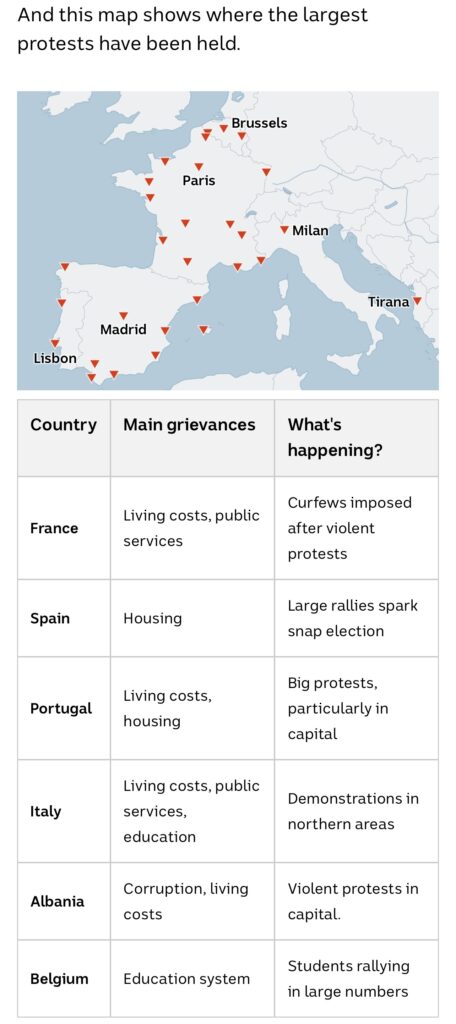
The world is not witnessing a series of isolated protests. It is witnessing a synchronised crisis of affordability being converted into a geopolitical weapon—or, more precisely, into a self-inflicted wound that adversaries are happy to salt. In the span of days around mid-October 2026, roughly 550,000 people marched across France according to official Interior Ministry figures (organisers claimed closer to 800,000). The toll: approximately 2,397 arrests and 997 police and gendarmes injured. As soaring fuel prices squeeze household budgets and businesses across Europe, cost-of-living pressures are driving unrest and giving fresh momentum to far-right parties ahead of elections next year in countries including France, Germany and Italy. Clashes erupted in Milan, Bologna, Turin and other Italian cities; roadblocks by farmers, truckers and steelworkers disrupted southern Italy, producing localised fuel shortages and empty shelves. Tens of thousands marched in Lisbon and Porto over housing and wages. Spain’s housing crisis, ignited by the eviction of an 87-year-old woman, helped force a snap election. Albania’s anti-corruption and student protests entered their multi-week phase with violence in Tirana. Belgium saw student and anti-austerity clashes. The official trigger is mundane: cost of living. Housing unaffordability, strained public services (especially schools), and especially energy prices. Diesel has hovered well above €2 per litre in much of Europe, with EU averages around €2.08–2.17 and peaks higher; gas prices have surged dramatically. Inflation in Italy hit 4.2% in September. These are not abstract statistics. They empty wallets and empty supermarket shelves when logistics seize up. This is not primarily the work of a single puppet-master. The grievances are organic and national—student conditions and public services in France and Belgium, housing in Spain and Portugal, fuel and living costs plus “no more war spending” chants in Italy, corruption and education in Albania. Yet they converge because Europe faces a second major energy shock in under five years. The first was Russia’s 2022 full-scale invasion of Ukraine. Europe’s rapid decoupling from Russian pipeline gas and oil, enforced by sanctions and moral clarity, carried enormous costs. Industry contracted, energy prices spiked, and governments papered over the pain with subsidies that strained budgets. The second shock arrived with the US-Israel military campaign against Iran that began in late February 2026. Disruptions in the Strait of Hormuz (through which roughly 20% of global seaborne oil and significant LNG volumes normally pass), attacks on shipping, damage to Gulf infrastructure, and retaliatory dynamics sent Brent crude above $100, diesel prices roughly doubling in Europe at peaks, and gas prices soaring 140% in some measures. The European Commission has estimated the Iran conflict’s direct costs to Europe at around €100 billion through trade and energy market disruption. Ukrainian strikes on Russian refining capacity have further tightened global diesel markets. These are the foreseeable consequences of strategic choices. Europe chose energy security through diversification and renewables in principle, but implementation lagged behind geopolitical tempo. The United States under the current administration pursued kinetic pressure on Iran while European governments largely followed or accommodated, without securing alternative supply chains or strategic reserves adequate for simultaneous Ukraine and Middle East contingencies. The result is a perfect storm: structural high energy costs from the Ukraine war’s aftermath, overlaid by an acute Middle East supply shock, hitting households already stretched by post-pandemic inflation, housing shortages driven by regulation, migration, and investment-fund dynamics, and public services squeezed by fiscal constraints and competing demands, including defence and Ukraine support. Europe’s streets are seething with a continent-wide revolt against the quiet collapse of the postwar social contract: soaring housing costs, stagnant wages, crumbling schools and universities, and public services stretched beyond endurance have driven hundreds of thousands into the open, from Paris to Tirana, Madrid to Milan. What began in mid-September with French high-school students protesting dilapidated classrooms and missing teachers rapidly mutated into a broader fury over living standards, then leapt borders—Spain after an 87-year-old woman’s fatal eviction following a 230 per cent rent hike, Portugal over house prices rising 16.5 per cent in a single year, Italy and Belgium over fuel and daily costs, Albania over corruption and a Trump-linked coastal development—each spark different yet all feeding the same combustible mixture of slow growth, high debt, and political paralysis. Another factor is France’s 2027 presidential election, as opposition parties seek to capitalise on growing public discontent with President Emmanuel Macron. Prime Minister Sébastien Lecornu has proposed a 2027 budget aimed at narrowing France’s deficit, projected at 5.4% of gross domestic product this year. Measures include freezing the civil service pay index and tightening reimbursement for sick leave. Finally, there are the students, the poor students who started this by making reasonable demands for having their dilapidated infrastructure repaired and perhaps getting some air conditioners installed in the classrooms, and so these three forces have come together and created an out-of-control hurricane. The economic backdrop has also deteriorated. In the second quarter of 2026, France’s unemployment rate rose to 8.3%, representing 2.7 million people, according to Insee, the national statistics bureau. The unemployment rate among 15- to 24-year-olds climbed to 21.6%. Consumer prices rose 3.1% in September from a year earlier, up from 2.4% in August, according to final Insee data. Energy prices jumped 21.3%. Meanwhile, purchasing power per consumption unit is projected to fall 0.7% in 2026, according to Insee figures. As per the calculations by the French Institute of Economics, the decline in purchasing power since 2024 is equivalent to a loss of 1,200 euros ($1,345) a year for a household with two adults and two children, and 600 euros for a single adult. The situation across Europe varies, with Portugal in a stronger fiscal position and with much less debt than France. Those countries, with higher public debt, have much less fiscal margin to act, but the main issue is that we need to resolve the problem of productivity and competitiveness at the European level. In the second quarter of 2026, Portugal recorded the EU’s highest annual increase in house prices, up 16.5% from a year earlier, according to Eurostat. The Portuguese government is looking to increase the supply of housing to reduce buying and renting costs to resolve the issue.
Europe’s governments confront an arithmetic that admits no easy solution: without accelerated productivity and competitiveness they cannot finance improved public services or rising wages, yet any move toward fiscal restraint—raising the retirement age, freezing civil-service pay, or increasing taxes—risks transforming protest into sustained unrest, especially as a continental super-cycle of elections approaches and France’s 2027 presidential contest already darkens the horizon. What has erupted is less a coordinated conspiracy than the sudden fusion of long-suppressed grievances into a single storm, exposing a continent whose leaders can no longer credibly promise a better life. Hundreds of thousands have taken to the streets across France, Spain, Italy, Portugal, Belgium, Albania and beyond, driven by soaring housing costs, strained schools and universities, and the lingering pressure of energy prices inflated by distant wars; the largest marches, more than half a million strong in France, remained mostly peaceful yet still produced looting, Molotov cocktails, burning barricades and attacks on police, prompting crisis talks, curfews in Paris and Lille, and mutual recriminations among parties barely six months from a presidential vote. Snap elections loom in Spain after housing reforms collapsed, while in Albania anger over university conditions and allegations of elite corruption—including a luxury coastal project linked to the Trump family—has brought calls for Prime Minister Edi Rama’s resignation. Smaller echoes have been heard in Greece, Austria, Ireland and Germany. The energy-price spike is milder than in 2022, when comparable violence did not materialise, underscoring that no single trigger explains the unrest. Beneath it all lies a deeper failure: Europe’s economy lags the United States, public debts constrain both spending and tax cuts, and politicians find themselves unable to offer the one commodity that might restore calm—the tangible hope of a better tomorrow. The bill has arrived—and Europe is paying it. The first wrong decision was treating the Ukraine–Russia war as an economic self-goal. The initial moral case for supporting Ukraine was legitimate; the strategic execution was catastrophic. For two years, Brussels and Washington told their citizens that economic pain was the price of principles. Sanctions on Russia would cripple Putin. Deterrence on Iran would contain Tehran. The European public paid the bill. Now the bill is due. European Commission, October 2026: The US-Israel war on Iran that began in February 2026 has cost the European economy €100 billion [$112 billion] in six months alone in energy, shipping insurance and supply chain disruption. Natural gas is up 140% since February, and diesel has more than doubled. In Caltanissetta, Sicily, farmers’ representative Arcangelo Gambino says: “We are completely at a standstill. The cost has more than doubled.” Their banner: “We cultivate the land, we harvest debts.” As per French Interior Ministry: 550,000 demonstrators united farmers, unions, climate activists and students – an impossible coalition under normal politics – because all share one reality: inflation; public service cuts; and fuel. Portugal, Italy, Spain: The same script. Lisbon marched for housing. Milan looted over public services. Spain went to a snap election over housing and rent. This is not a leftist or rightist protest. This is what happens when a continent that imports 90% of its gas and 97% of its oil decides to wage two simultaneous energy wars – one with Russia over Ukraine, one with Iran over Israel – without an exit strategy. Europe had outsourced its security to Washington and its energy to Moscow, then chose to punish the latter while remaining dependent on it and without securing any viable alternative. The result has been deindustrialisation: Germany, the continent’s engine, watched its chemical and steel foundations shutter as Russian gas at €20/MWh was replaced by American LNG at €70/MWh. The factories did not migrate to green energy; they migrated to Texas. Sanctions proved a boomerang—they failed to collapse the Russian economy and merely rerouted it. Moscow now sells oil to India and China at a discount; India refines it; Europe buys the diesel back at a premium, so that European taxpayers bankroll the very circumvention they claim to enforce. Meanwhile, the war economy grinds on without end. Kyiv itself warns that the EU’s pledged €90 billion for 2026–27 will fall short, even as Ukraine strikes civilian energy infrastructure ahead of winter and European streets burn over energy bills. The moral high ground is collapsing beneath the cost-of-living ground. As Sciences Po’s Gilles Ivaldi observes, “Purchasing power has become the major driver of populist politics.” When voices on both the hard right and hard left now openly argue that restoring energy ties with Russia would ease the pain, the political consensus on Ukraine is no longer merely challenged—it is electorally doomed. The second wrong decision was the US–Israel war on Iran—the match that lit the diesel. If Ukraine doubled the price of gas, the Iran war doubled the price of everything else. In February 2026 the United States joined Israel in direct strikes on Iran; Washington called it containment. Overnight the Strait of Hormuz—through which 20 percent of the world’s oil and 20 per cent of its LNG still passes—became a war zone. Shipping insurance for tankers soared 400 percent. Diesel, the lifeblood of European farmers, truckers and factories, turned scarce: Europe had already banned Russian supplies and now lost the Iranian crude that might have replaced them. The €100 billion European loss is not an abstraction; it is the empty shelf and the unpaid invoice. Roadblocks in southern Italy are not ideological theater; they are the sound of people who can no longer afford to drive to work. Europe followed America into this conflict without a mandate, without a UN resolution, and without any plan for who would pay for the diesel. Its citizens are paying now. There is no mastermind behind the protests—that is the convenient fantasy of governments unwilling to confess policy failure. The streets are organic. The 21-year-old student in Nantes who says the cost of living is “truly terrifying” is not funded by anyone; he is simply hungry. Yet the aftermath is being engineered by three actors who profit at once. Russia is the silent beneficiary: French intelligence and independent monitors show it did not create the riots, only amplified them through its Matryoshka network, seeding distrust with fabricated reports. It need not manufacture chaos; every night European police spend battling their own farmers is a night not spent debating the next Ukraine aid package. Senator Pushkov’s gloating Telegram post—“France is burning”—is not commentary; it is strategy. The American far-right and energy lobby harvest the same images. Within days of each other in October, Trump announced a diesel deal with Putin, froze new sanctions on Russian oil and gas, and waived key provisions of his own sanctions law. His National Security Strategy of December 2025 already framed Europe as facing “civilizational erasure” and praised its “patriotic parties.” For a coalition staring at midterms, burning Paris is campaign gold: proof that liberal Europe has failed, that the remedy is American oil, Russian diesel via American intermediaries, and an end to the Ukraine war on Moscow’s terms. Europe’s own populist right—Marine Le Pen polling 33–35 per cent in the first round, the AfD, Reform UK, the Rassemblement National—now possesses the perfect message: “We told you sanctions would make you poor. We were right.” The protests have given them what elections alone could not: legitimacy.
The Perfect Storm in Europe: Who Really Profits When the Streets Burn? A Result of Wrong Decisions and Policies of US & Europe Regarding Ukraine-Russia War and US-Israel War on Iran. History will record that in October 2026, Europe was not defeated by Russia or Iran. It was audited by its own people. The farmers in Sicily, the teachers in Brussels, the renters in Lisbon are not protesting for Russia. They are presenting an invoice for two wars fought without a cost-benefit analysis for the European household. Until Brussels and Washington admit that sanctions without energy alternatives is not policy, it is masochism, and war in the Strait of Hormuz without a price cap for Europe is not alliance, it is exploitation, the streets will not calm.
The ultimate cost is not fuel—it is sovereignty. Europe entered 2022 preaching “strategic autonomy.” It exits 2026 a continent that cannot heat its homes without American LNG, cannot fuel its tractors without Russian or Iranian oil laundered through third countries, cannot arm Ukraine without U.S. weapons, and cannot resist American policy on Iran without jeopardizing NATO itself. This is the perfect storm: a civilization that outsourced its security to Washington, its energy to Moscow and Tehran, and its economic logic to sanctions that its own citizens now reject in the streets. When a French interior minister offers to resign after imposing night curfews, and Italian police clash with their own farmers, the signal that reaches Beijing, Moscow and Washington is identical and unmistakable—Europe is distracted, divided, and exhaustible. Russia is the most obvious geopolitical beneficiary, even if it did not light the match. Kremlin spokesmen deny any role and call the unrest an “internal matter,” while state-aligned channels map the protests with evident satisfaction and frame them as proof of Western decadence and the folly of supporting Ukraine. Moscow gains propaganda points, potential political fragmentation in key EU states ahead of elections (France’s presidential contest in 2027, Spain’s snap vote), and pressure on governments to prioritize domestic relief over sustained military and financial aid to Kyiv. Hybrid operations—sabotage, drones, information campaigns—have intensified across Europe in 2026, but available reporting finds no credible evidence that Russia orchestrated these particular street movements. It does not need to; the material conditions do the heavy lifting, and amplification is cheap. Domestic political actors also profit. Far-right parties—National Rally in France, AfD in Germany, and analogous forces elsewhere—have long campaigned on fuel prices, energy sovereignty, and scepticism toward open-ended Ukraine support or “globalist” wars. Rising costs reinforce their narrative that mainstream governments sacrificed working households for distant geopolitical goals. Hard-left groups and opportunistic violence (looting, arson) further polarise, eroding trust in institutions. Energy majors and producers outside Europe have enjoyed windfall profits from elevated prices, as have some traders. In a broader strategic sense, any prolonged European distraction or fiscal strain reduces bandwidth for great-power competition with China or sustained pressure on Russia. The United States gains less clearly. Higher global energy prices can benefit American producers and LNG exporters, and a weaker, more inward-focused Europe reduces free-riding critiques. But American policy helped create the dual shocks, and a destabilised European pillar of the Western alliance is not a strategic win if it accelerates fragmentation or forces premature concessions on Ukraine. The deeper aim of the unrest, from the perspective of those who exploit it, is not revolution but attrition. Keep European governments reactive, budgets strained, publics angry, and Ukraine aid contested. Force a choice between heating homes and funding artillery. The strategic interest of revisionist powers is a Europe that is rich enough to buy but too divided and energy-insecure to project power or maintain consensus. For European elites, the danger is that repeated affordability crises will permanently shift the Overton window toward isolationism, protectionism, and transactionalism—precisely the outcome that undermines collective leverage. None of this absolves domestic failures: zoning and housing policies that protect incumbents, education systems that under-deliver, fiscal choices that prioritise consumption over investment, and an energy transition managed with more ideology than engineering. External shocks expose internal brittleness. Europe’s streets are not burning because of a grand conspiracy. They are burning because a sequence of high-stakes decisions—on energy dependence, sanctions design, and Middle East escalation—produced predictable economic pain without sufficient buffers or political consent. Adversaries did not create the tinder; Western policy stacked it. They are merely enjoying the fire. The question for European leaders is whether they will keep adding fuel through denial and half-measures, or finally treat energy security, industrial competitiveness, and social cohesion as the foundational strategic interests they always were. Until then, the perfect storm will keep returning. Who Really Profits When the Streets Burn? A Result of Wrong Decisions and Policies of the US & Europe Regarding the Ukraine-Russia War and US-Israel War on Iran. History will record that in October 2026, Europe was not defeated by Russia or Iran. It was audited by its own people. The farmers in Sicily, the teachers in Brussels, the renters in Lisbon are not protesting for Russia. They are presenting an invoice for two wars fought without a cost-benefit analysis for the European household. Until Brussels and Washington admit that sanctions without energy alternatives are not policy, it is masochism, and war in the Strait of Hormuz without a price cap for Europe is not alliance; it is exploitation, the streets will not calm. The perfect storm does not need a mastermind. It only needed a series of wrong decisions – made in Washington, Tel Aviv, Moscow, Kyiv, and ratified in Brussels – to all mature at once. And they just did…