
The writer is an economist, anchor, jurist, geopolitical analyst and the President of All Pakistan Private Schools’ Federation
president@Pakistanprivateschools.com
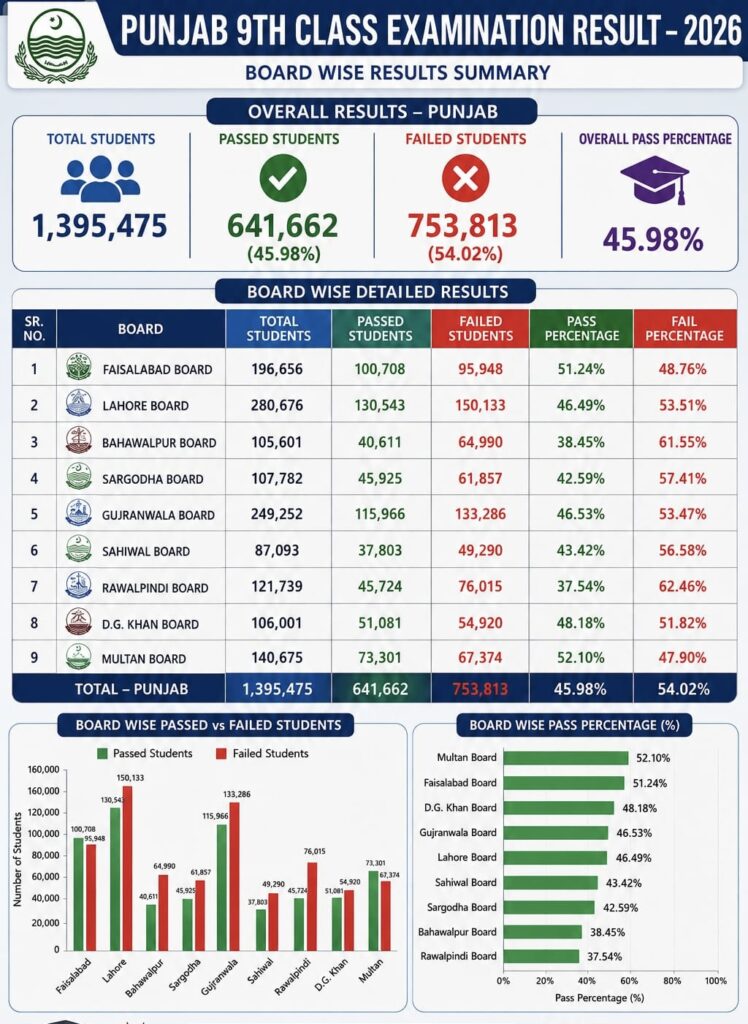
The Punjab 9th Class Examination Result 2026 is not a report card. It is a post-mortem. The All Pakistan Private Schools Federation’s (APPSF) compilation of Punjab 9th Class Examination Results 2026 lays bare a system in deep crisis. Of 1,395,475 students who sat the exams, only 641,662 passed—an overall pass percentage of just 45.98%. A staggering 753,813 students, or 54.02%, failed. More than half a generation of ninth-graders has been declared academically unsuccessful by the very system meant to equip them for the future. This is not a statistical anomaly. It is the predictable outcome of years of superficial reforms, misplaced priorities, and institutional inertia under successive Punjab governments and the Schools Education Department (SED). Of 1,395,475 children who entered the examination hall with textbooks in hand and hope in their eyes, only 641,662 walked out with a pass. The rest — 753,813 children, or 54.02% — were told by the state that they are not good enough. A pass rate of 45.98% is not a dip. It is a freefall. When more than half a generation is declared academically unfit in a single year, the problem is not the students. The problem is the system that taught them, tested them, and then abandoned them. This is province-wide collapse, masquerading as “results.” There is no board to celebrate. Multan’s 52.10% and Faisalabad’s 51.24% are the “best” — meaning nearly every second child still failed. In Lahore and Gujranwala, the supposed engines of Punjab with the most schools, teachers, and budgets, 283,419 students were failed. In South Punjab, Bahawalpur, D.G. Khan, Sargodha and Multan together condemned 248,641 more children to repeat, to drop out, to disappear. And in Rawalpindi, 37.54% passed. 62.46% failed. Two out of every three children, in the shadow of the federal capital, could not clear 9th grade. Board-wise figures expose both the scale of failure and glaring regional inequities. Multan Board recorded the highest pass rate at 52.10%, followed closely by Faisalabad at 51.24%. At the other extreme, Rawalpindi Board managed only 37.54%, Bahawalpur 38.45%, and Sargodha 42.59%. Lahore, the provincial capital and supposed educational hub, scraped through at 46.49%, with 150,133 failures out of 280,676 candidates. Gujranwala (46.53%), Sahiwal (43.42%), and D.G. Khan (48.18%) similarly hovered around or below the already dismal provincial average. The accompanying charts drive the point home: in most boards, the red bars of failure dominate the green of success. Absolute numbers are even more damning—Lahore alone failed more students than the entire enrolment of several smaller boards. These are not isolated pockets of underperformance; they reflect a province-wide collapse in foundational secondary education. A pass rate below 50% after years of announced “reforms,” tablet schemes, smart classrooms, and curriculum revisions is evidence of systemic breakdown, not student deficiency. The SED and provincial leadership have repeatedly prioritised optics over outcomes. Infrastructure announcements and digital rhetoric have not translated into competent teaching, consistent assessment standards, or meaningful learning gains by Grade 9. Disparities between boards point to uneven implementation and weak oversight. Boards serving relatively better-resourced urban centres still produced mass failure, while southern and northern boards lagged further. This suggests that central directives rarely survive the journey to the classroom. Teacher training remains episodic and poorly evaluated. Curriculum changes appear layered on without corresponding capacity building. Examination and marking processes have not been insulated from the broader culture of short-term political signalling rather than long-term academic integrity. Let us be clear: this is not an anomaly. This is arithmetic. Years of cosmetic reforms, of paper policies without classrooms, of enrollment drives without learning outcomes, and of political slogans substituting for teacher training have led us here. The Schools Education Department has managed inputs — buildings, tablets, schemes — but it has failed at its only real job: learning. A 54% failure rate is not data. It is a verdict. It is an indictment of curriculum disconnected from reality, of exams that test memory, not understanding, of ghost monitoring and real ghost teachers, and of a leadership class that treats education as a press release, not a lifeline. We are not failing exams. We are failing children. And a province that fails more than half its 14-year-olds today is signing a contract for unemployment, crime, and social unrest tomorrow. Punjab does not need another committee. It needs radical surgery: curriculum overhaul, teacher accountability with support, board autonomy from politics, and a war-footing investment in foundational literacy and numeracy before Grade 9. Anything less is to accept that 753,813 failures in one year is just “normal.” It is not normal. It is national sabotage. The 54 per cent failure rate in Punjab’s 9th class examinations of 2026 stands not as a mere statistical outcome but as a devastating indictment of an education system that has long mistaken bureaucratic inertia for governance, rote pedagogy for teaching, and high-stakes testing for genuine assessment. When more students are declared failures than successes, the numbers cease to measure individual shortcomings and instead expose the structural bankruptcy of policies that treat learning as an assembly-line process rather than a formative human endeavour; they convict a governance culture that prioritises administrative convenience over intellectual rigour, teacher preparation over accountability, and examination volume over educational substance. This collapse is no isolated mishap—it is the inevitable mirror of decades of superficial reforms that papered over decaying foundations while declaring progress, revealing that the crisis lies not in the capacities of Punjab’s youth but in the very architecture of policy, instruction, evaluation, and oversight that has systematically failed them. Radical reform is therefore no longer optional; it is the only remaining path to reclaim education as a site of possibility rather than institutionalised defeat. The data is particularly uncomfortable because when even that segment records majority failure, the problem is no longer confined to government schools only; it implicates the regulatory environment, teacher pipelines, and the overall quality ecosystem that the Punjab government is supposed to steward. 54% Failure Is Not a Result; It Is an Indictment. The collapse of Punjab’s 9th Class system and the case for radical reform in school education. The numbers don’t lie; they convict. When more students fail than pass, the problem is not the students. It is policy, teaching, assessment, and governance.
54% failure is not a result, but is an Indictment. We did’t fail the exam; the system failed our children. The numbers don’t lie; they convict. Reform the system, or bury the future. A province that abandons its children has already abandoned itself. If this debacle is allowed to stand as mere data rather than a summons to radical redesign—root-and-branch structural reforms of assessment, equity, and pedagogical purpose—then the indictment will not remain confined to one year’s cohort. It will become the enduring legacy of a system that chose comfort over courage, and in doing so, forfeited the future it claimed to serve.
The 2026 Punjab 9th Class results are not an education statistic; we are also witnessing poor performance and policy failure compounded over a decade. This is the logical endpoint of a system that prioritised enrollment over learning, buildings over teachers, and announcements over accountability. For years, the Schools Education Department chased optics: new curricula without trained teachers, IT labs without power, monitoring apps without classroom observation. The bill has come due. From Rawalpindi’s 62% failure to Lahore’s 150,133 failed students, the collapse is total and geographic. Even our “best” boards could not get half their children across the line. A 54% failure rate means we spent 8 years promoting children who could not read or solve, and then blamed them when the board exam exposed the lie. It means 400,000 teachers were never equipped, and no bureaucrat will lose a job for it. It means South Punjab falls further behind, and the gap becomes permanent poverty. The 2026 9th Class results are not a set of percentages. They are a confession that Punjab has quietly written off — not because the children could not learn, but because the system refused to teach. A decade of press releases, schemes, and cosmetic reforms has culminated in this: a province where failing is now the majority outcome. When Rawalpindi fails 62% and Lahore fails 150,133 students, this is no longer about students. It is about leadership, accountability, and political will. You cannot build a digital economy on illiteracy. You cannot claim progress while half your 14-year-olds are declared unfit by the state. This is the bill for treating education as an expense, not an investment — for buildings without teachers, apps without training, and data without consequences. Punjab stands at a fork. One path leads to more committees and more excuses. The other demands radical surgery: competency-based teaching, teacher accountability tied to learning, emergency support for failing districts, and an independent authority that measures what children actually know. The numbers have spoken. They have convicted us. If we ignore them now, the next 9th class result will not be a surprise. It will be our choice. And a province that chooses to fail its children has already chosen to fail itself. Behind the percentages are hundreds of thousands of adolescents whose academic trajectories have been derailed. For many families, especially lower-middle and working-class households, a failed 9th-grade exam means delayed entry into intermediate education, higher private tuition costs, early exit from schooling, or entry into low-skill labour. The cumulative loss to human capital and provincial productivity is enormous. Punjab cannot claim progress on literacy, skills, or youth employment while more than half its ninth-graders are officially failing the first major public examination of secondary education. For 10 years, the Schools Education Department Punjab has launched “reforms”: Danish Schools, Punjab Education Foundation, Single National Curriculum, IT labs, and monitoring apps. The 2026 result proves they did not touch the core. The focus was enrollment and buildings, not learning. Budgets went to salaries and infrastructure. Classroom instruction, teacher training, and assessment were ignored. You cannot get 46% pass rates if 70% of class time is not spent on actual teaching. 9th grade is the first high-stakes board exam. The sudden jump from school-based to board-based assessment exposes that students were promoted without basic literacy and numeracy. The SNC was implemented without aligned teacher training or past papers. The result: mass failure. Punjab has 400,000 plus teachers, but most were never retrained for the new curriculum or competency-based questions. Contract teachers, political postings, and absenteeism persist. When Rawalpindi fails 62%, it means the teaching corps has collapsed. No CEO, no DEO, no board chairman is held responsible for a 54% failure rate. There are no KPIs tied to learning outcomes. Data is published after the fact, not used to intervene during the year. The gap between Multan 52% and Rawalpindi 37% shows there is no “one Punjab” standard. Poor districts are being left behind, cementing intergenerational poverty. 753,813 failures in one year mean: Dropouts will spike. A child who fails 9th rarely returns; Child labor and early marriage will rise, especially for girls in South Punjab; A generation will enter the workforce without basic skills, deepening Punjab’s unemployment crisis. This is not an education statistic. It is an economic and security time bomb. Cosmetic announcements will not reverse this trajectory. Concrete, measurable, and sustained action is required: Independent diagnostic of learning outcomes: Commission a rigorous, board-by-board learning assessment (beyond high-stakes exams) to identify precisely where teaching and content mastery break down—by subject, grade, and region. Publish the findings and tie subsequent funding to measured improvement. Teacher quality and accountability: Move beyond one-off training workshops. Introduce continuous professional development linked to classroom observation and student learning gains. Strengthen recruitment standards and create meaningful consequences for persistent underperformance while protecting competent teachers from political interference; Curriculum and assessment alignment: Ensure that what is taught, what is tested, and what students actually learn are coherent. Reduce the culture of rote examination preparation that produces brittle results. Pilot competency-based assessments in selected boards and scale what demonstrably works; Targeted support for lagging boards: Rawalpindi, Bahawalpur, and Sargodha require intensive, time-bound interventions—additional academic support, mentoring of school heads, and resource reallocation—rather than uniform provincial programmes that ignore local realities; Transparent data and public accountability: SED should release full, disaggregated results (public vs private, urban vs rural, gender) annually and subject itself to independent performance audits. Pass percentages below 50% must trigger automatic policy reviews rather than defensive press statements; Long-term political commitment: Education reform cannot remain a five-year electoral slogan. Multi-year funding guarantees, protection of the education budget from mid-year cuts, and insulation of technical decisions from short-term political cycles are essential. Piecemeal fixes will not work. Punjab needs structural surgery. Establish a Punjab Learning Assessment Authority with independent, annual, competency-based testing in Grades 3, 6, and 8. Tie 30% of federal and provincial funding to districts meeting minimum learning KPIs. Publish district scorecards. Mandatory 6-week subject training for all 9th grade teachers before 2027 exams. Link teacher promotions and postings to student learning gains, not seniority. Remove 50,000 ghost/ politically posted teachers identified in audits. Use the savings to hire 30,000 subject specialists for Math, Science, and English. BISEs must release itemised question analysis within 30 days. Why did 150,133 students fail in Lahore? Which topics? Which schools? Boards must shift from “pass/fail” to “diagnostic.” Introduce on-screen marking and re-checks. Declare Rawalpindi, Bahawalpur, Sargodha, and Sahiwal “Education Emergency Zones.” Deploy mobile teacher support units, double-shift schools, and after-school tutoring funded by a conditional grant. No new buildings until existing schools reach a 70% pass rate. Every parent must receive a “Learning Report Card” in Grade 8 showing if their child is on track for board exams. All school data — teacher attendance, results, facilities — must be on a public dashboard. Let communities see which school is failing.In the stark arithmetic of Punjab’s 9th Class results for 2026, where failure claims more than half the examinees, we confront not a statistical anomaly but a moral verdict on decades of neglected classrooms and policy inertia. These numbers do not merely measure academic shortfall; they expose the quiet betrayal of an entire generation, revealing how structural rot in curriculum design, teacher preparation, and accountability has hollowed out the very foundations of learning. The Punjab Government cannot claim “reforms” while the majority of its children fail the first public exam of their lives. Buildings without teachers, apps without training, and slogans without accountability have produced this result. Education is not a provincial luxury. It is the foundation of Pakistan’s survival. If the Punjab Government does not shift immediately from managing schools to guaranteeing learning, this 45.98% pass rate will become the new normal. The children of Punjab do not need more schemes. They need one thing: a system that teaches them, tests them fairly, and is held responsible when it fails them. Anything less is constitutional and moral abdication. The 2026 9th class results are a public indictment. They show that incrementalism and announcement-driven governance have failed Punjab’s children. The government and SED still have the authority and resources to change course. What they lack, on the evidence of these figures, is the urgency and honesty required to confront the scale of the problem. Until that changes, another cohort of students will face the same avoidable failure. Punjab’s future cannot afford it. Behind the cold figure of 45.98% are 753,813 lives rerouted — not by lack of talent, but by a system that promoted children without teaching them, tested them without preparing them, and then blamed them for failing. For a working-class family in Bahawalpur or Rawalpindi, one failed 9th-class paper is not a setback. It is an exit door: into private tuition debt, into a workshop, into early marriage. Multiply that by three-quarters of a million, and you do not get “low results.” You get a province eating its own future. For a decade, Punjab chased optics over outcomes — buildings, apps, and slogans — while ignoring the only metric that matters: whether a child can read, reason, and pass. We now have the bill. A 54% failure rate is not poor performance. It is state failure. It is the direct cost of 400,000 teachers without training, of boards without accountability, of reforms without learning, and of politics without consequence. Punjab must choose now: continue to manage enrollment and manage excuses, or finally guarantee learning and accept responsibility for it. That means independent testing, competency-based teaching, real consequences for failure, and emergency intervention where failure is highest. The alternative is already here — mass dropouts, a generation without skills, and a human capital crisis that no CPEC corridor or IT park can fix. The 2026 results are not the end of a cycle. They are the start of one. If we do not perform structural reforms today, the next 9th-class result will not shock us. It will simply confirm that we chose to abandon 54% of our children. This is not about one exam. This is about a generation entering the workforce without basic skills — a demographic time bomb for unemployment, crime, and social decay. Punjab does not need another reform package. It needs structural reforms: independent learning diagnostics, teacher training tied to outcomes, competency-based assessment, and funding linked to results, not politics. Until we stop managing schools and start guaranteeing learning, the 2026 result will not be an outlier. It will be the template. And a province that normalises failure for more than half its children has already surrendered its future. A province that abandons its children has already abandoned itself. If this debacle is allowed to stand as mere data rather than a summons to radical redesign—root-and-branch structural reforms of assessment, equity, and pedagogical purpose—then the indictment will not remain confined to one year’s cohort. This is not a report card, but is a warning. 54% failure is not a result, but is an Indictment. We didn’t fail the exam; the system failed our children. The numbers don’t lie; they convict. Reform the system, or bury the future. A province that fails 54% of its children fails itself… It will become the enduring legacy of a system that chose comfort over courage, and in doing so, forfeited the future it claimed to serve.