The writer is an economist, anchor, jurist, and geopolitical analyst
and the President of All Pakistan Private Schools’ Federation
president@Pakistanprivateschools.com
We live in a post-imperial age that is deeply imperial. We are told empires are dead — that we live in a world of sovereign nations, free markets, and international law. It is a polite fiction. From 3000 BC to 2026 AD, over 230 empires have risen and fallen. The average lifespan of an empire is 250 years. The Roman Empire in the East lasted 1,480 years, the British 286 years, the Soviet only 69 years. Yet their skeletons are identical. If we dissect an empire, like an anatomist, we find the same four organs in every single one: The Sword (Military Innovation); The Ledger (Administrative System); The Story (Ideological Justification); and The Cancer (Seeds of Decline). If we analyse the anatomy of empire: it’s patterns of rise, rule, and collapse, we see that every empire is built by outsiders and ended by insiders. On October 1st, 2026, the world is witnessing the same imperial grammar in new vocabulary – sanctions instead of sieges, data cables instead of caravan routes, dollar hegemony instead of tribute. The grammar is the same, only the vocabulary has changed: data cables instead of caravan routes, semiconductors instead of spices, aircraft carriers instead of legions. The United States does not have colonies, but it has 750 military bases in 80 countries. Rome had 40,000 troops on its frontiers. Britain had to send a gunboat. America has to press a button. It does not collect tribute, it collects seigniorage — the privilege that 58% of all foreign exchange reserves, 54% of all SWIFT transactions, and 88% of all foreign exchange trades still run through dollars, according to IMF COFER Q2 2025 and BIS 2025 data. It does not lay sieges; it lays sanctions — the US now sanctions 38% of the world’s countries, affecting 28% of global GDP, up from 12% in 2000, per Washington’s own OFAC 2025 report. The anatomy of empire — its patterns of rise, rule, and collapse — from Roman legions to Mongol horse archers, from Ottoman Janissaries to British dreadnoughts to Soviet tank armies, we find one immutable law: Every empire is built by outsiders and ended by insiders. It is built by a hard people on the periphery who solve the problem of violence better than the decadent center, and it is ended by its own children who no longer believe its story, no longer pay its price, and no longer serve its system. It is a manual to understand the present American hegemony — and what comes after. The British Empire reached 35.5 million km in 1920, about 26 per cent of Earth’s land surface and roughly a quarter of humanity. The Mongols assembled 24 million km, the largest contiguous land empire ever, within about three generations of 1206. The Soviet Union held a sixth of the world’s land and dissolved in 1991 without a foreign army crossing its borders. Size, speed and lifespan differ enormously, yet the structure underneath barely changes. An empire is a machine that converts violence into revenue, revenue into legitimacy, and legitimacy back into cheaper violence. Empires die when that loop stops paying for itself. The claim can be tested against five very different cases: Rome, the Mongols, the Ottomans, Britain and the USSR. Political scientist Michael Doyle defined empire in 1986 as a relationship in which one society controls the effective sovereignty of another. Historians Jane Burbank and Frederick Cooper (2010) add a structural point: empires expand by conquest, then preserve hierarchy and difference among the peoples they absorb instead of melting them into one nation. Managing difference is therefore the whole job of an empire. Area and population tell different stories. Britain’s territory in 1920 held roughly 410 to 460 million people, about a quarter of humanity. Qing China is credited with some 37 percent of world population at its late-18th-century peak, and Achaemenid Persia with around 44 percent circa 480 BCE, though ancient figures are uncertain. The Mongols ruled about 110 million people around 1279, again roughly a quarter of the world. The ruling group is almost always tiny. The Mongols themselves numbered perhaps a million or two (approximate) atop that 110 million, and a few thousand British officials and officers supervised a subcontinent. Empire is less a matter of mass than of leverage: how few rulers can control how many subjects, and at what price. If we circle this pattern for six centuries. Ibn Khaldun argued in the 1370s that dynasties rise on group solidarity and rot as luxury and taxation erode it. Paul Kennedy (1987) named “imperial overstretch.” Joseph Tainter (1988) showed that added complexity eventually yields diminishing returns. Peter Turchin ties imperial birth to harsh frontier zones and decline to elite overproduction. I synthesise these into four functions that every durable empire must perform. The first is force: a military edge over neighbours, usually organisational rather than technological. The second is administration: a cheap way to extract taxes, troops and grain from people who do not share the ruler’s culture. The third is legitimacy: an idea that persuades conquered elites that obedience is rational, even honourable. The fourth is adaptation: the capacity to reform when costs rise. Behind the four functions sits a single ledger. Yield (tribute, trade, security, prestige) must exceed cost (garrisons, intermediaries’ cut, ideological upkeep). Rise is the period when yield outruns cost. Collapse is the crossing point, usually triggered by a shock the system is too brittle to absorb. Five empires show the same lifecycle in different costumes: Rome was the cheap empire that at its 2nd-century height governed 50-70 million people with an army growing from 255,000 under Tiberius to 383,000 under Hadrian and 442,000 by 211 CE for only 2.5% of GDP and 1 billion sesterces in annual outlays by outsourcing collection to cities — a low-cost model that cracked under the Antonine Plague, pay rises tying emperors to soldiers, and 3rd-century civil wars, forcing Diocletian and Constantine to rebuild with 400,000-600,000 troops for 55 million people, so the West fell in 476 but the reformed East survived to 1453, proving adaptation works; the Mongols were speed without institutions, proclaimed in 1206 and completing the Song conquest in 1279 while destroying Khwarazm (1219-21) and Baghdad (1258) through a portable OS of loyal cavalry, yam relays, passports and tribute, which failed because succession required a council of princes, so the 1260 Kublai-Arig Boke split created four khanates whose rulers assimilated — Ghazan taking Islam in 1295 and the Golden Horde in the 1310s — dissolving the ruling caste until the Yuan were expelled in 1368, aided briefly by a warm wet phase 1211-1225 that boosted herds per Pederson’s 2014 tree-ring work; the Ottomans bought longevity through reinvention, from a 1299 frontier beylik to taking Constantinople in 1453, the Mamluk lands in 1517 and besieging Vienna in 1529 and 1683 over ∼5.2 million km² and 600+ years, switching from timar cavalry to gunpowder Janissaries, fratricide to seniority, and tax farming to Tanzimat (1839) and constitutions of 1876-1908, before slow decline after Karlowitz (1699), destroying the Janissaries in 1826, defaulting in 1875, creditor control in 1881, and collapse after WWI in 1922; Britain was the empire that paid with credit and sea power, growing from 1600s trading companies and Plassey (1757) to Crown rule after 1858 and a 35.5 million km² peak in 1920 by combining the two-power standard navy with public credit holding 40% of global foreign investment by 1914, yet as Davis and Huttenback (1986) argued it subsidized a minority, and two world wars left debt over 200% of GDP by 1946, India — its manpower reservoir — independent in 1947, and Suez in 1956 proving it could not act without the US, exiting via Commonwealth rather than civil war; and the Soviet Union was an empire that denied being one, formed in December 1922 with 22.4 million km and 287 million people in 1989, surviving a war that killed 27 million Soviet citizens to build nuclear parity and rule through Party, secret police and 15 nominal republics while insisting it was the antithesis of empire.
The five empires did not die the same way. Rome and the Ottomans declined for more than two centuries: roughly 240 years from the third-century crisis of 235 to the fall of the West in 476, and about 220 years from Karlowitz in 1699 to 1922. The unified Mongol realm fragmented over about a century, from the 1260 split to the expulsion of the Yuan in 1368. Britain retreated by negotiation over some 80 years, from 1914 to the Hong Kong handover of 1997. The USSR dissolved in about six years after Gorbachev took power in 1985. The dating of “decline” is a judgment call, so these figures are indicative. The shortest collapse was the one with the most centralised, ideology-dependent structure. A system built on belief fails abruptly when belief goes, while one built on tribute, trade or custom can degrade for generations before anyone notices. No single theory fits all five cases, but each captures a piece. Ibn Khaldun’s cycle predicts that dynasties last about three generations, roughly 120 years. The unified Mongol empire comes close, but the Ottomans clearly do not. Kennedy’s overstretch fits the USSR and Britain well, since military and financial commitments outran the economy, but it fits Rome less neatly, because the Roman army was a modest share of output until the third-century crisis. Turchin’s elite overproduction fits Rome’s third century, with its dozens of claimants to the throne, and the Ottoman provincial notables who outgrew the centre, though it is harder to test for the Soviet Union, where elite competition was channelled through the Party. The ledger inverted in the 1970s and 1980s. Growth slowed from about 5 percent in the 1960s to under 2 percent by the late 1970s, military spending took an estimated 15 to 25 percent of GDP, the Afghan war (1979–89) bled legitimacy, and the 1986 oil-price collapse wiped out hard-currency earnings. Gorbachev’s reforms, meant to rescue the system, exposed it. The republics that Moscow had created as administrative units became the seams along which the union broke: all 15 emerged as states by December 1991. Every empire here began with a new way of organising force, not a single wonder weapon. Rome built a professional standing army. By Augustus’s death in 14 CE, it fielded about 28 legions, roughly 150,000 citizen-soldiers, matched by auxiliaries and sustained by regular pay, pensions and road-building. Genghis Khan smashed tribal loyalties by reorganising his forces into decimal units of 10, 100, 1,000 and 10,000, promoting on merit and recruiting Chinese and Persian siege engineers. The Ottomans married gunpowder to a slave-soldier infantry: Mehmed II’s giant bombards breached Constantinople in 1453, and the Janissaries, levied through the devshirme, were among Europe’s earliest standing infantry with firearms. Britain’s edge was financial. The Bank of England (1694) and a funded national debt let a small island borrow more cheaply than France and keep the Royal Navy afloat. The USSR’s edge was industrial mobilisation, which beat Germany, reached nuclear parity by about 1970 and built a stockpile of roughly 40,000 warheads by the mid-1980s. The pattern is consistent: rivals copy the innovation, the edge narrows, and the empire has to replace conquest with administration. No premodern or early modern empire could afford direct rule, so each leased authority to local intermediaries in exchange for taxes and troops. Rome collected an estimated 5 to 10 percent of output through city councils and provincial elites, with a tiny central bureaucracy. The Mongols confirmed local rulers who paid tribute and supplied soldiers, and linked the continent with the yam, which carried officials and intelligence. The Ottomans paid cavalrymen with timar tax rights instead of salaries and let religious communities run their own affairs under the millet system. Britain governed India with roughly a thousand Indian Civil Service officers atop some 560 princely states, which covered around 40 percent of the subcontinent’s territory. The Soviet Union federated 15 republics but ran them through one party and its nomenklatura. The hidden cost is that every intermediary keeps a share, and over time becomes a power centre. The Ottoman case is textbook: from 1695, life-term tax farms gradually moved the surplus from the sultan’s treasury to provincial notables. Successful imperial ideologies offer the conquered elite a path upward. Rome extended citizenship to nearly all free inhabitants in 212 CE and later adopted Christianity as a unifying creed. The Mongols claimed a mandate from Heaven, issued the Yassa law code and tolerated every major religion, which helped trade flourish across Eurasia. The Ottomans framed expansion as holy war and, after 1517, claimed the caliphate, while the devshirme turned Christian boys into viziers. Britain fused free trade, the “civilising mission” and Pax Britannica into a story of progress that also recruited colonial lawyers, soldiers and clerks. Soviet Marxism-Leninism promised the “friendship of peoples” and, in the 1920s, promoted local languages and cadres in the non-Russian republics. Each ideology contains a promise the empire cannot keep for everyone. Once the educated colonial subject can use the ruler’s own language of rights, citizenship or equality against him, ideology becomes a weapon for the other side. Collapse rarely begins with conquest. It begins when the ledger inverts, and five seeds recur. The first is the military cost spiral. Rome’s army absorbed the largest share of the imperial budget, and the USSR devoted an estimated 15 to 25 percent of GDP to defence in its final decades, against a few percent in most NATO states today. The second is fiscal erosion. Roman emperors paid for armies by debasing coinage: the denarius fell from roughly 95 percent silver in the first century to under 5 percent by about 270 CE (approximate). The Ottoman state defaulted in 1875, and a creditor-run Public Debt Administration controlled key revenues by 1881, while Britain ended the Second World War with debt above 200 percent of GDP and could no longer police the world’s sea lanes alone. The third seed is elite overproduction and a fractured centre. Rome saw more than 20 recognised emperors between 235 and 284. The Mongol realm split into rival khanates after the 1259 succession struggle, and the Ilkhanate ended without an heir around 1335. The Janissaries evolved from instrument to veto player until Mahmud II destroyed them in 1826. The fourth is that intermediaries capture the surplus: Ottoman tax farmers, Roman provincial magnates and Soviet republic bosses each held what the centre needed and ultimately outbid it. The fifth is a shock that hits a brittle system. The Black Death of the 1340s struck a Mongol world already divided. Oil prices fell from over $30 a barrel to below $10 in 1986, hitting a Soviet economy that earned most of its hard currency from energy. Two world wars did the same to Britain’s finances, and decolonisation after 1947 removed most of the empire within about two decades. Tainter’s insight ties these together: each fix adds layers of garrison, bureaucracy and ideology, and each layer yields less than the last. Tainter’s diminishing returns fits all of them at the level of fiscal cost per unit of order, but it is hard to measure and easy to retrofit. Exogenous shocks matter more than older narratives allowed: Kyle Harper’s work stresses the Antonine and Cyprian plagues and a deteriorating climate for Rome, and the Black Death played a similar role for the Mongols. Shocks rarely kill healthy empires, but they find the weak ones. The popular claim that a Reagan-era arms race broke the USSR is contested. Soviet military spending was already high before the 1980s, and the oil-price collapse, the Afghan war and a stagnant civilian economy look at least as important.
We live in an empire that pretends not it doesn’t exist. 230 Empires, 250 years, one pattern: converting violence into revenue, revenue into legitimacy. Sanctions are the new sieges: America has 750 bases in 80 countries with 58% of global reserves, and sanctions on 38% of the world say otherwise; but calls itself not an empire — Rome said the same thing. Why size, speed and lifespan change, but the structure of empire never does. They told us empire was dead — buried with colonies and emperors, replaced by flags, free markets, and international law. The empire did not end. It became invisible. Every empire is built by hard outsiders but is killed by soft insiders who stop believing its story, stop paying its price, and stop serving its system. This is the anatomy of that grammar — and the autopsy of the hegemony that lives in it now.
Empire is not an accident but a lifecycle — Rise comes from military innovation, administrative vacuum; and rule comes from efficient extraction, universal story. The framework yields practical diagnostics, which describe patterns that preceded decline in these cases rather than predictions about any present-day state. What share of revenue goes to interest, garrisons and intermediaries rather than to productive investment? Is the currency or credit of the centre losing quality, as with Roman silver or Ottoman borrowing? Do soldiers or enforcers hold a veto over succession? Are intermediaries gaining autonomy faster than the centre is gaining control? Do local elites still see advancement inside the system, or only outside it? Does the ideology still persuade, or is it merely recited? And when a shock arrives, whether plague, war or a price collapse, does the system reform or bluff? Similarly, collapse is associated with overstretch, sclerosis, elite war with story Failure — and the question for 2026 is not whether the American empire is declining but which stage it is in: militarily still dominant yet narrowing its gap as Russia and China lead in hypersonics, administratively still ruling through SWIFT and the dollar but facing a BRICS bloc representing 45% of humanity building alternatives, ideologically fractured as the “Liberal Democracy” story broke after Iraq, the 2008 crisis and January 6th, and overstretched with 750 bases in 80 countries. The anatomy of empire teaches us that empires are never murdered; they die of metabolic failure by consuming more energy than they produce, and whatever comes next — Chinese, Digital, or something yet unnamed — will follow the same anatomy with a new sword, a new ledger and a new story, but carrying the same cancer within its cells. Five cases cannot prove a law. All five are Eurasian, and most left abundant records, so the sample is skewed. The framework should be tested against Han China, the Qing, the Mughals, the Habsburgs and the Inca. Calling the USSR an empire is itself contested. The “ledger” is also a metaphor: yield and cost are measurable for Rome only in rough orders of magnitude, and for the Mongols barely at all. Survivorship bias lurks too, since we study empires that reached scale rather than the many that failed early, so the factors we list as causes of success may simply be traits of the survivors. The comparison yields three working conclusions. First, empires fall to arithmetic more often than to armies: cost outruns yield, and a shock finishes what the ledger started. Second, the strengths that create an empire i.e. a loyal army, local partners, a persuasive ideology, become liabilities once they harden into interest groups. Third, collapse is slow and then sudden, because declining empires can conceal weakness for decades by borrowing, debasing or bluffing. Three questions run through, why did Britain and Turkey transform into stable successor states while Rome and the USSR shattered? Can reform ever outpace the ledger, or does it merely change the timing? And how much of the pattern survives in modern systems of influence that rely on alliances, finance and ideas rather than formal colonies? No empire has ever existed without four organs, and the first is The Sword — every empire begins not with a king but with a killer innovation that makes old warfare obsolete, which is never just a weapon but an organization of violence: Rome organized men through the professional legion and Marian Reforms, where 5,000 legionaries could march 30km and build a fort overnight, defeating armies five times its size for 500 years; the Mongols organized speed through the 120lb composite bow and decimal Arban system, moving 100km a day versus Europe’s 25km to create history’s largest contiguous land empire of 24 million sq km; the Ottomans organized gunpowder through the Janissary Corps and 17-foot Dardanelles guns firing 600kg stones to end the 1,000-year Byzantine Empire in 53 days in 1453; the British organized the sea through a blue-water navy and the 1761 longitude chronometer, so that by 1880 its tonnage equaled the next two navies combined and it ruled 35.5 million sq km and 24% of the planet; and the Soviets organized industry through Deep Battle doctrine and the R-7 ICBM, fielding 12 million soldiers and 25,000 tanks in 1945 to control 22.4 million sq km — a pattern repeating today as SIPRI 2025 shows the US spending $916 billion on defence, more than the next 10 countries combined, with 11 aircraft carriers while the rest of the world has 7, mirroring Britain in 1880. Conquest is easy but tax collection is hard, which is why raids become empires only when they solve the Distance Problem: Rome built legal infrastructure through the Corpus Juris Civilis and a 5-year census to collect 5-7% of GDP from 60 million people without computers — a system still forming 60% of EU civil law in 2026; the Mongols used tolerance as technology via 1,400 Yam stations moving messages 300km/day, Ortoq joint-stock companies, and edicts of religious equality that boosted Silk Road trade 500%; the Ottomans and British perfected indirect rule, with the Ottoman Millet system governing 15 million with only 35,000 bureaucrats and the British ICS refining it to 1,200 civil servants ruling 300 million Indians at history’s lowest ratio of 1:250,000; and the Soviets used ideological administration via Gosplan managing 48,000 products through a 400,000-strong Nomenklatura until complexity required 10^15 calculations by 1980, while today America uses Google, SWIFT and GPS as its ledger. Yet no soldier dies for revenue, he dies for a story, and Oxford’s 2024 analysis of 2,000 imperial edicts shows 87% used the words Order, Peace, Destiny to claim they were saviors — Pax Romana, Tengri’s Mandate, Ghaza and Khilafat, White Man’s Burden, and Historical Materialism — and the moment elites stop believing it, the empire ends. That end always comes from inside through four recurring cancers identified by Paul Kennedy and Peter Turchin: imperial overstretch where Rome spent 70% of its budget on the army and debased its coin from 95% to 5% silver, the Ottomans spent two years’ revenue on the 1683 Vienna siege, British defence rose from 24% to 38% of budget by 1913 leaving debt at 250% of GDP by 1945, and the Soviets spent 15-20% of GDP on arms versus 5.8% for the US — paralleled in 2025-26 when US debt hit $36.2 trillion (122% of GDP) and interest ($1.1 trillion) exceeded its $916 billion defence budget; administrative sclerosis where meritocratic Timars became hereditary and slave Janissaries deposed 7 Sultans, and the East India Company morphed from efficient corporation to corrupt monopoly causing 10 million deaths in the 1770 Bengal famine; elite overproduction where Rome saw 20 Emperors in 50 years, Ottomans executed 60 princes under fratricide law, and Turchin’s 2023 data shows elite competition spikes 50 years before collapse; and loss of legitimacy when Romans turned Christian, Mongol Khans fractured into warring Muslim/Buddhist camps in 1260, and only 9% of Soviet youth believed in communism by 1989. The metabolic failure of the American Empire can be measured by the same four imperial metrics. What happens when military commitments exceed economic capacity? — has now been answered by the US Treasury. The Sword – Still sharp, but no longer unique. The US spends $916 billion on defence (SIPRI 2025) — more than the next 10 countries combined, with 11 carrier strike groups while the rest of the world has 7. But the monopoly is gone. In hypersonic missiles (Mach 5+), Russia’s Zircon and China’s DF-27 flew operationally in 2023-24 while the US Army’s LRHW only reached initial capability in late 2025. In drones, America produced 0.6 million; China produced 3.4 million. The British two-power standard of 1880 collapsed exactly like this. The Ledger – Still central, but being hedged. The dollar was 71% of reserves in 2000. It is 58% in 2025. SWIFT was 80% of cross-border messages in 2015; it is 54% in 2025. Why? Because the ledger has been weaponized. After the freezing of Russia’s $300 billion reserves in 2022, BRICS — now 10 members and 45% of world population, 35% of world GDP (PPP) — built SPFS, CIPS, and mBridge. In 2024, 20% of world oil was sold in non-dollar currencies, up from 2% in 2020. This is exactly how the Ottoman timar and British sterling slowly became irrelevant. The Story – Fractured at home. An empire cannot survive if its own elite stops believing. Rome’s elite became Christian; Soviet youth wanted Levi’s. In 2000, 75% of Americans believed democracy was essential; in 2025, Pew shows it is 49% among under-30s. The story of “liberal democracy and free markets” collapsed after three traumas: Iraq WMD (2003), the financial crisis (2008) where Wall Street was bailed out and Main Street foreclosed, and January 6th (2021). A 2024 Oxford study of 2,000 imperial edicts found 87% used the words Order, Peace, Destiny. America still uses them, but the world no longer hears them the same way. This is the fatal triad Kennedy and Peter Turchin predicted. By 2026, the US has: Imperial Overstretch: Debt of $36.2 trillion — 122% of GDP. For the first time in history in 2025, interest on debt ($1.1 trillion) exceeded the entire defence budget. Like Rome debasing its silver from 95% to 5% in 350 AD, the US now debases via inflation.
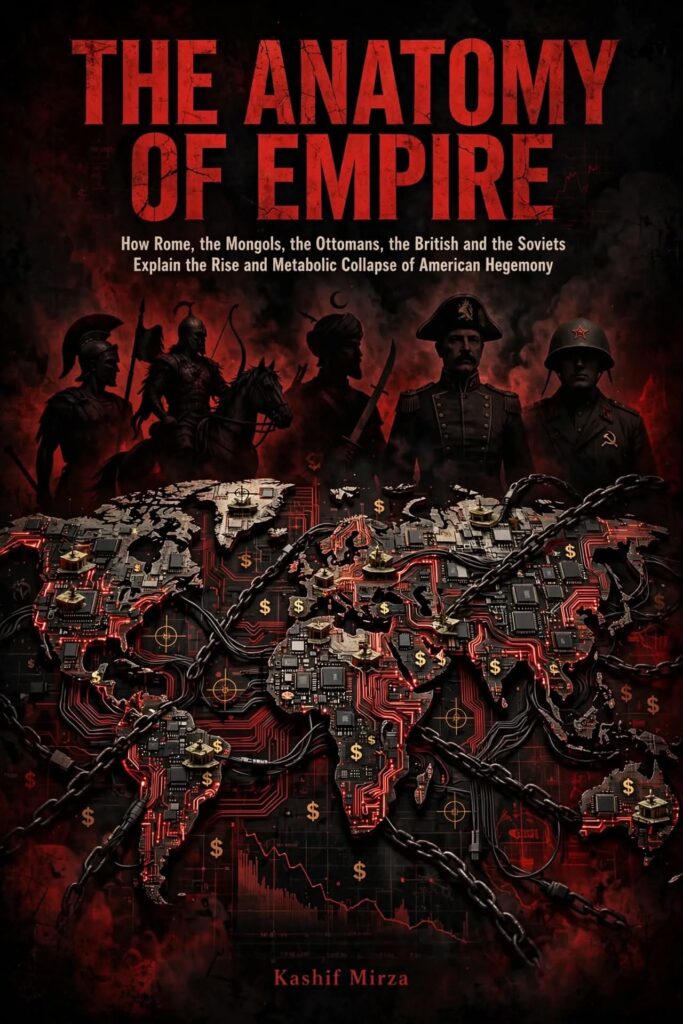
Administrative Sclerosis: The system built for efficiency becomes parasitic. The Pentagon has failed 7 consecutive audits (2018-2024), unable to account for $2.3 trillion in assets. 15,000 pages of Federal Acquisition Regulation where Rome had 1 page of edict.Elite Overproduction: Turchin’s 2023 Cliodynamics data shows America has produced more lawyers, MBAs and PhDs than positions that can satisfy them. In 1970, there were 350,000 law graduates; in 2025, 1.35 million. Result: elite polarisation, civil war of lawyers — impeachment, litigation, and institutional paralysis. Rome had 20 Emperors in 50 years in the 3rd century; America has had zero-budget, shutdown, and lawfare as its equivalent. The anatomy of empire teaches us the final lesson: Empires are never murdered. They die of metabolic failure. They consume more energy, money, belief and talent than they can produce. No barbarian destroyed Rome; Rome destroyed Rome and the barbarians just walked in. No Afghan defeated the Soviets; the Soviet Gosplan defeated itself. The American empire is not collapsing tomorrow. The Eastern Roman Empire took 300 years to die after it was already dead. Britain took 30 years from Suez (1956) to handing Hong Kong (1997) while still being a rich, powerful island. But the pattern holds. The next empire — whether it is Chinese, digital, corporate, or something we cannot yet name — will follow the same anatomy. It will have a new Sword, perhaps AI swarms; a new Ledger, perhaps digital currencies and data; and a new Story, perhaps climate salvation or civilizational destiny. And it will carry the same Cancer inside its own cells, waiting. That is why we study the dead — to recognize the living. How Rome, the Mongols, the Ottomans, the British, and the Soviets Explain the rise and metabolic collapse of American hegemony. Empires don’t get murdered; they commit suicide — The metabolic failure of US hegemony. We live in an empire that pretends not it doesn’t exist. 230 Empires, 250 years, one pattern: converting violence into revenue, revenue into legitimacy. Sanctions are the new sieges: America has 750 bases; 35.5 Million km in 80 countries with 58% of global reserves, and sanctions on 38% of the world say otherwise; but calls itself not an empire — Rome said the same thing. Why size, speed and lifespan change, but the structure of empire never does. Only the vocabulary has changed. They told us empire was dead — buried with colonies and emperors, replaced by flags, free markets, and international law. The empire did not end. It became invisible. From the legions of Rome to the horse archers of the Mongols, from the cannons of the Ottomans to the dreadnoughts of the British to the tank armies of the Soviets, the skeleton is identical. Every empire is built by hard outsiders who solve violence better than the centre. And every empire is killed by soft insiders who stop believing its story, stop paying its price, and stop serving its system. This is the anatomy of that grammar — and the autopsy of the hegemony that lives in it now.