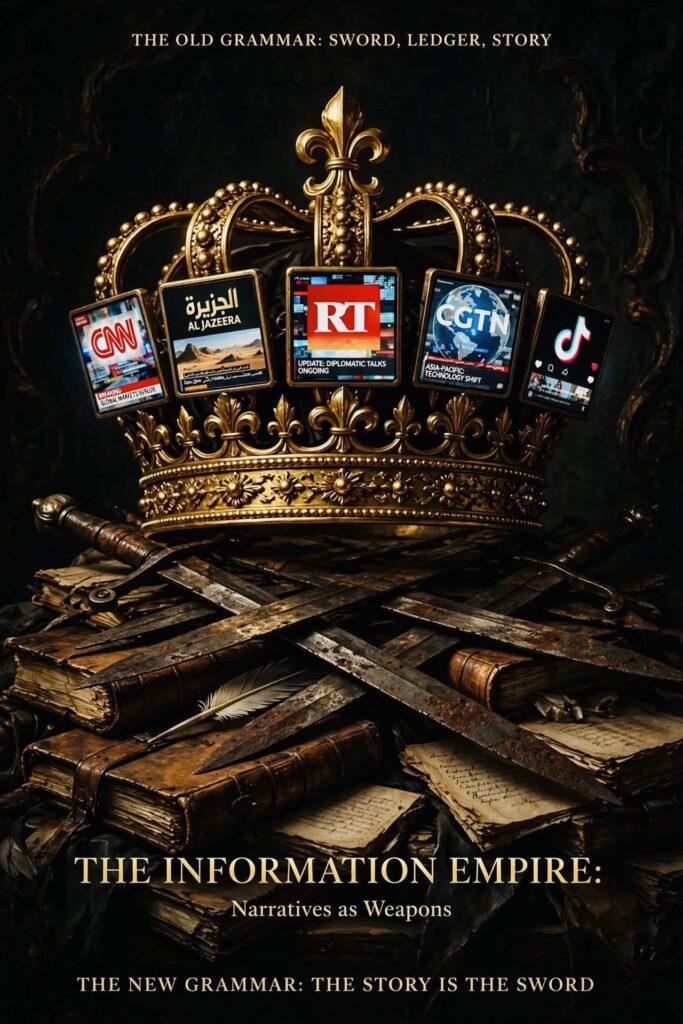
In the inverted empire of the screen, where the algorithm crowns itself emperor and every feed becomes a frontier, the true conquest is not of soil or sky but of the unexamined assumption that reality is still shared. Whoever seizes the first cut of the story no longer needs to occupy the land; the land occupies itself inside the edit, and the only territory left worth defending is the shrinking space between what is shown and what is still possible to see. The old grammar of empire was simple: The sword conquered the land, the ledger taxed it, and the story justified it. The legion came first, the tax collector second, the historian last. That grammar is dead. The new grammar is inverted: THE STORY IS THE SWORD. The anatomy of empire has changed. The Sword is now a Server, the Ledger is now an Algorithm. The Story is now the Battlefield itself. And the Cancer? The Cancer is that no one believes the official story anymore. Empires used to censor information. Information empires now flood you with it, until you cannot tell a base from a broadcast. And that is why 16 destroyed bases will matter less than one CNN Special Report about them. The report is not covering the war, the report is the war. We thought empire was about bases, but we were wrong. It is about the broadcast that tells you why the bases deserved to be destroyed. In an era of instant global media, the story of American bases rendered fragile becomes a strategic fact independent of the precise crater count. This is the information empire. Military dominance without narrative dominance is brittle. Narrative without capability is theatre, and capability without narrative is occupation. The empires that lasted had both. The ones now rising and falling are discovering that the story is no longer the final layer of power but the first. In 1991, the US won the Gulf War on CNN. The missile and the camera arrived together. In 2026, the US will lose its next war on TikTok, even if it wins it on the battlefield. Because the 19-year-old in Basra with an iPhone now has more alliance-shaping power than CENTCOM’s spokesperson. Joseph Nye’s classic soft power—the ability to shape preferences through attraction rather than coercion—has mutated. Today it coexists with “sharp power”: the piercing, manipulative use of information, platforms, and cultural vectors by authoritarian systems to confuse, divide, and dominate open societies. Hard power still decides battles; narrative power decides whether those battles can be sustained, legitimised, or even fought. On October 1st, 2026, the most powerful weapon in the world is not a hypersonic missile. It is the edit. Every empire I dissected in The Anatomy of Empire had four organs. The fourth, The Story, used to be justification. Now it is the operation itself. The sword conquered, the ledger extracted, and the story, whether Roman citizenship, Mongol Heavenly mandate or British civilising mission, persuaded the conquered to stay conquered. The story came fourth in the sequence; it justified power after it had been won. In the twenty-first century the order has inverted. Narrative now comes first, because it decides who is allowed to fight, who will fund the fighting, who will stay neutral and whether the home front will tolerate the cost. A state that loses the story before the first shot usually finds that its military superiority cannot be spent. We live under five information empires, each with a different business model of reality. CNN’s live coverage of the 1991 Gulf War showed that a broadcaster could put a war into every living room in real time. Al Jazeera, launched in 1996 and funded by Qatar, showed that the Arabic-speaking world no longer needed Western frames to interpret its own region. RT and CGTN are the state-built answers to both. RT’s budget was estimated by EU officials at about €1.3 billion in 2021, a scale that explains why Brussels treated it as a strategic asset rather than a news channel. Narrative dominance matters before the shooting begins for four reasons. First, it determines coalitions: sanctions, arms deliveries and basing rights all depend on whether foreign publics and parliaments accept the justification. Second, it sustains morale at home, because invaders must keep their own people convinced that the war is worth it. Third, it shapes deterrence, since deterrence is fundamentally a story about resolve that adversaries must believe. Fourth, it controls the cost of occupation, because a population that views the occupier as illegitimate forces the ledger to turn against it. The framework from the earlier chapters applies directly: legitimacy was always one of the empire’s four functions, but it used to be an internal affair. Now it is exported, contested in real time and measured in attention. In the spring of 2026, a CNN investigation reported that Iranian strikes had damaged at least 16 American military sites across eight countries—the majority of U.S. positions in the Middle East—including high-value assets such as radar systems, radomes, and multi-million-dollar aircraft like the Boeing E-3 Sentry (valued near half a billion dollars in today’s terms). Some facilities were described as virtually unusable; sources spoke of unprecedented scale compared with Iraq or Afghanistan. Pentagon figures indicated evacuation of more than 90 per cent of personnel from affected positions. Consider this scenario: At 03:14 UTC, 16 US forward positions in the CENTCOM AOR are hit simultaneously. The Pentagon confirms 11 dead. At 03:17 UTC, before the smoke clears, three narratives are already in orbit: CNN Special Report: “Unprovoked attack on rules-based order. Sources say Iran-backed militias.” RT / CGTN Simulcast: “Occupation bases, rejected by local parliaments, face legitimate resistance.” TikTok / Al Jazeera Arabic Live: A 19-year-old in Basra live-streaming the burning fuel depot with the caption “They finally left our sky.” 40 million views in 2 hours. The missile destroyed a building. The narrative destroys an alliance. By 06:00 UTC, the Iraqi parliament votes to expel US forces. Not because of the missile. Because of the 40 million views. This is why narrative dominance is now a prerequisite to military dominance. The European response is instructive. The EU banned RT and Sputnik in 2022, and on 2 July 2026 the EU’s top court ruled that the ban reaches free, non-commercial websites too, regardless of profit. Yet a March 2026 study by the Institute for Strategic Dialogue found that enforcement across EU countries remains inconsistent, leaving banned outlets accessible and influential. A ban can close a channel. It struggles to close a narrative that has moved to mirror sites, networks and live events. TikTok completes the set, and it changes the grammar. A broadcaster pushes a message; a recommendation algorithm chooses which messages each person sees. That is why the 2026 settlement matters beyond commerce. The U.S. joint venture formed in January, with non-Chinese investors holding roughly 80 per cent and ByteDance a minority 19.9 per cent, and the plan is to license the algorithm from ByteDance, then retrain and review it on U.S. data under Oracle’s oversight. Whatever one thinks of the deal, it marks a threshold: a major power forced a change of control over a narrative engine because it judged the engine a security asset. CNN and BBC World – The Empire of Legitimacy: CNN reaches 90 million US households and is in 212 countries. BBC World News reaches 492 million weekly viewers [BBC Annual Report 2024/25]. Their power is not persuasion; it is certification. When CNN calls a group “rebels” vs “terrorists,” SWIFT, OFAC, and the UN follow. Their budget is credibility. And credibility is collapsing: Reuters Digital News Report 2025 shows trust in US mainstream media at 26%, down from 42% in 2015. Al Jazeera – The Empire of the Street:
We were told empire was about territory. It never was. Empire was always about who gets to edit reality — and who is forced to live inside that edit. The old grammar of empire was simple: The SWORD conquered the land, the LEDGER taxed it, and the STORY justified it. The legion came first, the tax collector second, the historian last. That grammar is dead. The new grammar is inverted: THE STORY IS THE SWORD. The Sword used to write history; Now history writes the Sword.
Funded by Qatar with an estimated $650m annual budget, Al Jazeera Arabic has 70+ million daily viewers and was the only network inside Gaza for 340 days. It proved in 2011 and again in 2023-2025 that it can topple a government faster than the CIA. Its power is that it shows the bodies CNN pixelates. RT (Russia Today) – The Empire of Cynicism: With a declared budget cut to $325m in 2024 but operating in 100+ countries, RT’s strategy is not to make you believe Russia. It is to make you believe nothing. The Rand Corporation calls this the “Firehose of Falsehood.” It doesn’t need to be trusted. It needs you to distrust everyone else. Its YouTube ban in 2022 pushed it to Telegram, where it now has 1.2M+ subscribers on RT Arabic alone. CGTN / Xinhua – The Empire of Infrastructure: China spends an estimated $10 billion annually on external propaganda [David Bandurski, China Media Project]. CGTN is in 170 countries, but its real power is not CGTN. It is that it owns the cable beneath the narrative. 60% of Africa’s 4G was built by Huawei. When you control the pipe, you don’t need to control the anchor. You control what can be uploaded. TikTok – The Empire of No Editor: 1.7 billion monthly active users in 2026. Average use: 95 minutes per day. This is the first empire in history with no Ministry of Information, because the algorithm IS the ministry. During the US campus protests of 2024, pro-Palestinian content on TikTok outperformed pro-Israel content 5:1 [Study by The Wrap / Rutgers Network Contagion Lab, 2024]. Congress passed PAFACA to ban it because it was Chinese; and for the first time, the Story escaped the Ledger. CNN operates within a competitive Western media ecology that prizes scoops, sourcing, and visual evidence. Its 16-base investigation exemplifies both the strength and the double-edged nature of independent (or semi-independent) journalism: it can expose genuine vulnerabilities that official narratives prefer to minimise, thereby accelerating political and diplomatic consequences. Western outlets like CNN and the BBC still set global agendas more often than not, partly because English remains the dominant language of international discourse, science, and elite education. Yet they are not immune to commercial incentives, ideological capture, or the selective framing that prioritises certain conflicts and victims. Al Jazeera, bankrolled by Qatar, projects an alternative Global South or Arab-centric lens. It has broken important stories and given voice to perspectives marginalised in Western coverage, particularly on Palestine and broader Middle Eastern dynamics. At the same time, its editorial line frequently aligns with Qatari foreign policy interests and has been criticised for amplifying certain Islamist narratives while downplaying others. It functions as both corrective and competitor in the contest over whose suffering and whose agency define the story. RT and CGTN represent overt state instruments. RT perfected a “partisan parasite” model: it mimics the style of Western partisan media, amplifying domestic divisions in target societies (U.S. elections, European energy debates, culture-war flashpoints) while advancing Kremlin talking points. CGTN favours a “surface neutrality” approach—slick production, multilingual reach across 160 countries, and carefully curated positivity about China’s rise that cloaks Party priorities. Both invest heavily in foreign-language services and social amplification.
Soft Power, Culture, and Long-Term Control
Philosophically, the contest is over the status of truth. Classical liberal traditions treat information as a marketplace in which better arguments and evidence eventually prevail. Culture is where the contest is most surprising, because it no longer belongs to any one flag. Simultaneously, recognising sharp power for what it is—coercion by other means—prevents naive equivalence between open journalism and state propaganda organs. Narrative dominance is not optional ornamentation to military power. In an interconnected world of real-time imagery, viral clips, and algorithmically curated reality, the side that controls the prevailing story about costs, legitimacy, and inevitability often determines whether hard power can be applied effectively or at all. The 16 bases were damaged by missiles and drones. Alliances and political will are damaged—or fortified—by the stories told about them. The information empire is already here. The question is who writes its history while the smoke is still rising. Culture remains the deepest soft-power reservoir. Joseph Nye coined “Soft Power” in 1990: Hollywood, Harvard, McDonald’s make them want what you want. That world is over. We are in the age of Sharp Power – a term coined by the National Endowment for Democracy in 2017. Soft power says: “Our movies are cool, so our policies are legitimate.” Sharp power says: “We will use your open system to pierce your culture and paralyse your policy.” The digital authoritarianism in practice: not crude blocking for foreign audiences, but preferential amplification and omission at planetary scale. You cannot hold territory if you cannot hold the story of why you are there. The physical damage mattered, and the narrative mattered more. Chinese state media have been documented coordinating with Russian outlets to reinforce shared narratives, for instance around Ukraine. Reports from organisations monitoring propaganda detail rigid internal controls at CGTN: pre-approved scripts, political correctness filters, and propaganda prioritised over news value. TikTok is the most consequential vector. With well over a billion users, its short-video algorithm shapes the information diet of a generation. Multiple studies have found systematic disparities: searches for sensitive terms such as “Uyghur,” “Tiananmen,” or “Tibet” return far less critical content on TikTok than on Instagram or YouTube; heavier users show more favourable views of China and desirability as a destination. Pro-China influencers and lifestyle content often outperform traditional state media in persuasion precisely because they do not look like propaganda. ByteDance’s ownership and documented algorithmic patterns raise the prospect of scalable “networked authoritarianism”—subtle curation that suppresses inconvenient realities while flooding feeds with attractive alternatives. Authoritarian information strategies treat narrative as territory to be seized and held. When a CNN report on damaged bases can shift alliance calculus faster than kinetic recovery, the prerequisite becomes clear: sustained military superiority requires not only platforms and precision munitions but also credible storytelling capacity and societal resilience against adversarial framing. A single well-sourced special report, amplified across platforms, can fracture alliance cohesion, embolden adversaries, pressure host nations, and reshape domestic political calculations faster than any follow-on missile barrage. Publics and parliaments respond to perceived vulnerability long before logistics recover. Public diplomacy budgets show how seriously states take the narrative contest. The U.S. administration’s FY2026 request for the Agency for Global Media, which oversees Voice of America and Radio Free Europe, sought $153 million to support an orderly shutdown of operations. Congress instead approved about $653 million, down from roughly $860 million in each of the past two years but more than four times the request. Litigation continues: in March 2026, a federal judge ruled the wind-down unlawful and ordered more than 1,000 VOA employees back to work, before an appeals court temporarily suspended that order on 31 March. In 2017, the National Endowment for Democracy’s researchers coined the term ‘sharp power’ for authoritarian influence that does not attract but pierces and manipulates the information environments of open societies. It differs from soft power the way a needle differs from a magnet. The tools include state media with deniable distribution, coordinated inauthentic accounts, funding of cultural and academic partnerships with strings attached, and pressure on diaspora communities. Its domestic counterpart is digital authoritarianism: controlling narrative at the border. Freedom House’s 2025 report found that conditions worsened in 27 of 72 countries while only 17 improved, with the survey covering 89 percent of the world’s internet users. In at least 57 of those countries, people were arrested or imprisoned for online expression, a record. China and Myanmar remained the worst environments, and Russia has undergone the steepest 15-year decline as it tries to build a sanitised domestic internet. Only about 16 percent of the world’s internet users live in countries rated Free. The asymmetry deserves attention. Authoritarian systems can wall off their own audiences while operating freely in open ones, whereas open societies cannot mirror that behaviour without damaging the thing they are defending. And the democratic advantage is itself eroding from within: among the Free countries, the United States and Germany were both among the biggest decliners (Georgia fell furthest). A narrative of openness is only as persuasive as the practice behind it. There is a serious counterargument. Narrative did not stop Russia from taking Crimea in 2014, and soft power rankings measure what people say about countries, not what they do when interests collide. China ranks second in the same index that places its reputation only 18th, a reminder that influence and admiration are different currencies. Authoritarian information campaigns often fail to persuade foreign audiences and mostly reinforce existing divisions. And the strongest narrative has never saved a military that lost the logistics war. ‘KPop Demon Hunters’ was produced by Sony Pictures Animation, directed by a Korean-Canadian, set in a stylised Seoul, and distributed by Netflix. By September 2025, it had passed 266 million views, making it the most-watched title in Netflix history. South Korea’s cultural exports tripled in a decade to $9.8 billion in 2024, with some 225 million fans worldwide. Seoul designed none of this film’s success, but it spent thirty years building the ecosystem that made it legible. Hollywood remains the world’s biggest narrative factory, yet its most globally resonant product of 2025 was a hybrid that neither Washington nor Seoul can fully claim. Language and universities are the slow channels. English remains the working language of aviation, science, software and diplomacy; some 1.5 billion people speak it (an approximate figure cited from memory), which means that anyone competing for global attention is competing, to some degree, on English-language terms. Universities convert that advantage into long-term influence. The United States hosted 1.2 million international students, about 6 per cent of its higher-education population, who contributed nearly $55 billion to the economy. In fall 2025, however, new international enrollment fell 17 per cent while the overall total slipped only 1 per cent, which NAFSA estimated cost over $1.1 billion and nearly 23,000 jobs. The drop mostly mirrors a broader slump in graduate enrollment rather than a political shock. Either way, a foreign student spends years inside a country’s institutions, and today’s graduate class becomes tomorrow’s ministry, bank and newsroom. Policy implications follow; Democracies must defend the integrity of their information ecosystems without mirroring authoritarian controls. The soft power ledger is tighter than it looks. The Brand Finance Global Soft Power Index, based on a survey of more than 150,000 respondents in over 100 countries, puts the United States first at 74.9, followed by China at 73.5, Japan at 70.6 and the United Kingdom at 69.2. The gap between first and second is only 1.4 points. The same index records that China’s reputation rose nine places to 18th, overtaking that of the United States for the first time, and that the U.S. recorded the steepest decline of any nation. Brand Finance attributes this to a backlash against ‘America First’ policies. It is a perception survey from a brand consultancy, not a physics experiment, but the direction of travel is hard to ignore. Transparency about state-affiliated media, algorithmic audits for platforms with foreign ownership ties, media literacy that distinguishes evidence from performance, and continued investment in genuine cultural and educational attraction are essential. Over-reliance on censorship or deplatforming risks the very legitimacy that soft power requires. Hollywood vs. K-pop: US cultural export fell from 28% of global box office in 2019 to 18% in 2025. K-pop generated $12.3 billion for South Korea in 2024 [KOCCA]. Hollywood sells superheroes. K-pop sells training systems. It is administrative power disguised as culture. Universities as Forward Operating Bases: The US has 1.1 million international students, 35% of all globally mobile students. 284,000 are Chinese. China now hosts 600,000 international students, up from 50,000 in 2005. A student is a 30-year influence operation. You don’t need a base in their country if you educate their minister of finance. English as the Dollar of Language: 58% of internet content is in English, spoken by only 16% of the world. This is seigniorage of thought. Just as the world must hold dollars to trade, it must think in English to be heard. The greatest imperial tax ever levied. And then there is Digital Authoritarianism: The export of the model itself. China has exported its “Safe City” surveillance package, cameras along with AI and law, to 83 countries. You don’t need to send a gunboat if you sold them the software that runs their police station. Hollywood long exported American aspiration, individualism, and technological optimism; even as its global box-office share has slipped from earlier peaks, U.S. films still command disproportionate influence. South Korea’s K-pop and broader Hallyu wave demonstrate that smaller powers can punch far above their weight. Government-supported yet commercially dynamic, K-pop generates billions, drives tourism and product demand, and positions Korea as modern, creative, and desirable. BLACKPINK, BTS, and successors have become informal public diplomats; surveys repeatedly show K-pop as the primary overseas association with Korea. China has invested heavily in cultural exports and platforms yet struggles to match this organic magnetism, often resorting to sharper tools when attraction falters. English-language dominance compounds these effects. It is the default of diplomacy, science, business, and higher education. Universities function as multi-decade influence machines: the HEPI Soft Power Index consistently shows the United States and United Kingdom educating the largest numbers of current world leaders (dozens each), far ahead of others. Elite networks formed on campus transmit norms, personal ties, and worldviews that outlast any particular administration. Authoritarian competitors understand this and expand Confucius Institutes, scholarship programs, and campus influence operations—while simultaneously restricting reciprocal openness at home. Sharp power exploits the openness of democratic systems. Disinformation, co-opted influencers, diaspora pressure, and algorithmic preference do not seek admiration so much as confusion, self-censorship, and eroded trust. Digital authoritarianism extends this logic: comprehensive domestic information control (China’s Great Firewall model) paired with selective outward projection. The result is asymmetric: open societies absorb foreign narratives while closed ones filter theirs.
In the inverted empire of the screen, where the algorithm crowns itself emperor and every feed becomes a frontier, the true conquest is not of soil or sky but of the unexamined assumption that reality is still shared. Whoever seizes the first cut of the story no longer needs to occupy the land; the land occupies itself inside the edit, and the only territory left worth defending is the shrinking space between what is shown and what is still possible to see. The old grammar of empire was simple: The SWORD conquered the land, the LEDGER taxed it, and the STORY justified it. The legion came first, the tax collector second, the historian last. That grammar is dead. The new grammar is inverted: THE STORY IS THE SWORD. CNN does not report the war; it decides which war is legal. Al Jazeera does not report the street; it decides which street is legitimate. RT does not need to win the argument; it needs to make you believe no argument can ever be won. CGTN does not need to persuade you; it owns the cable that carries your persuasion. And TikTok does not need an editor; it is the first empire in history where the algorithm is the emperor — where a 19-year-old in Basra with a burning fuel depot behind him reaches more people in two hours than the Pentagon press corps does in two weeks. This is why narrative dominance is no longer a luxury of empire. It is the prerequisite. You cannot hold 750 bases in 80 countries if you cannot hold the sentence that explains why you are there. Missiles can destroy buildings, but only narratives can destroy alliances — and alliances collapse faster on a screen than they do on a battlefield. Soft power was attraction. Hollywood, K-pop, the BBC, a degree from Harvard — they made the world want to be you. Sharp power is puncture. It does not attract you. It pierces you, personalizes you, and persuades you that you chose it. We were told empire was about territory. It never was. Empire was always about who gets to edit reality — and who is forced to live inside that edit. The old grammar of empire was simple: The SWORD conquered the land, the LEDGER taxed it, and the STORY justified it. The legion came first, the tax collector second, the historian last. That grammar is dead. The new grammar is inverted: THE STORY IS THE SWORD. The Sword used to write history; Now history writes the Sword.
The writer is an economist, anchor, jurist, geopolitical analyst and the President of All Pakistan Private Schools’ Federation
president@Pakistanprivateschools.com