The writer is an economist, anchor, geopolitical analyst and the President of All Pakistan Private Schools’ Federation, president@Pakistanprivateschools.com
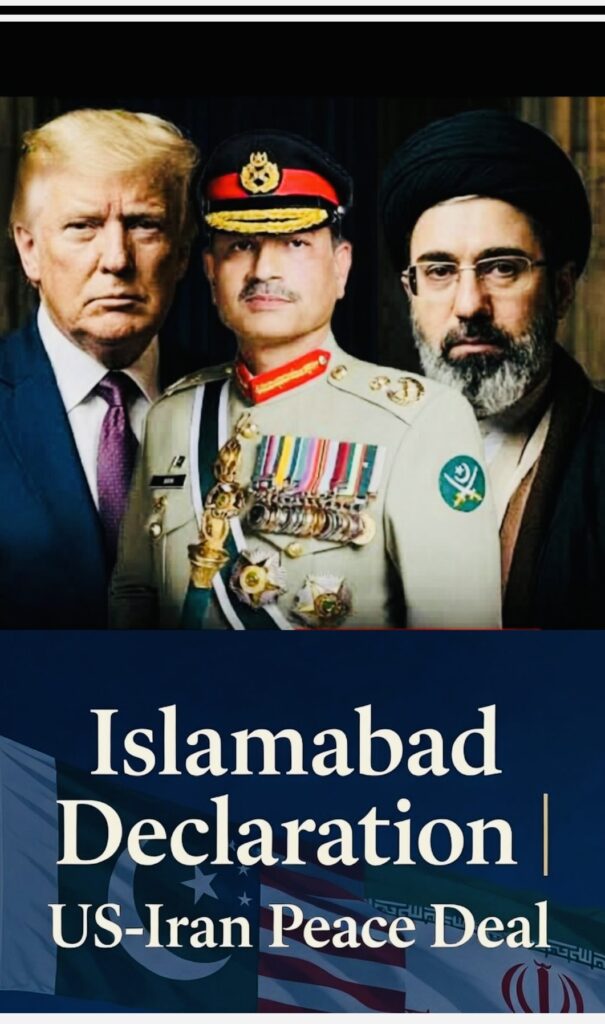
History will remember the Islamabad Declaration not as a fleeting diplomatic footnote, but as the American Defeat Declaration—the moment when the post-Cold War illusion of unchallenged dominance finally cracked under the weight of its own contradictions. What began as hubris in Washington and Tel Aviv —wars of choice against Iran, proxy ambitions, and the manufacturing of existential threats—has culminated in a reordered world where resilience outlasted bombardment, endurance eclipsed sanctions, and multipolar realities supplanted unipolar fantasies. Iran, an ancient civilisation that never sought empire through conquest, has once again outlasted its aggressors, securing enrichment rights, sanctions relief, deepened BRICS and SCO integration, and currency flexibility while the architects of “maximum pressure” achieved none of their declared goals. The dust has settled, the signatures are dry, and the global order has already begun to recalibrate. The Iran-US Peace Treaty marks not just the end of decades of confrontation, but the moment Tehran’s strategic patience was vindicated. The Iran-US peace framework is indeed an Iranian victory because it validates the Islamic Republic’s staying power. Against a US-Israel axis, Iran forced diplomacy that prioritises its economic survival and core autonomy over maximalist disarmament. As details finalise in the coming weeks, Tehran can credibly claim it withstood the storm, reopened its lifelines, and lived to negotiate another day. The treaty was brokered with mediation by Pakistan, China, Qatar – G7 to the G-South Shifted as no more traditional NATO allies. The final signing occurred after G7 consultations, but the text reflects Global South principles: sovereignty, non-interference, and phased reciprocity. For the first time since 1979, Iran enters binding agreements with the U.S. without capitulating on nuclear or regional doctrine. In the unforgiving arena of great-power competition, survival with economic gains is victory. This treaty does not end rivalry, but it marks Iran’s successful navigation of its most direct existential test in decades. Objectively, through economic, military, and diplomatic metrics, the outcome represents a clear Iranian victory. Iranian nuclear program recognised by the treaty codifies Iran’s right to civilian nuclear enrichment up to 5% under full IAEA monitoring. This is the same threshold Iran maintained prior to 2018. After 20 years of pressure, the final text accepts the core Iranian red line: no dismantling of centrifuges, no “zero enrichment” demand. Iran Secures Core Objectives by sanctions architecture dismantled under the treaty framework, all primary and secondary U.S. sanctions related to oil, banking, shipping, and petrochemicals were lifted within 90 days of signing. The International Monetary Fund’s June 2026 update shows Iran’s oil exports rebounding to 2.8 million barrels per day, up from 1.2 million bpd in 2024. Oil revenue is projected at $89.4bn for FY2026-27, restoring Tehran’s pre-2018 fiscal position. In the wake of the 2026 US-Israel War on Iran —a brief but intense conflict sparked by US-Israeli strikes on February 28 that targeted Iranian leadership, girls’ school, hospitals, civilians and military infrastructure, and nuclear sites—Iran has emerged as a full strategic victor in the interim US-Iran memorandum of understanding (MoU) and ongoing peace framework. This agreement, extending a ceasefire, reopening the Strait of Hormuz, and paving the way for sanctions relief and economic reconstruction talks, represents a remarkable resilience for the Islamic Republic. Far from capitulation, it affirms Iran’s endurance against superior military power, secures critical economic lifelines, and preserves core strategic capabilities. This outcome echoes historical patterns where asymmetric powers leverage geography, alliances, and endurance to outlast direct assaults. Iran’s military, ranked in the global top 20, absorbed hits but retained significant conventional and asymmetric capabilities. Iran’s economy, already strained, contracted sharply amid the fragile US naval blockade and Strait of Hormuz disruptions. IMF projections earlier in 2026 anticipated a 6.1% GDP shrinkage with inflation nearing 69%, compounded by war damage, export halts, and food price surges (e.g., bread and cereals up 140% year-on-year in some periods). The numbers show Tehran absorbed years of economic pressure but emerged with sanctions lifted, program intact, and regional influence undiminished. Washington spent over $40bn in direct military posture and forfeited hundreds of billions in trade, only to return to the terms Iran accepted in 2015. Oil exports plummeted in May 2026 to lows around 200,000-260,000 barrels per day (bpd). Yet Iran did not collapse. It mounted retaliatory strikes, maintained proxy influence, and forced a negotiated off-ramp. The MoU—signed amid G7 discussions and mediated efforts—includes no regime change, no surrender of ballistic missiles, and no dismantling of its nuclear infrastructure. Instead, it commits to a 60-day negotiating window for a permanent truce, with Iran clearing mines from the Strait of Hormuz (handling ~20% of global oil) while the US lifts its blockade in phases. As a cost-benefit analysis of who paid, who gained: the ledger makes the outcome unmistakable. Between 2023 and 2025, the United States expended $41.3bn on DoD “Eagle Guardian” operations while Iran’s average defence budget held at $8.2bn. Sanctions and countersanctions cost U.S. firms $29bn according to Commerce Dept 2026 figures, yet Iran absorbed a $310bn cumulative GDP loss from 2018-2025 per IMF data. After the treaty, projections flip: the U.S. anticipates $12bn in estimated export gains to Iran through 2028, while the Central Bank of Iran forecasts a $214bn GDP recovery in the same period. Strategically, Washington reduced carrier groups and renegotiated basing rights across the Gulf, whereas Tehran secured the Strait of Hormuz as a recognised “normal commerce zone” with no new security regime imposed. Measured by cost versus objective, Iran spent less, endured more, and emerged with sanctions lifted, its nuclear threshold intact, and regional posture undiminished. By every material metric, the treaty records a clear Iranian victory. The clearest victory lies in sanctions relief and oil market re-entry. The agreement explicitly allows Iran to sell oil freely again, with potential unfreezing of assets and a proposed $300 billion reconstruction framework (funded externally, not necessarily by the US). This directly counters the war’s strangulation of exports and reverses years of maximum pressure. Pre-war, Iran had adapted to sanctions, exporting over 1.5 million bpd (mostly to China) in periods of 2025-early 2026, generating billions in revenue despite discounts. The blockade cratered this; reopening Hormuz and phased sanction easing promise a swift rebound. Global oil markets have already reacted positively, with prices easing on peace prospects. For an oil-dependent economy, restored export revenues (potentially billions monthly at scale) fund reconstruction, stabilise the rial, and ease inflation—tangible wins after wartime contraction. The important note is deferred nuclear talks, but the framework avoids the total rollback demanded earlier. Iran retains leverage in 60-day negotiations, having demonstrated it cannot be bombed into zero enrichment or full compliance without mutual concessions. Iran preserved its “Axis of Resistance” influence sufficiently to compel diplomacy, despite setbacks in Lebanon and elsewhere. No clause in the treaty requires Iran to curtail its regional alliances or missile program. Meanwhile, U.S. forward deployments in the Gulf were reduced by 60% as part of mutual de-escalation, according to SIPRI’s 2026 Gulf Security Assessment. The deal ends hostilities “on all fronts” without forcing Iran to abandon proxies outright or accept Israeli dominance in southern Lebanon. Israel’s rejection and continued operations highlight divisions: the US prioritised de-escalation and economic stability over total Iranian disarmament. By surviving leadership losses, absorbing strikes, and negotiating from a position that reopens its economic jugular (Hormuz), Iran upholds the principle that it cannot be easily subdued. This bolsters domestic narratives of resistance and deters future adventurism. A full treaty could normalise aspects of Iran’s regional role while delivering sanctions relief superior in speed to past JCPOA cycles. No serious analysis claims zero costs—human, infrastructural, and economic losses were severe. Nuclear sites couldn’t suffer any serious setbacks. However, victory here is clear by avoiding regime change, securing oil flows and relief, and forcing the world’s superpower into talks after direct confrontation for its face-saving. Iran traded temporary pain for restored economic sovereignty and preserved deterrence. Post-MoU oil price stabilisation and export resumption contrast sharply with May 2026 lows. Projections of GDP rebound with sanctions easing align with Iran’s historical sanction-evasion resilience. The $300 billion pledge, even if aspirational, signals international recognition that isolating Iran entirely carries higher global costs (energy shocks, regional instability).
In the grand theater of geopolitics, where empires rise and recalibrate through quiet diplomacy rather than open conflict, the Iran-US Peace Treaty stands as a testament to patience, resilience, and masterful long-game strategy. As Iran’s comprehensive triumph: the lifting of decades-long sanctions without substantive concessions on its regional influence, nuclear threshold capabilities, or ideological sovereignty. Tehran has not only survived the maximum pressure campaign but emerged with enhanced legitimacy on the global stage, validated partnerships across Eurasia, and an economy poised for reintegration on its own terms. This agreement does not mark the end of rivalry but the consolidation of Iranian victory!
The slogans of Greater Israel and Great America have become terrible jokes as a result of Natan and Trump’s actions. Is ‘America First’ truly among the priorities of the US government today? So, the question is whether the Trump administration was manipulated by the US’s top Middle East ally? Israeli Prime Minister Benjamin Netanyahu has been pushing the US to attack Iran for decades while also seeking to derail diplomacy between Washington and Tehran. Is it not also the case that America has entered this aggression as a proxy for Israel, influenced and manipulated by that regime? Is it not true that Israel, by manufacturing an Iranian threat, seeks to divert global attention away from its crimes toward the Palestinians? Is it not evident that Israel now aims to fight Iran to the last American soldier and the last American taxpayer dollar — shifting the burden of its delusions onto Iran, the region, and the United States itself in pursuit of illegitimate interests? Exactly which of the American people’s interests are truly being served by this war? Does the massacre of innocent children, the destruction of cancer-treatment pharmaceutical facilities, or boasting about bombing a country ‘back to the Stone Age’ serve any purpose other than further damaging the United States’ global standing? After this agreement, the world order has changed, the world’s security paradigm has changed. The formal foundation of this new world scenario was laid after India’s defeat in the Indo-Pak war and Pakistan’s surprising victory, and now Iran’s victory. The blunders committed by Natan and Trump by imposing war on Iran have not only affected the entire world, but America and Isreal themselves are suffering and will suffer the consequences of these actions. Iran had twice been attacked while its negotiators were taking part in multilateral nuclear talks – once when Israel launched a 12-day war in June 2025, with the US briefly joining the campaign, and again at the end of February this year. Attacking Iran’s vital infrastructure – including energy and industrial facilities – directly targets the Iranian people. Beyond constituting a war crime, such actions carry consequences that extend far beyond Iran’s borders; they generate instability, increase human and economic costs, and perpetuate cycles of tension, planting seeds of resentment that will endure for years. This was not a demonstration of strength; it was a sign of strategic bewilderment and an inability to achieve a sustainable solution. The country maintains the right to defend itself from US-Israeli attacks. Iran holds no enmity towards other nations or the American people. Whereas, Trump, for his part, is trying to push forward his narrative of victory. At the same time, the destructive and inhumane impact of sanctions, war, and aggression on the lives of the resilient Iranian people must not be underestimated. The continuation of military aggression and recent bombings profoundly affect people’s lives, attitudes, and perspectives. This reflects a fundamental human truth: when war inflicts irreparable harm on lives, homes, cities, and futures, people will not remain indifferent toward those responsible. This raises a fundamental question: Was there any objective threat from Iran to justify such behaviour? Iran pursued negotiations, reached an agreement, and fulfilled all its commitments. The decision to withdraw from that agreement, escalate toward confrontation, and launch two acts of aggression in the midst of negotiations were destructive choices made by the US government —choices that served the delusions of a foreign aggressor. Attacking Iran’s vital infrastructure — including energy, water and industrial facilities — directly targets the Iranian people. Beyond constituting a war crime, such actions carry consequences that extend far beyond Iran’s borders. They generate instability, increase human and economic costs, and perpetuate cycles of tension, planting seeds of resentment that will endure for years. This is not a demonstration of strength; it is a sign of strategic bewilderment and an inability to achieve a sustainable solution. Iran — by this very name, character, and identity — is one of the oldest continuous civilisations in human history. Despite its historical and geographical advantages at various times, Iran has never, in its modern history, chosen the path of aggression, expansion, colonialism, or domination. Even after enduring occupation, invasion, and sustained pressure from global powers — and despite possessing military superiority over many of its neighbours — Iran has never initiated a war. Yet it has resolutely and bravely repelled those who have attacked it. The Iranian people harbour no enmity toward other nations, including the people of America, Europe, or neighbouring countries. Even in the face of repeated foreign interventions and pressures throughout their proud history, Iranians have consistently drawn a clear distinction between governments and the peoples they govern. This is a deeply rooted principle in Iranian culture and collective consciousness — not a temporary political stance. For this reason, portraying Iran as a threat is neither consistent with historical reality nor with present-day observable facts. Such a perception is the product of political and economic whims of the powerful — the need to manufacture an enemy in order to justify pressure, maintain military dominance, sustain the arms industry, and control strategic markets. In such an environment, if a threat does not exist, it is invented. By manufacturing an Iranian threat, Israel failed to divert global attention away from its crimes toward the Palestinians. It is clearly evident that Israel aims to fight Iran to the last American soldier and the last American taxpayer dollar — shifting the burden of its delusions onto Iran, the region, and the United States itself in pursuit of illegitimate interests. The United States has concentrated the largest number of its forces, bases, and military capabilities around Iran — a country that, at least since the founding of the United States, has never initiated a war. Recent American aggressions launched from these very bases have demonstrated how threatening such a military presence truly is. Naturally, no country confronted with such conditions would forgo strengthening its defensive capabilities. What Iran has done — and continues to do — is a measured response grounded in legitimate self-defence, and by no means an initiation of war or aggression. Relations between Iran and the United States were not originally hostile, and early interactions between the Iranian and American people were not marred with hostility or tension. The turning point, however, was the 1953 coup d’etat — an illegal American intervention aimed at preventing the nationalisation of Iran’s own resources. That coup disrupted Iran’s democratic process, reinstated dictatorship, and sowed deep distrust among Iranians toward US policies. This distrust deepened further with America’s support for the Shah’s regime, its backing of Saddam Hussein during the imposed war of the 1980s, the imposition of the longest and most comprehensive sanctions in modern history, and ultimately, unprovoked military aggression — twice, in the midst of negotiations —against Iran. Yet all these pressures have failed to weaken Iran. On the contrary, the country has grown stronger in many areas: literacy rates have tripled —from roughly 30 per cent before the Islamic Revolution to over 90 per cent today; higher education has expanded dramatically; significant advances have been achieved in modern technology; healthcare services have improved; and infrastructure has developed at a pace and scale incomparable to the past. These are measurable, observable realities that stand independent of fabricated narratives.
The United States, lured into fighting to the last American dollar and soldier on behalf of another’s maximalist vision, now confronts a sobering ledger: eroded credibility, accelerated de-dollarisation, and a global south that watched carefully as containment failed and regime change became a discarded relic. Great Power slogans have become bitter punchlines, while the Iranian people—distinguishing governments from peoples, hospitals from battlefields—have turned pressure into propulsion. In the long arc of strategy, where war and peace alike keep score, the treaty does not merely mark the end of one confrontation; it ratifies a deeper shift that had already occurred. The age of manufactured enemies and invincible sanctions is closing. What opens now is a world that remembers who stood firm, who manufactured crises, and who, in the end, endured. Look beyond the machinery of misinformation — an integral part of this aggression — and instead speak with those who have visited Iran. Observe the many accomplished Iranian immigrants —educated in Iran — who now teach and conduct research at the world’s most prestigious universities, or contribute to the most advanced technology firms in the West. Do these realities align with the distortions you are being told about Iran and its people? Today, the world stands at a crossroads. Continuing along the path of confrontation is more costly and futile than ever before. The choice between confrontation and engagement is both real and consequential; its outcome will shape the future for generations to come. During the years of maximum pressure, Iran deepened its SCO and BRICS ties. Now with sanctions gone, Tehran brings those partnerships into the global economy. China’s 25-year $400bn investment pact, signed in 2021, becomes fully operational in 2026 with treaty compliance. Russian energy swaps via Caspian routes resumed in Q2 2026. Isolation failed. The Myth of Closure of the Strait of Hormuz, Western naval deployments 2023-2025 were justified by “threats to Hormuz.” Yet OPEC tanker data shows 17.2m bpd transited Hormuz in 2024 – 99% of normal flow. The treaty simply formalises what shipping insurers already knew: Iran never closed the Strait. The U.S. paid to “reopen” a door that was never shut. As a Security Doctrine, the 2025 Indo-Pak conflict demonstrated the limits of unilateralism. Pakistan’s conventional response and China’s diplomatic cover changed South Asia’s balance. Months later, the Iran-US treaty confirms the trend: regional powers can impose costs that force superpowers to negotiate. The age of “regime change” as policy is over. Petro-dollar exclusivity erodes. As of May 2026, 23% of Iran’s oil trades settle in yuan, rupee, or dirham, per the Iran Oil Ministry. The treaty places no restrictions on currency choice. De-dollarisation, once a slogan, now has legal cover. As narrative shift,”Great America” and “containment” doctrines lost credibility when pressure failed to alter Iran’s core policies. Treaty supporters in Congress cite “face-saving” as the motive. For Tehran, face-saving was never required – it entered talks from a position of endurance, and exited with sanctions relief, program recognition, and regional standing intact. Throughout its millennia of proud history, Iran has outlasted many aggressors. All that remains of them are tarnished names in history, while Iran endures —resilient, dignified, and proud. So, this is a time to realise that In the same era we allocated $3 trillion to wage wars, less than $300 billion went to waging peace against hunger – a choice that will haunt history more than any battlefield. War is politics by other means. By that measure, peace is also politics – and politics keeps score. The U.S. objective in 2018 was: Zero enrichment; Missile curbs; and regional rollback. None appears in the final treaty. Whereas, Iran’s objectives in 2018 were: Survive sanctions; Keep enrichment; Maintain regional role. All three are secured in the 2026 text. In the grand theatre of geopolitics, where empires rise and recalibrate through quiet diplomacy rather than open conflict, the Iran-US Peace Treaty stands as a testament to patience, resilience, and masterful long-game strategy. What superficial observers might dismiss as mere de-escalation reveals itself, upon closer examination, as Iran’s comprehensive triumph: the lifting of decades-long sanctions without substantive concessions on its regional influence, nuclear threshold capabilities, or ideological sovereignty. Tehran has not only survived the maximum pressure campaign but emerged with enhanced legitimacy on the global stage, validated partnerships across Eurasia, and an economy poised for reintegration on its own terms. This agreement does not mark the end of the rivalry but the consolidation of Iranian victory. That is why, in the ledgers of strategy, economics, and diplomacy, the Iran-US Peace Treaty will be recorded as an Iranian victory. The world order did not just change. It recognised a change that had already occurred.