The writer is an economist, jurist, anchor, and geopolitical analyst
and the President of All Pakistan Private Schools’ Federation
president@Pakistanprivateschools.com
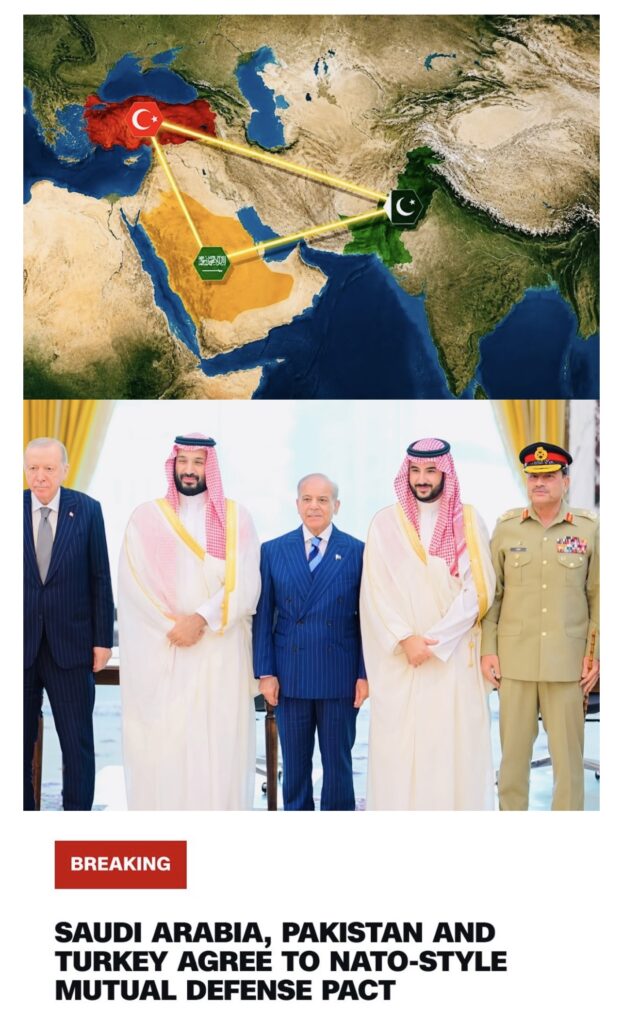
In a deliberate move set to reshape the strategic landscape of the Middle East and South Asia, Saudi Arabia, Turkey, and Pakistan have formalised a landmark joint defence pact in Mecca, dubbed by analysts as the “Mecca Joint Defence Agreement.” The agreement was formalised at the Makkah Al-Mukarramah Summit for Joint Defence at Al-Safa Palace after Erdoğan and Sharif, accompanied by Pakistan’s army chief Field Marshal Asim Munir, travelled to the Kingdom at the invitation of King Salman. It builds directly on the bilateral Strategic Mutual Defence Agreement signed between Saudi Arabia and Pakistan in September 2025. The timing is deliberate. Field Marshal Syed Asim Munir has achieved what others could only dream of. He made Pakistan a global “PEACEMAKER” during the Iran–US conflict and now, under his leadership, Pakistan has signed the “Mecca Agreement” with Turkey and Saudi Arabia. In a world fractured by geopolitical rivalries, proxy wars, and resurgent great-power competition, Pakistan often appears in global narratives through the lens of its challenges—security threats, economic pressures, and regional tensions. With special reference to the recent Islamabad MoU and the special efforts and diplomatic role of Field Marshal Syed Asim Munir, the recalibration of Pakistan’s global standing from security consumer to stability provider crystallised in the recent Islamabad Memorandum of Understanding, a framework that formalised Pakistan’s quiet, backchannel architecture into a declared doctrine of regional mediation. Saudi Crown Prince Mohammed bin Salman, Turkish President Recep Tayyip Erdoğan and Pakistani Prime Minister Shehbaz Sharif signed the Makkah (Mecca) Joint Defence Agreement in the holy city. What the agreement actually says: While the full text has not been published, the joint statement and prior bilateral terms confirm several key points: NATO Article 5-Style Clause: An attack on one is an attack on all three. Aimed at strengthening collective deterrence and promoting peace, security and stability in the region and beyond. The Makkah Joint Defence Agreement is more than a treaty. It is a statement that three of the most capable Muslim-majority states no longer want to outsource their security. By combining Turkey’s industry, Saudi’s capital, and Pakistan’s nuclear umbrella, the pact creates a deterrent that did not exist 18 months ago. Whether it becomes a true “Islamic NATO” will depend on exercises, funding, and political will. But the signal is clear: the regional power balance has been rewritten. In Mecca, three capitals have decided that in an era of great power competition, they will stand — or fall — together. The pact formalises and elevates existing bilateral ties into a trilateral collective-defence commitment at a moment of high regional volatility. It signals closer coordination among three significant military and economic players and could increase deterrence against further attacks on Gulf energy infrastructure or Saudi territory. Symbolic weight is added by the choice of Mecca as the signing venue.
For India, the development is being closely watched. Pakistan’s nuclear capability, Turkey’s growing defence-industrial partnership with Islamabad, and Saudi Arabia’s financial and diplomatic weight create a denser web of mutual obligations involving a long-standing rival. Indian analysts have noted the Turkey-Pakistan defence relationship in particular. At the same time, India maintains substantial economic, energy and strategic partnerships with Saudi Arabia and other Gulf states, as well as improving ties with several regional actors; these relationships provide counterbalancing factors. Immediate operational impact on South Asia is not automatic—the agreement’s focus is the current Middle Eastern security crisis—but the political and signalling effect is real. The joint statement affirms that the pact strengthens collective deterrence by stipulating that any armed attack against one of the three states shall be regarded as an attack against them all, while providing for enhanced defence cooperation across multiple domains; its timing and substance underscore Pakistan’s recalibration from security consumer to stability provider, crystallized through the recent Islamabad Memorandum of Understanding and the quiet backchannel diplomacy of Field Marshal Syed Asim Munir, who accompanied the Pakistani leadership and whose earlier role as a global peacemaker during the Iran–US conflict helped elevate Islamabad’s standing amid intensifying geopolitical rivalries, proxy wars and resurgent great-power competition. The pact comes amid a sharp escalation in the wider Middle East conflict that followed U.S. and Israeli strikes on Iran in late February 2026. Iran and its aligned groups have since conducted attacks on Saudi and other Gulf targets and disrupted energy shipping through the Strait of Hormuz and Red Sea. Houthis in Yemen have continued operations against Saudi-backed forces. The three signatories—major Sunni powers with existing security ties to the United States—have sought to bolster collective security and deterrence in this environment. The alliance brings together NATO’s second-largest military, the Gulf’s dominant power, and the Muslim world’s only nuclear-armed state under a single collective security umbrella. The signing marks the culmination of nearly a year of negotiations and represents the most significant defence alignment among major Sunni Muslim powers in decades. The foundation was laid in September 2025 when Saudi Arabia and Pakistan signed a Strategic Mutual Defence Agreement at Al-Yamamah Palace in Riyadh. Under Article 1 of that pact, “any aggression against either country shall be considered an aggression against both.” By early 2026, amid escalating regional missile attacks on Gulf oil exporters and growing doubts about long-term US security guarantees, talks began to expand the arrangement. Pakistani Defence Minister Khawaja Asif publicly stated that Turkey and Qatar could join the existing framework to build a wider platform of cooperation among “like-minded” countries to strengthen “regional stability and collective security”. In August 2026, Turkey formally acceded. The now-trilateral agreement was signed in Mecca and immediately went into effect, with a joint statement declaring that “an armed attack against any of the three would be regarded as an attack on all”. The Mecca Agreement fuses three distinct but complementary capabilities: Turkey with the Military-Industrial Engine, NATO’s second-largest armed forces with battle-tested experience, a robust domestic drone and missile industry; and strategic control of the Bosphorus. Turkish officials described the pact as defensive in nature, not directed against any specific actor; Saudi Arabia as the Financial and Geographic Anchor. One of the world’s biggest defence spenders, custodian of the Two Holy Mosques, and located at the centre of global energy routes. Riyadh brings funding, air bases, and strategic depth; Pakistan as the Nuclear Deterrent, the Muslim world’s only nuclear-armed state. Islamabad brings nuclear capability, a large standing army, and decades of experience in asymmetric warfare. As one diplomatic summary put it: Turkish drones and tech with Saudi money along with Pakistani nukes in one axis. The Mecca Agreement as a direct response to 3 structural shifts: US Reliability Gap, concerns about American commitment after years of pivoting away from the region. US-Israel Escalation on Iran made the need for collective air defence and missile deterrence among US-aligned Sunni states. South Asia-Gulf Linkage: For the first time, a nuclear power in South Asia is formally tied to Gulf security. For Pakistan, it elevates its role from bilateral ally to a central pillar of a broader Islamic security architecture. For Saudi Arabia, it reduces dependence on a single patron. For Turkey, it extends its influence from the Mediterranean to the Arabian Sea. The pact creates a new centre of gravity. Any conflict involving one member now risks drawing in two others with combined GDP over $2.5 trillion, advanced air forces, and nuclear backing. Turning a political declaration into joint command, intelligence sharing, and interoperable weapons systems.
US Reaction is that all three are US security partners. Washington will have to balance alliance management with concerns about a new bloc. While officials stress it is not against anyone, rivals will inevitably label it a Sunni axis. Turkey confirmed the agreement does not replace existing alliances, but its very existence gives the three states more bargaining power.
Article 5-Style Clause: An attack on one is an attack on all three. Aimed at strengthening collective deterrence and promoting peace, security and stability in the region and beyond. The Makkah Joint Defence Agreement is more than a treaty. It is a statement that three of the most capable Muslim-majority states no longer want to outsource their security. By combining Turkey’s industry, Saudi’s capital, and Pakistan’s nuclear umbrella, the pact creates a deterrent that did not exist 18 months ago. Whether it becomes a true “Islamic NATO” will depend on exercises, funding, and political will. But the signal is clear: the regional power balance has been rewritten.
The shift of global and regional power from unipolarity to contested multipolarity has redefined what constitutes geopolitical significance, and it is within this fracture that Pakistan’s role as peace maker becomes strategically indispensable. Pakistan’s Doctrine of credible neutrality which requires three currencies of peacebuilding: access, trust, and risk tolerance. Pakistan holds all three. From facilitating the U.S.-Taliban Doha Agreement by bringing Taliban leadership to the table, to hosting OIC emergency sessions on Gaza and Afghanistan, Pakistan remains one of the few states that can convene adversaries without preconditions. With Iran, Pakistan shares a 900km border and a Shia minority that demands careful diplomacy. With Saudi Arabia and the UAE, it shares economic and defence ties. With China, it shares the CPEC corridor. With the U.S., it shares a 75-year, albeit turbulent, security relationship. That web makes Pakistan one of the only countries that can pass a message from Qom to Washington without it leaking or mutating. Mediation in South Asia and the Middle East is not seminar diplomacy. It carries blowback. Pakistan has absorbed that cost repeatedly, from hosting 4 million Afghan refugees for 40 years to losing 80,000 citizens in the post-9/11 war. States that have paid for war in blood understand the price of peace. Analytically, Pakistan’s peacekeeping engagement serves multiple layers. Normatively, it aligns with the country’s constitutional emphasis on international peace and the vision of its founder, Muhammad Ali Jinnah, who advocated for global harmony. Strategically, it enhances Pakistan’s diplomatic leverage, builds military professionalism through exposure to multinational operations, and fosters goodwill in the Global South, particularly in Africa. Pakistani forces have earned praise for their discipline, effectiveness in counter-insurgency settings, and community engagement—qualities that distinguish them in missions where consent and legitimacy are fragile. This record challenges stereotypes. While some view South Asia primarily through the prism of nuclear rivalry, Pakistan’s blue-helmeted soldiers embody a different narrative: one of investment in collective security. More recently, Pakistan has engaged in mediation efforts amid tensions with Afghanistan itself, including talks facilitated by third parties like China, Türkiye, and Qatar. These initiatives highlight a pattern: even amid disputes, Pakistan often prioritises de-escalation and dialogue over prolonged confrontation. Its efforts in broader West Asian crises, including attempts to mediate between the US and Iran, further illustrate a growing profile as a pragmatic interlocutor capable of engaging multiple sides. Pakistan’s role in conflict resolution extends deeply into regional diplomacy, most notably in Afghanistan. As a neighbour sharing a long, porous border and deep historical, cultural, and demographic ties, Pakistan has been both affected by and instrumental in Afghan peace efforts. It facilitated dialogue between the Taliban and the United States leading to the 2020 Doha Agreement, hosted key stakeholders, and supported intra-Afghan negotiations. Pakistani officials have repeatedly emphasised that stability in Afghanistan is vital for Pakistan’s own security—a principle tested by cross-border militancy but pursued through persistent engagement. Pakistan’s advocacy for peaceful dispute settlement is consistent in multilateral forums. It has sponsored or supported UN resolutions on strengthening mechanisms for peaceful settlement of disputes, emphasising preventive diplomacy and multilateralism. This stance reflects a worldview that sees dialogue—not escalation—as the default path, even when facing complex threats like terrorism. Global audiences rarely see this number: Pakistan has contributed over 230,000 troops to 46 UN peacekeeping missions since 1960. It is consistently among the top 3 troop contributors. As the international order transitions from post-Cold War unipolarity toward a fluid multipolar landscape—marked by the relative decline of Western dominance, China’s assertive global outreach, and the resurgence of middle powers—Pakistan’s evolution from a quintessential frontline state into an indispensable architect of regional stability acquires profound geopolitical significance. Once defined by its role as a Cold War ally and a primary theatre in the War on Terror, Pakistan now sits at the critical intersection of South Asia, Central Asia, West Asia, and the Indian Ocean, wielding influence far beyond its size through a unique blend of hard-earned peacekeeping credibility, mediation diplomacy, and connectivity infrastructure like CPEC. Pakistan’s peace-making role faces credible constraints: domestic political and economic pressures, terrorism legacies, and trust deficits in key relationships. In an era where great powers increasingly rely on regional stabilisers to manage proxy conflicts, prevent spillover extremism, and secure trade corridors amid great-power competition, Pakistan’s demonstrated willingness to absorb costs for dialogue—whether in Afghan reconciliation, UN missions, or backchannel de-escalation—positions it as a pragmatic bridge-builder rather than a peripheral actor. This shift challenges outdated narratives and invites a strategic reimagination: by investing in Pakistan’s peace-making capacity instead of isolating it amid persistent disputes, the global community can harness a nuclear-armed, battle-hardened nation uniquely equipped to anchor stability across one of the world’s most volatile yet vital geographies. Ultimately, Pakistan’s story underscores a deeper truth of 21st-century geopolitics—that enduring peace architects emerge not from unchallenged dominance, but from nations forged in the crucible of frontline realities, offering the world a model of resilient, interest-driven diplomacy in an age of fragmentation. In the end, true peace is rarely dramatic; it is the quiet accumulation of ceasefires honoured, dialogues sustained, and sacrifices remembered. How a frontline state became an Indispensable architect of regional stability. The question is no longer whether Pakistan matters, but whether the shifting global order will wisely recognise and partner with this indispensable peacemaker. Pakistan has contributed more than its share. The question for the international community is whether it will reciprocate by engaging Pakistan as the partner in stability it has long sought to be. The alternative—marginalisation amid persistent tensions—serves no one in our interconnected world.
In the evolving landscape of the Historic Makkah Joint Defence Agreement, full institutionalization would recast global security around four interlocking principles that systematically dismantle the post-1945 order: further membership defined by geography and control of vital waterways rather than shared values, so that dominion over Hormuz, Suez, Malacca or the Bosphorus confers decisive voice while others merely purchase access; contribution measured by blood equity and deployed combat power instead of GDP, elevating Pakistan’s integrated regiments above Japan’s budgetary percentages; deterrence grounded in calculated ambiguity rather than formal Article 5 guarantees, with regional nuclear umbrellas remaining unwritten and explicitly tied to chokepoint defence; and enforcement shifted from the Security Council to the market mechanisms of Lloyd’s, where rising premiums and war-risk declarations instantly punish defection and recalibrate strategic calculations from Beijing to Brussels. Because Washington will not extend its nuclear umbrella to Riyadh as it once did to Europe, the agreement points toward a multipolar future of three or four regional umbrellas—Pakistan’s calibrated capabilities, Turkey’s Black Sea shield, Indonesia’s Malacca stewardship—yet its coherence derives not from ideology or theology but from the map’s own mutual-hostage geography: Hormuz and Suez bind Sunni, Shia, Arab, Persian and Turk in an inescapable shared vulnerability that no member can outrun. In this architecture, order is sustained not by a distant hegemon but by the states themselves, for whom the straits have become sovereigns and blood, not budgets, the ultimate guarantee—insurance, rather than ideology, enforcing a new 1815-style equilibrium. The mind-blowing truth is that multipolarity in practice returns agency to humanity’s mosaic. Stability will not come from one empire’s vision but from negotiated equilibria among many. Whether that yields renaissance or ruin depends on whether leaders recognise shared vulnerability before it is too late. In the updated development of the Makkah Joint Defence Agreement, three major Muslim-majority powers—Riyadh, Ankara, and Islamabad—with complementary military, technological, and financial assets have locked in a formal mutual-defence commitment that adds an explicitly collective layer to the regional security architecture, remaining compatible with existing alliances while powered by middle-power agency that embraces pluralism over universality. This multipolar arrangement returns agency to humanity’s mosaic, generating stability not from any single empire’s vision but from negotiated equilibria among many, where geography is the ultimate sovereign and ideology yields to pragmatism, turning human rights, democracy promotion, and universal rules into bargaining chips that risk moral erosion yet may enhance realism on existential threats. Broader questions remain open—how the collective-defence clause will be interpreted and activated, whether intelligence-sharing, joint production, training, or deployments will expand, and whether other countries will join—yet the agreement’s durability will hinge on whether leaders recognize shared vulnerability before escalating proxy wars, tech decoupling, resource scrambles, and climate migrations overwhelm institutions, and before the next livestream replaces the next communiqué; in a post-American world of swing states that hold the balance of history’s next chapter, whoever controls the gate controls the state, and how this pact functions under pressure will determine whether it remains a limited defensive arrangement or evolves into a more consequential strategic axis capable of turning geographic destiny into durable order. The question is whether the new guarantors can turn geographic destiny into durable order before the next livestream replaces the next communique. This risks moral erosion but might enhance pragmatism on existential issues. Escalating proxy wars, tech decoupling into rival ecosystems, resource scrambles, and climate-induced migrations overwhelm institutions. Middle powers play all sides, proliferating nukes or disruptions. Unipolar hangover leads to U.S. Broader questions remain open: how the collective-defence clause will be interpreted and activated in practice; whether intelligence-sharing, joint production, training or deployments will expand significantly; and whether other countries will eventually join. The agreement does not abrogate existing alliances and is presented as compatible with them. In short, three major Muslim-majority powers with complementary military, technological and financial assets have locked in a formal mutual-defence commitment. The regional security architecture has gained a new, explicitly collective layer among Riyadh, Ankara and Islamabad. How this pact functions under pressure—and how other capitals respond—will determine whether it remains a limited defensive arrangement or evolves into a more consequential strategic axis.