The writer is an economist, anchor, geopolitical analyst, jurist and the President of All Pakistan Private Schools’ Federation
president@Pakistanprivateschools.com
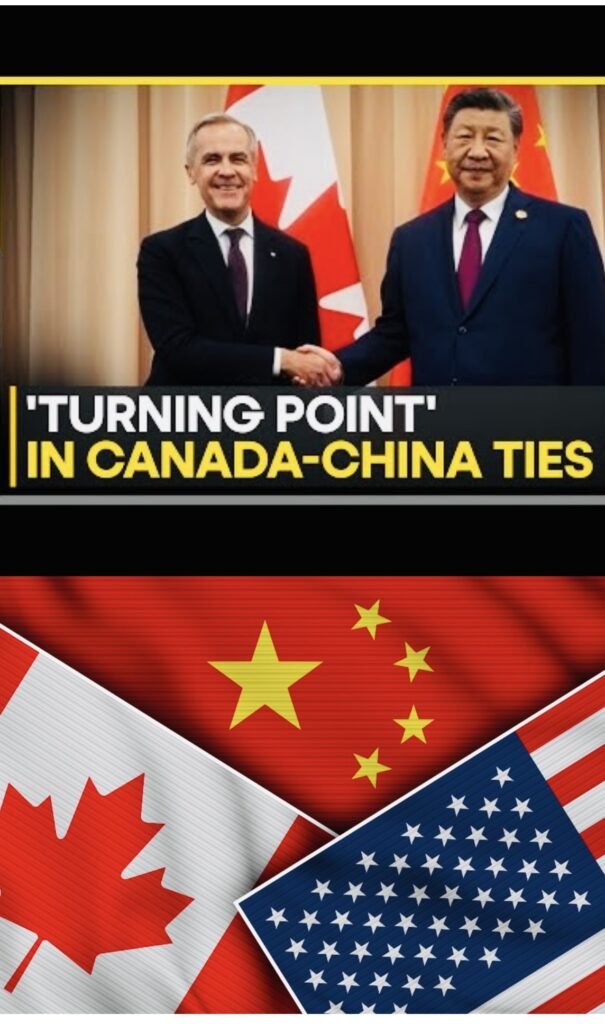
In early 2026, Canada and China announced a “Canada-China Economic and Trade Cooperation Roadmap” under Prime Minister Mark Carney, signaling a pragmatic reset in bilateral ties. This includes welcoming Chinese investments in sectors like energy, agriculture, and consumer products, alongside tariff adjustments—such as reducing Canadian tariffs on limited Chinese EVs from 100% to 6.1% with quotas, in exchange for China lowering barriers on Canadian agricultural exports like canola. This development occurs amid strained U.S.-Canada relations under the second Trump administration, including tariffs and trade disputes. While not a formal alliance against the U.S., it reflects Canada’s efforts to diversify trade amid uncertainty with its largest partner. Canada’s pivot highlights broader global fragmentation. China views deeper ties with Canada—a traditional U.S. ally—as an opportunity to demonstrate “strategic autonomy” for middle powers and counter U.S. influence. Canada sits at the intersection of Atlantic, Pacific, and Arctic access, making it one of the few countries with direct routes to both major ocean basins and the emerging Arctic shipping corridor. Canada’s position as the northern anchor of North America gives it outsized geopolitical weight: it controls the world’s longest undefended border with the United States, commands Atlantic, Pacific, and Arctic access, and holds vast reserves of energy, minerals, and fresh water. China’s growing interest in Canada reflects this geography. Beijing views Ottawa not only as a source of commodities and technology, but as a strategic entry point to North American markets and emerging Arctic sea routes. For Canada, engagement with China offers diversification from U.S. market dependence and capital for infrastructure and resource development. For Washington, it tests the cohesion of North American economic and security alignment. The relationship therefore sits at the intersection of trade, sovereignty, and great-power competition, where economic ties carry direct implications for how influence is projected across the continent. As climate change reduces sea ice, the Northwest Passage and broader Arctic sea routes are drawing attention from global powers seeking shorter transit times between Asia, Europe, and North America. China, which declared itself a “near-Arctic state” in 2018, has positioned investment in Canadian ports, shipping infrastructure, and resource projects as part of its Polar Silk Road vision. For Ottawa, Chinese capital offers potential funding for underdeveloped northern infrastructure and trade diversification beyond the U.S. For Washington and other Arctic Council members, it raises questions about security, sovereignty, and control of critical maritime chokepoints. The Canada-China relationship in this context is therefore not just about trade volumes—it’s about who helps build, operate, and influence the sea lanes of the 21st century. The strategic value of Canada’s sea and Arctic routes ensures that China will remain an interested investor, even as security reviews and alliance pressures limit the scope of cooperation. Opportunities exist in financing ports, icebreakers, logistics hubs, and resource development that Canada alone cannot fund at the pace climate change demands. Yet the same geography that creates opportunity also creates risk: control over Arctic access touches on Canadian sovereignty, U.S. continental defense through NORAD, and broader competition over polar governance. Ottawa’s challenge through 2026 and beyond will be to convert geographic advantage into infrastructure and prosperity without ceding strategic control. For North America, the outcome will shape whether Arctic routes become a zone of multilateral cooperation or a new frontier of great-power competition.
As global trade realigns in the 2020s, China’s investment footprint in Canada has become a focal point of economic and security debate. Chinese FDI in Canada has fluctuated, with a sharp decline in deal volume in 2025 (down to 34 transactions, a 43% drop), shifting toward smaller greenfield projects by private firms in non-sensitive sectors. While “partnership” and “hegemony” are politically charged terms, the reality is more nuanced: Canada seeks capital and market access, China seeks resources and technology, and the United States watches closely given its deep integration with Canada. China has invested in Alberta oil sands, LNG projects in BC, and uranium/nickel/lithium mining. As the world transitions to EVs and batteries, Canada’s cobalt, nickel, and graphite are strategic. Chinese firms bring capital for projects Western investors sometimes avoid due to long timelines. Agri-food exports—canola, pork, seafood—benefit from China’s massive consumer market. Before 2019 canola restrictions, China bought $2.7B CAD/year. Restoring stable trade would help Canadian farmers. Chinese investment has funded condos, commercial property, and infrastructure in Toronto and Vancouver, addressing capital gaps. Partnerships in AI, clean tech, and university research create knowledge exchange, though this is now heavily scrutinized. The 2022 “Investment Canada Act” changes allow Ottawa to block investments on national security grounds. Concerns focus on critical minerals, telecom, and dual-use technology. The 5G Huawei ban reflects this. Economic Dependence: Over-reliance on China risks “weaponized trade,” as seen with the 2019 canola ban. Diversification is the stated Canadian policy, but difficult in practice. Human Rights & Values: Differences over Hong Kong, Xinjiang, and Taiwan create political friction in Canada’s parliament and public opinion, limiting government flexibility. Washington views Chinese investment in North America through a security lens. The US has urged Canada to align screening and export controls, creating pressure on Canadian sovereignty. China is Canada’s second-largest trading partner after the US. Bilateral trade reached $100 billion CAD annually before the 2018 diplomatic crisis over Huawei and Meng Wanzhou. Since then, investment flows dropped sharply, but Chinese capital remains present in energy, mining, real estate, and tech. Geopolitically, Canada sits between two poles: its USMCA alliance with the US and Mexico, and China’s Belt and Road ambitions plus its demand for Canadian resources like oil, LNG, potash, and critical minerals. For Beijing, Canada represents a stable, resource-rich entry point to North America. For Ottawa, China represents diversification away from US market dependence—a strategic goal since NAFTA days. This tension defines the relationship: economic complementarity vs. strategic competition. For Canada, it addresses over-reliance on the U.S. (which accounts for the vast majority of its trade, versus $100+ billion with China). The move aligns with long-standing goals of market diversification, especially in resources and agriculture hit by prior retaliatory tariffs. However, experts caution that this is hedging rather than a fundamental break; Canada remains deeply integrated with the U.S. via USMCA, defense (NORAD), and supply chains. The timing amplifies perceptions of wedge-driving in U.S.-China rivalry. U.S. responses have included threats of substantial retaliation, with concerns that Chinese economic footholds could extend to influence operations or technology and security risks. Canada by market access and relief, through reduced Chinese tariffs on canola, seafood, pork, and other agri-products help recover lost exports. Chinese investment in food processing, manufacturing, and energy (e.g., potential LNG/oilsands involvement) could address underinvestment and create jobs. Limited Chinese EV imports and potential production investments offer affordable options and supply chain learning, supporting Canada’s auto sector and emissions goals. China holds significant FDI stock in Canada (CAD 30+ billion recently), historically in energy and mining. Diversified, transparent investments could boost sectors like consumer goods and finance. Canada gains better access through two-way flows for its firms in Chinese sectors like aerospace, advanced manufacturing, and agriculture. China would secure access to Canadian resources, stable agricultural supplies, and a foothold in North America. Demonstration of economic diplomacy amid its own global outreach. But the Challenges are equally important regarding security and regulatory hurdles: Canada maintains strict Investment Canada Act reviews, especially for state-owned enterprises (SOEs), critical minerals, sensitive tech, and national security. The Canada-China economic relationship is constrained by asymmetries and security guardrails, but even limited progress forces the U.S. to account for a more independent Canadian posture. For Canada, the test is turning resource leverage into bargaining power without triggering retaliation or alliance costs. For the U.S., the challenge is keeping Canada inside a “North American perimeter” on sensitive tech and minerals while accepting that Ottawa will pursue some trade diversification. Canada runs a deficit with China in manufactured goods while relying heavily on China for purchases of commodities like canola, pork, and seafood. Deeper integration with Chinese markets, capital, and technology offers diversification from the U.S. Chinese state-owned enterprises (SOEs) often enter with long investment horizons and state backing, raising “net benefit” questions under Canada’s Investment Canada Act. Unlike U.S. FDI, which operates mostly through private firms, SOE involvement introduces governance concerns over market distortion, subsidies, and long-term strategic control of critical assets. Chinese FDI in Canada remains modest compared to U.S. or European flows. Quotas and federal reviews keep EV and battery impacts limited, and Ottawa has restricted Chinese investment in critical minerals, telecom, and other sensitive sectors since 2022. Broader FDI faces heightened scrutiny, meaning growth will depend on non-sensitive sectors like agriculture, housing, and clean tech. Canada has transparency commitments for foreign investment review, but enforcement and political direction have shifted over time. This creates uncertainty for investors and for policymakers trying to balance openness with control. A closer Canada-China economic relationship directly challenges U.S. strategy to “de-risk” and “friend-shore” supply chains away from China. Three effects stand out: Supply Chain. If Chinese firms gain access to Canadian lithium, nickel, or battery tech, it could undercut U.S. efforts to build a North American critical minerals bloc under the Inflation Reduction Act and USMCA. Canada has so far blocked sensitive deals, but any exception creates precedent. Chinese EVs, machinery, or consumer goods gaining ground in Canada could reduce U.S. market share in sectors where America currently dominates, such as autos and equipment. Even modest shifts matter because the Canada-U.S. market is so integrated. Disagreements over China policy could surface during USMCA reviews, tariff disputes, or defense cooperation discussions. U.S. officials have repeatedly signaled that Chinese investment in Canada’s critical sectors is “troublesome” for NORAD and NATO alignment. The risk is not a rupture, but increased friction and pressure on Ottawa to align more closely with Washington’s screening regime. If Canada demonstrates that diversification toward China is viable without losing U.S. market access, other U.S. allies may follow suit. That would complicate America’s broader containment strategy and signal that middle powers can hedge between Washington and Beijing.
As global power dynamics fragment and the Arctic emerges as a critical arena of the 21st century, Canada’s calibrated economic reset with China represents neither a strategic realignment nor a challenge to American primacy, but a pragmatic assertion. Ultimately, Canada’s approach underscores a timeless geopolitical truth: in an era of great-power competition, sovereign leverage belongs to those nations that can engage the world on their own terms while preserving the strategic perimeters that define their security
Geopolitically, this fits a multipolar pattern where middle powers pursue autonomy without full realignment. Conversely, pragmatic Canada-China trade could indirectly pressure China in U.S. negotiations or provide data points for American deals. Canada insists it is not targeting third parties and continues emphasizing security guardrails. U.S. leverage remains immense due to economic interdependence with Canada. Escalatory tariffs could backfire by accelerating Canadian diversification. Deep integration (trade, energy, security) makes outright rupture unlikely and mutually damaging. Canada cannot easily replace U.S. markets or alliances. Canada’s approach prioritizes “taking the world as it is”—pragmatic engagement with guardrails—over ideological alignment. Success depends on balancing diversification with core alliances, rigorous screening, and avoiding new vulnerabilities. The Canada-China partnership represents economic pragmatism amid global tensions, not a renaissance against “hegemony” or sovereign rupture. It offers opportunities for diversification but carries substantial strategic, security, and relational risks. Outcomes will hinge on implementation transparency, regulatory enforcement, and management of U.S. relations. All parties benefit from stable, rules-based economic ties rather than zero-sum framimy. The US is Canada’s largest trading partner, with $900B USD in annual two-way trade via USMCA. US concerns about Chinese investment in Canada center on 3 areas: Supply chain security: Chinese ownership of Canadian mines could affect US access to critical minerals. Technology leakage: Joint Canada-China R&D could transfer tech to China, affecting US competitiveness. Strategic alignment: Washington prefers Canada to “decouple” from China in sensitive sectors to maintain a unified North American front. However, the US also benefits when Canada develops its resources, as North American energy and minerals reduce reliance on other regions. Complete US-Canada conflict over China policy is unlikely due to USMCA integration, shared defense via NORAD/NATO, and border security ties. China’s investment in Canada carries real economic opportunities in resources, infrastructure, and markets, but also real strategic risks around security and alliance cohesion. For the US, Canada’s choices matter because North American supply chains are integrated. The most likely outcome is not a US-Canada split, but tighter coordination on screening sensitive sectors while Canada preserves room for non-sensitive trade with China. The question for Ottawa in 2026 and beyond is whether it can execute that balance without being forced to choose sides outright. The “sovereign resurgence” for Canada will depend less on opposing the US and more on building a diversified, resilient economy that can engage both Washington and Beijing on Canadian terms. Canada has the resource base and geography to negotiate with multiple partners, but it operates within a North American security and trade architecture dominated by the United States. Chinese investment can accelerate infrastructure, energy, and critical mineral development, yet it also triggers scrutiny over control of strategic assets and alignment with U.S.-led frameworks like USMCA and NORAD. By 2026, Canada’s ability to manage this relationship will determine whether it strengthens its own sovereign leverage or gets pulled into a binary choice between Washington and Beijing. In that sense, Canada-China ties are not just a bilateral story—they are a measure of how middle powers navigate influence when the center of global gravity shifts northward and westward. As global power dynamics fragment and the Arctic emerges as a critical arena of the 21st century, Canada’s calibrated economic reset with China represents neither a strategic realignment nor a challenge to American primacy, but a pragmatic assertion of middle-power agency rooted in geography, resources, and necessity. For North America as a whole, the outcome of this balancing act will help determine whether the Arctic becomes a domain of cooperative development or contested influence. Ultimately, Canada’s approach underscores a timeless geopolitical truth: in an era of great-power competition, sovereign leverage belongs to those nations that can engage the world on their own terms while preserving the strategic perimeters that define their security. Ottawa’s challenge—and opportunity—in 2026 and beyond is to prove that such hedging can strengthen rather than erode the resilience of the continent.