The writer is an economist, anchor, jurist, geopolitical analyst and the President of All Pakistan Private Schools’ Federation.
president@Pakistanprivateschools.com
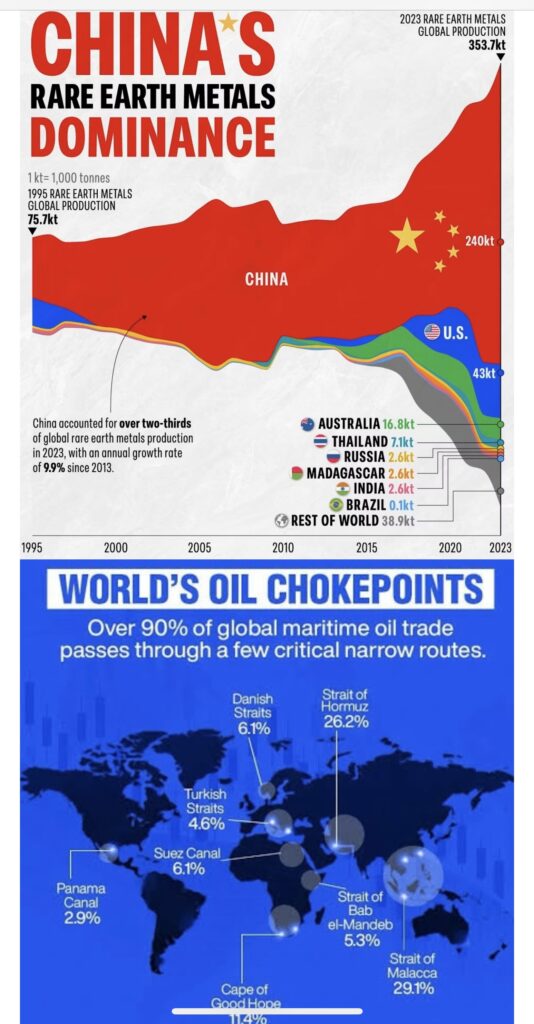
n a world transitioning toward decarbonization while remaining heavily dependent on hydrocarbons, control over energy resources, critical minerals, water, and food supply chains has become the defining currency of geopolitical power. Chokepoints—both physical maritime straits and concentrated processing nodes—act as leverage points where states can exert outsized influence, disrupt adversaries, or secure advantages. As of mid-2026, this dynamic is sharpened by ongoing conflicts (notably involving Iran and disruptions in the Strait of Hormuz), export controls on rare earths and minerals, persistent water stress in key regions, and the lingering effects of the Russia-Ukraine war on global food systems. The Strait of Hormuz exemplifies classic chokepoint vulnerability: in 2025, it handled ~20 mb/d of crude and products (25% of global seaborne oil trade, with 15 mb/d crude representing 34% of global crude trade). Roughly 80% of this flow heads to Asia (China, India, Japan key importers). Disruptions in 2026, including blockades and hostilities, highlighted risks, forcing rerouting, inventory draws, and price spikes. Alternative routes (e.g., Saudi pipelines to the Red Sea) offer only 3.5-5.5 mb/d capacity—insufficient to fully compensate. Other chokepoints like the Strait of Malacca (23 mb/d oil in early 2025 data) and Bab el-Mandeb add layers of risk for Asian importers. In a decarbonising world, oil’s role shifts toward petrochemicals, aviation, and heavy transport, sustaining hydrocarbon dependence even as EVs and renewables grow. Control over Gulf production and transit thus retains enormous leverage for producers and potential disruptors. Energy, Resources, and the Geopolitics of Scarcity based on oil, rare earths, critical minerals, water, and good security in a decarbonising yet Hydrocarbon-Dependent World. By 2026, the defining axis of global power is no longer just military alliances or GDP. It is who controls the molecules, metals, and megawatts that keep the world running. We are living through a paradox: the world is decarbonising, yet remains deeply hydrocarbon-dependent. At the same time, new scarcities — of critical minerals, water, and arable land — are redrawing maps of influence faster than oil ever did. Oil has not been replaced. It has been layered over. Global oil demand in 2025-2026 remains around 103-105 million barrels per day, driven by petrochemicals, aviation, shipping, and developing economies. But geopolitics has shifted from “who has the most oil” to “who controls the routes and refineries”: Strait of Hormuz: 20% of world oil and 25% of LNG passes here. Iran’s tanker seizures in 2019 and Middle East instability in 2023 showed how quickly prices spike. Strait of Malacca, Bab el-Mandeb, Panama Canal, Danish Straits: 60% of seaborne energy trade transits 8 chokepoints. A drone strike, cyberattack, or insurance ban here equals instant inflation. Refining concentration: The U.S. shale boom helped Europe in 2022, but refining capacity is now the bottleneck. Countries with spare refining — India, Saudi Arabia, UAE — gain leverage. The lesson of Ukraine 2022 and Israel-Palestine 2023: weaponised energy is back. Russia cut gas, prices surged, and Europe was forced to re-industrialise around energy security. If oil was the 20th century, lithium, cobalt, nickel, copper, graphite, and rare earths are the 21st. They are in EVs, wind turbines, solar panels, chips, and fighter jets. The numbers are stark: Demand: IEA forecasts demand for critical minerals must triple by 2030 and quadruple by 2040 for net-zero. Concentration: For 19 out of 20 strategic minerals, China is the leading refiner with 70% market share. For processing, China holds less than 50% of refined graphite, dysprosium, cobalt, lithium, and manganese. Geographically, Australia is for lithium, the DRC holds a major part of cobalt, Indonesia is rich in nickel, Chile is rich in copper and lithium, and South Africa is rich in platinum. The top 5 miners control 61% of lithium and 56% of cobalt. This is why IEA Chief Fatih Birol warned in 2025: dependence on one country for critical minerals is one of the most serious risks to energy security, and “serious tensions between countries over critical minerals” could erupt from 2026 onward. 2025 inflexion point: China tightened export licenses for 7 rare earth elements in April, then widened to magnets and processing tech by October. Result: price shocks, production cuts in EVs and defence. This was not scarcity — global production was 196,000 tonnes. It was a crisis of access. A single EV needs 1- 2 kg of rare earth magnets. An offshore wind turbine: 600- 2,000 kg. A fighter jet is less than 400kg. No rare earths means no energy transition, no AI, no modern military. The new choke point is no longer just the mine. It is IP and processing. Patents for magnetic separation, battery cathode chemistry, and gallium nitride are held by a handful of Chinese, Japanese, Korean and US firms. You can own the ore in Congo, but without the processing patent in China or Korea, you have nothing. Critical minerals and rare earths are the New Chokepoints of the Energy Transition. The shift to clean tech—EVs, wind turbines, batteries, semiconductors—has created new dependencies. China dominates refining and processing for 19 of 20 key energy-related critical minerals, with shares often 70-99% (e.g., 91-94% for rare earth refining/magnets, 96% graphite, 95% manganese, high shares in gallium, cobalt). Mining is less concentrated, but downstream bottlenecks are acute. In 2024-2025 data, China accounted for 60-70% of rare earth mining, but over 90% of refining. Heavy rare earths (dysprosium, terbium) are particularly concentrated (83% from China and Myanmar sources). Export controls introduced in April 2025 (on seven heavy REEs) and expanded in October disrupted supply chains, affecting autos, defence, and renewables. Full enforcement could jeopardise trillions in downstream output. Diversification efforts (US Mountain Pass, Australian projects, Malaysian processing) are progressing slowly; China’s share in rare earth refining dropped modestly but remains dominant. Refining concentration increased for many minerals (top countries accounting for 86% on average). Investment fell 9% in 2025 amid volatility and geopolitics. Governments have ramped up financial commitments, but lead times for new supply are long (years). This “mineral statecraft” allows China to weaponise supply in trade disputes, mirroring (but differing from) traditional oil leverage. In a decarbonising world, these chokepoints determine who leads in EVs, renewables, and defence tech. Control over processing and magnets translates to influence over technology deployment and military capabilities.
Water scarcity intersects with energy and food, amplifying geopolitical risks. The Middle East and North Africa face acute stress, exacerbated by drought, mismanagement, upstream dams, and conflict. Iran’s 2025 crises (low reservoir levels, potential urban evacuations) highlight domestic instability risks. Transboundary rivers (Nile, Tigris-Euphrates, Indus) create flashpoints: Ethiopia’s GERD, Turkey/Iran dams affecting Iraq, India-Pakistan Indus tensions. Conflicts damage infrastructure (desalination, treatment plants), worsening shortages. Climate change intensifies variability; demand rises with population and agriculture (which uses 70-80% of water in many arid regions). No major interstate “water wars” have occurred, but cooperation via treaties is strained, and subnational violence over resources is rising. Water stress correlates with higher conflict risks in vulnerable areas. Energy links are direct: hydropower, cooling for thermal plants, and desalination (energy-intensive) tie water to power security. Food production depends on irrigation, making scarcity a food security threat. Global acute food insecurity affected 266 million in 47 crisis countries and territories in 2025 (GRFC data), with protracted crises in places like Sudan, Gaza, and others. Hunger estimates for 2025 showed gradual improvement (645 million facing hunger, 7.8% globally), but Africa bears a heavy burden, and two famines were confirmed in one year. Moderately/severely food insecure: 2.1 billion. The Russia-Ukraine war (four years on) reduced Ukrainian output and exports (grains down significantly), while Russia expanded market share in some years but faced its own constraints. Black Sea disruptions affect importers in Africa and the Middle East. Fertiliser and energy price shocks ripple through. Other risks include Red Sea/Hormuz disruptions raising shipping costs and climate events. Food has been weaponised via blockades, infrastructure attacks, and export restrictions. Vulnerable importers lose agency; exporters gain influence. Water: 70% of freshwater goes to agriculture. Aquifers in India, Pakistan, the Middle East, and the US Southwest are depleting. Water scarcity now appears in ESG risk models for mines. Countries upstream on rivers — Turkey, Ethiopia, China — use dams as leverage. Food: Fertiliser depends on natural gas, phosphate, and potash. Wheat, rice, and corn trade flows through the Black Sea, Suez, and Panama. The Russia-Ukraine war cut exports of cobalt and copper 35.5% and triggered food inflation. Climate shocks with export bans as 2022-style food riots. Food and water scarcity don’t cause wars alone. They amplify mineral and energy disputes. A drought in Chile raises copper costs. A heatwave in Pakistan strains the grid, food and social stability.The response to concentration has been a global scramble: United States: Inflation Reduction Act subsidies for domestic refining, project finance, and Minerals Security Partnership expansion. EU: Critical Raw Materials Act targeting less than 65% from any single country, faster permits. China: 15th Five-Year Plan doubles down on supply chain control, and 2023 ban on rare earth extraction tech exports. Producer states: DRC, Chile, Indonesia, Türkiye now demand local value-add — processing, jobs, revenue. Türkiye is targeting top 5 rare earth producer status with 694 million tons at Beylikova. The UN Security Council debate in 2025-2026 framed minerals as essential for clean energy and AI, but warned poor governance fuels conflict. No binding resolution passed, but a “Group of Friends” on resource governance was proposed. IRENA’s message for COP28 was blunt: collaborate or the transition slows. No single country can be self-sufficient. Despite ambitious net-zero targets, oil remains central to the global economy. Global liquid fuels consumption hovered around 102-104 million barrels per day (mb/d) in recent projections for 2025-2026, with demand showing resilience in non-OECD countries (especially Asia) even as OECD demand softens. Forecasts for 2026 indicated potential contractions or modest growth depending on economic recovery, prices, and conflict resolution, with IEA and EIA projections ranging from slight declines to rebounds toward 105 mb/d by 2027. Supply has been volatile. Global production faced significant disruptions in 2026 linked to Middle East tensions, with forecasts showing contractions (e.g., 3-4 mb/d drops in some quarters) before potential rebounds. OPEC plus output has been curtailed at times, while non-OPEC plus growth (led by the Americas) provides some buffer. We are decarbonising and re-carbonising at once: Hydrocarbons still fund the transition. Oil and gas revenues build solar factories and mines. Clean tech is more mineral-intensive. A wind farm needs 9x more minerals than a gas plant of the same output. New risks replace old ones. We traded OPEC for “OREC” — an Organisation of Rare Earth Countries, de facto led by China. Cost vs Security: De-risking supply chains adds immediate costs and inefficiencies, slowing clean energy uptake. Geopolitical risk directly increases “renewable energy poverty” by raising mineral prices and slowing deployment. Control now flows through 4 layers: Resources: Who has reserves. DRC, Chile, Australia, Indonesia. Processing and IP: Who can turn ore into battery-grade material. Still China-dominated. Chokepoints: Maritime straits, pipelines, power grids, data cables. Physical and digital. Governance & ESG: Who can mine without conflict and deliver community benefits. Countries that master all four — like the US with shale, tech, allies, or China with mines, refineries, ports — set the rules. Middle powers like Türkiye, India, and Gulf states are positioning as “swing producers”. These domains overlap: Oil and minerals power (and are powered by) water-intensive agriculture and industry; conflicts over one exacerbate others. Decarbonization redistributes risks—from fossil chokepoints (Hormuz, Malacca) to mineral processing nodes dominated by few actors. Supply chain resilience requires diversification, stockpiles, recycling, substitution, and diplomacy—but progress is uneven and slow.
The next decade will not be won by the country with the most oil, nor the one with the most solar panels. It will be won by the actor that can keep energy, minerals, water, and food moving through a brittle, contested system; and by the country that can keep electrons, electrons’ metals, water, and wheat flowing through a world of chokepoints — without breaking.
We entered the energy transition believing scarcity would end. Instead, it changed form. In 2026 the world is decarbonising on paper, yet remains stubbornly hydrocarbon-dependent in practice. Oil still moves navies, heats homes, and funds budgets. At the same time, a new architecture of scarcity has emerged: rare earths that make magnets spin, lithium that powers batteries, copper that carries electrons, water that grows food, and grain that stabilises societies. The decisive battleground is no longer who owns the most reserves, but who controls the chokepoints and supply chains in between — the straits, refineries, smelters, ports, and patents. With China refining roughly 70% of 19 out of 20 strategic minerals and the IEA warning of serious tensions over critical minerals from 2026 onward, dependence has become leverage. This is the geopolitics of scarcity: a world where influence flows not just from barrels, but from bottlenecks. We are not running out of resources. We are running out of easy, cheap, apolitical resources. The 2026 world is defined by negotiated scarcity: every barrel, kilogram of lithium, and cubic meter of water comes with strings. For governments: diversification is the “golden rule of energy security”. For companies: supply chain transparency and IP access matter more than geology. For citizens: the energy transition will be slower, costlier, and more political than promised — unless cooperation beats competition. Major powers manoeuvre accordingly: the US and allies pursue “friendshoring” for minerals and critical tech; China leverages processing dominance; Gulf states invest in diversification (e.g., renewables, food imports); importers seek alternatives. Naval presence near chokepoints signals readiness to protect (or threaten) flows. In this hydrocarbon-dependent yet decarbonising era, scarcity geopolitics favours those controlling upstream resources, midstream chokepoints/processing, or adaptive technologies. Vulnerability is highest for import-dependent nations lacking leverage. Long-term solutions demand innovation in efficiency, alternatives, and governance—yet near-term realities reward strategic control and resilience-building. The coming decades will test whether cooperation or competition defines outcomes in this high-stakes arena.Decarbonization has not erased geopolitics — it has multiplied it, trading OPEC’s leverage for a web of mineral refineries, shipping lanes, and data centres. In this era of negotiated scarcity, diversification is the only credible strategy and cooperation the only durable one. Nations that master processing, secure routes, and invest in resilient supply chains will set the rules. Those that don’t will pay the price in higher costs, slower transitions, and diminished sovereignty. Scarcity, once again, is writing the map of power. The next decade will not be won by the country with the most oil, nor the one with the most solar panels. It will be won by the actor that can keep energy, minerals, water, and food moving through a brittle, contested system; and by the country that can keep electrons, electrons’ metals, water, and wheat flowing through a world of chokepoints — without breaking.