The writer is an economist, anchor, jurist, geopolitical analyst and the President of All Pakistan Private Schools’ Federation
president@Pakistanprivateschools.com
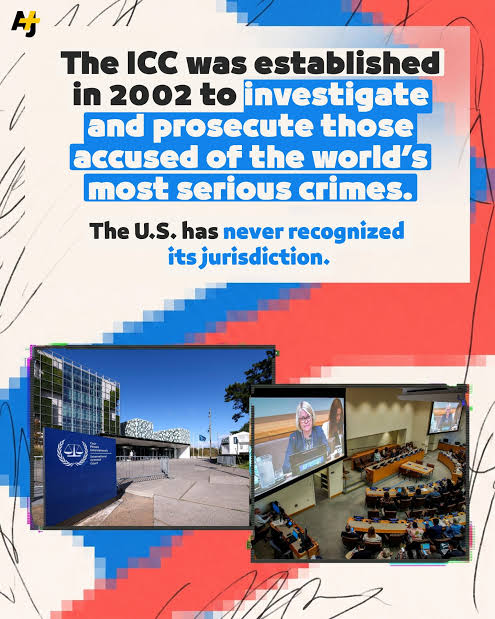
At the dawn of the 21st century, 120 nations voted to create a court meant to end the age of impunity — the International Criminal Court, designed as humanity’s court of last resort for genocide, war crimes, crimes against humanity, and aggression. Back in 1998, the United States was one of seven countries that voted against its foundation. Since the International Criminal Court opened in 2002, its relationship with the United States has been, at best, complicated. The International Criminal Court (ICC) was established to act as a court of last resort, trying individuals charged with genocide, war crimes, crimes against humanity, and aggression. Now, its leaders are vowing to dismantle the court “brick by brick”, describing the ICC as an intolerable threat to US sovereignty. In an election cycle, attacking international law plays well at home. But abroad, it sends a more dangerous signal: that veto powers can erase accountability at will. But this is an escalation, and it’s a dramatic one. With Executive Order 14203 in February 2025, the U.S. officially imposed sanctions on ICC officials involved in investigating U.S. or Israeli nationals. The sanctions, which include asset freezes, travel bans, and restrictions on services from U.S. companies, mirror sanctions attempted by the first Trump administration against ICC officials investigating alleged war crimes in Afghanistan. The International Criminal Court was born in 1998 with a historic promise: that no leader, no matter how powerful, would be above the law for genocide, war crimes, and crimes against humanity. 27 years later, that promise is colliding with a hard geopolitical reality. In 2025-2026, the United States publicly vowed to “dismantle” the ICC after it issued arrest warrants against Israeli and American officials, while the 5 permanent members of the UN Security Council — all veto powers — continue to use their political shield to block ICC action. The result: a court of law that depends entirely on the politics of the very states it is meant to judge.Why the US and veto powers have become an intolerable structural threat to ICC jurisdiction, where the Court has already failed to implement its own orders, and what must be done if international law is to mean anything for the billions people worldwide seeking accountability. Since taking office for the second time in January 2025, US President Donald Trump has taken anti-international sentiment to the extreme. The issuance of last year’s executive order, the second Trump administration has expanded its scope to institute sanctions on at least 11 ICC officials, including nine judges and the chief prosecutor. The Trump administration has simply taken it to the highest level ever. The US has cut funding to dozens of international organisations, permanently shuttered the US Agency for International Development (USAID) and exited the Paris Agreement, an international treaty on climate change. These moves are “part and parcel of the same sort of anti-international sentiment” that haslong been present in the Republican party. The ICC is not a world government. It is a court of “last resort” under the Rome Statute, with jurisdiction only when national courts are unwilling or unable to act. Its core significance: Ending Impunity: To prosecute the “most serious crimes of concern to the international community” when domestic systems fail; To deterrence the threat of prosecution to restrain state and non-state actors; Victim-Centered Justice to reparations and recognition for victims who have no other forum. Without sovereign equality before the law, the ICC becomes a tribunal for the weak and a spectator for the powerful. That undermines the entire post-WWII rules-based order. Although, the US signed but never ratified the Rome Statute. Since 2002 it has passed the “American Service-Members’ Protection Act” — nicknamed “The Hague Invasion Act” — authorizing force to free any US personnel held by the ICC. In 2020, the US sanctioned ICC Prosecutor Fatou Bensouda and staff over investigations into Afghanistan. In 2024-2025, after the ICC issued arrest warrants related to the Gaza conflict, senior US officials again threatened to “dismantle” the Court, impose new sanctions, and block its funding and cooperation agreements. The Impact was the world’s largest economy and military can criminalize cooperation with the Court, making arrests and evidence collection nearly impossible. Under Article 13(b) of the Rome Statute, the UNSC can refer situations to the ICC. Under Article 16, it can defer investigations for 12 months. The 5 permanent members — US, China, Russia, UK, France — can veto any referral or deferral. But the result was a two-tier system. Situations in non-P5 allied states get referred. Situations involving P5 or their allies are blocked. The Court’s legal authority has repeatedly crashed against political reality. Key examples: The International Criminal Court’s authority remains profoundly illusory: it can issue arrest warrants for genocide, war crimes, and crimes against humanity—as it did against Isreal against the atrocities of Israel genocide of Palestinian (2021-2024) after years of preliminary examination, the ICC issued arrest warrants in 2024. Several ICC member states publicly stated they would not execute the warrants. ICC issued warrants regarding Israel and Palestine have been met with public refusals by member states and threats of retaliation from Washington. In each instance the pattern is identical and damning: without the capacity to compel cooperation or overcome the Security Council’s veto-paralyzed inertia, the Court’s judgments and warrants function less as instruments of accountability than as symbolic declarations that expose the structural impotence of international justice when confronted by power.The recent US responded with threats to sanction judges and dismantle the Court. That’s failure is even with jurisdiction, political non-cooperation renders the warrant symbolic. The ICC can issue judgments, but it cannot arrest, cannot compel evidence, and cannot sanction non-cooperation without the UNSC — which is paralyzed by veto. Sudan’s Omar al-Bashir, Libya’s Saif al-Islam Gaddafi, and, more recently, figures linked to the Afganistan conflict—yet it possesses neither police nor independent coercive power, leaving enforcement wholly dependent on states that routinely subordinate legal obligations to political convenience, fractured sovereignty, or great-power pressure. In Sudan – Omar Al-Bashir (2009-2019) the ICC issued two arrest warrants for genocide, war crimes and crimes against humanity. Despite 100+ member states, Al-Bashir traveled freely to ICC members including Jordan, South Africa, and Uganda. No arrest was made. That failure was due to lack of enforcement. States chose political relations over legal obligations. The case stalled for a decade. Al-Bashir traveled freely for a decade among ICC members who declined to arrest him; In Libya – Gaddafi’s warrant has languished for fourteen years amid Libya’s collapse and absent UN Security Council enforcement. Saif al-Islam Gaddafi (2011-present) The ICC issued an arrest warrant in 2011. 14 years later, he remains at large in Libya. The Court has no police force and depends on Libyan authorities who are fractured and non-compliant; an Afghanistan investigation probing U.S. personnel was deprioritized and narrowed after American sanctions; Afghanistan (2006-2021) the ICC authorized an investigation into alleged crimes by Taliban, Afghan forces, and US personnel. After US sanctions on the Prosecutor in 2020, the investigation was “deprioritized.” The Court later narrowed its focus to only Taliban and ISIS-K crimes, effectively dropping US-related lines. The failure was direct pressure from a non-member great power forced the Court to retreat from part of its mandate. This impunity gap exacts a profound toll: victims perceive the ICC as selectively blind, crystallizing the corrosive narrative that international law binds only the weak; deterrence evaporates as leaders of powerful states internalize their practical immunity and the preventive force of accountability collapses; justice fragments as states retreat to regional courts, ad hoc tribunals, or outright revenge; and prosecutors, chilled by the threat of sanctions—as starkly illustrated in Afghanistan—increasingly self-censor, leaving the architecture of global justice hollowed by its own selective restraint.
A court that cannot prosecute the powerful cannot deliver justice for anyone. The choice is stark: reform the ICC to make it less dependent on the political whims of the P5, or admit that international criminal law will remain selective. The Rome Statute promised “Never Again.” Without sovereignty and enforcement, it risks becoming “Again and Again.”
The International Criminal Court (ICC), established by the 1998 Rome Statute and operational since 2002, was designed as a permanent tribunal of last resort to prosecute individuals for genocide, crimes against humanity, war crimes, and (under limited conditions) aggression when national courts are unwilling or unable to act. It operates on complementarity, territorial and nationality jurisdiction for states parties, and Security Council referrals. Yet its effectiveness is constrained by the absence of an independent enforcement arm, heavy reliance on state cooperation, and the political realities of great-power politics—particularly the positions of the United States and the other permanent members of the UN Security Council (P5: US, Russia, China, UK, France). The US, permanent Security Council members, and the structural limits that undermine ICC jurisdiction and enforcement. Revisiting power dynamics in international law. Those concerned with the recent sanctions against ICC officials should consider revisiting the domestic and international legal bases to underpin these and many other U.S. sanctions. There is only one existing mechanism that all states recognise as a legally valid way to impose globally binding sanctions: a United Nations Security Council decision. The Council has not adopted — and is extremely unlikely to adopt — a resolution mandating sanctions on ICC officials. In imposing sanctions on ICC officials as well as on many other people and entities in numerous other contexts, the U.S. relies on an extensive domestic architecture through which it asserts the power to exercise extraterritorial criminal and civil jurisdiction where U.S. national-security interests are perceived to be implicated. The International Criminal Court’s claim to universal jurisdiction is hollowed out by its structural dependence on the very sovereign states it purports to constrain: lacking any independent police, army, or reliable budget, it cannot compel compliance and must rely entirely on voluntary state cooperation or Security Council referrals that the most powerful actors can veto or ignore. Non-member giants—the United States, China, Russia, and India—remain formally beyond its reach yet freely sabotage its work through sanctions and intimidation aimed at judges and staff, while the complementarity principle is inverted into a shield whereby powerful states simply announce domestic “investigations” that never yield genuine trials. The result is a court whose authority evaporates precisely where accountability is most needed, exposing the uncomfortable truth that international justice remains subordinate to the raw calculus of power rather than the rule of law. Sanctions were slapped on the ICC Prosecutor in 2020 over an Afghanistan inquiry, lifted in 2021, only for the Court to quietly deprioritise US forces anyway. The message was clear: even without ratifying the Rome Statute, Washington can bend the Court’s docket through pressure, funding cuts, and threats. Today, this assault is not an anomaly. It is the sharpest expression of an “America First” doctrine now cutting funding to the UN system, shuttering USAID, and walking away from climate treaties. It is a move that has drawn fierce criticism from around the world, with Amnesty International condemning the campaign as reprehensible. However, a recent swath of official sanctions against ICC judges by the Trump administration represents a significant intensification of preexisting tension. We shouldn’t think the U.S. has been wholly supportive of the court. The U.S. has never signed up for the court and has been, in the past, extremely hostile to the court. What was once a relationship of quiet hypocrisy — public criticism paired with back-channel cooperation — has collapsed into open hostility. Before Mr Trump started attacking the ICC during his first administration, the US had already had a complicated relationship with the international court. Various US administrations had often criticised it publicly while providing behind-the-scenes support, but added that the complex relationship had become increasingly hostile under Mr Trump. His administration imposed sanctions on the ICC prosecutor in June 2020, after an investigation into US personnel in Afghanistan was announced. Those sanctions were lifted by then-president Joe Biden in 2021. Later that year, the new ICC prosecutor, Karim Khan, who has now been removed over sexual misconduct allegations, decided not to investigate US forces and the CIA for war crimes in Afghanistan. We can really only speculate about the reasons behind that deprioritisation. It could be, as some have suggested, that it was a reflection of US pressure put on the office of the prosecutor, but it’s very plausible that it is very difficult to investigate historic allegations when the states concerned are not cooperating. While the campaign is in line with the Trump administration’s America-first rhetoric, the renewed focus on fighting the ICC is predominantly for domestic political purposes, with upcoming mid-term elections in November, and the looming spectre of a presidential race. The US president’s executive order found that certain individuals at the court posed a national security threat to the United States on the theory that the court was exercising jurisdiction potentially over the United States, and certainly Israel, an ally of the United States, without having proper jurisdiction. As the US administration contends, the ICC has no jurisdiction over the U.S. because the U.S. is not a party to the Rome Statute, an international treaty with more than 100 participating countries that established the ICC. The administration’s argument is neither novel nor compelling. The court doesn’t get the kind of financial, political, or diplomatic support from the world that it should and the response to the sanctions, in some ways, exemplifies that. The argument that the court is unlawfully exercising jurisdiction is an argument the U.S. has been running for a long time; however, until last year, the government had kind of abandoned that position. There was a consensus on both sides, Democrats and Republicans, that that argument really was not a winner. The support for the ICC has been waning throughout the international community as a whole. There is a big problem of the world moving away from international law and certainly away from supporting the court. The court doesn’t get the kind of financial, political, or diplomatic support from the world that it should and the response to the sanctions, in some ways, exemplifies that. Essentially, if you are designated for sanctions under the executive order, then U.S. persons are blocked from engaging in those types of interactions with designated persons — and that blocking is incredibly broad. By its terms, the executive order prohibits individuals from providing designated ICC officials funds, goods, or services. As a result, recent sanctions will impact court proceedings and violate fundamental rights. Providing advice or services to designated individuals includes things like evidence or submission of amicus briefs. So, one of the things that we’ve been very heavily involved with over the last five years, starting with the first iteration of the sanctions regime under the first Trump administration, was to challenge the application of that sanctions regime on constitutional grounds. During the first Trump administration, human rights organisations and international law experts and others successfully obtained preliminary injunctions that restored their ability to interact with ICC officials. The injunction later became moot when the sanctions were revoked by the Biden administration. The February 2025 executive order “essentially re-instituted” the sanctions attempted under the first Trump administration. He successfully challenged the enforcement of sanctions against his clients by obtaining, this time, a permanent injunction. In April last year, we brought another constitutional challenge, largely on First Amendment grounds, on behalf of two international criminal law professors. That case was brought in the Southern District of New York. What we argued, and what the court ultimately agreed with, was that the application of the sanctions regime to U.S. persons violated the First Amendment. Although the sanctions overall remain in effect against the ICC officials and others.
The ICC’s jurisdictional architecture collides with core principles of state sovereignty and the UN Charter’s allocation of primary responsibility for international peace and security to the Security Council. Non-party status and claims of overreach: The US (along with Russia, China, India, and others) is not a party. The Rome Statute’s territorial jurisdiction can reach nationals of non-parties for crimes committed on the territory of states parties. Washington views this as incompatible with the principle that treaties do not bind non-consenting states and as a risk of politicised prosecutions of US service members or officials. Domestic legislation such as the American Servicemembers’ Protection Act reflects this stance. US officials argue the Court risks becoming an unaccountable supranational body overriding national constitutional systems. Security Council gatekeeping: Article 13(b) of the Rome Statute allows the Council (acting under Chapter VII) to refer situations even involving non-parties. Article 16 permits the Council to defer investigations or prosecutions for renewable 12-month periods. Because referrals and meaningful follow-up require no veto by any P5 member, the permanent members can block accountability pathways that touch their interests or those of allies (e.g., repeated failures to refer the Syria situation). This creates selective enforcement: the Council has referred Darfur (Sudan) and Libya, but vetoes or threats have limited broader action. Three P5 members are non-parties, amplifying the asymmetry—they can subject others to the Court while insulating themselves.
These features make the US and other veto powers significant variables in the Court’s practical reach. Sovereignty concerns are not unique to Washington; they reflect the tension between a consent-based international legal order and aspirations for universal accountability for the gravest crimes. The tension matters because the ICC was intended to reduce impunity gaps left by ad hoc tribunals and weak national systems. When powerful states reject or constrain it, deterrence is uneven. High-profile actors from non-cooperating or shielded states face lower practical risk of arrest and trial. Legitimacy suffers; the perceptions of selectivity (historically heavier focus on African situations, later expanded) and inability to execute warrants erode confidence among victims, states parties, and the broader public. Enforcement gaps compound; without its own police or military, the Court depends on states parties to arrest and surrender suspects and on the Council for political and logistical support in referred situations. Non-cooperation findings referred to the Assembly of States Parties (ASP) or Council frequently produce little concrete consequence. Broader international order effects: Undermining a permanent court risks reinforcing power politics over rules, complicating efforts on other transnational threats, and encouraging withdrawals or non-cooperation by other states. Recent US pressure—sanctions, diplomatic campaigns urging allies to reject the Court’s authority over Americans, scrutiny of assistance recipients—amplifies these effects by raising the costs of cooperation for states parties. Strengthening the ICC’s ability to contribute to resolving the gravest international crimes requires realism about consent, power, and incentives rather than pure aspiration: Strengthen ASP procedures with clearer timelines, public reporting, and graduated consequences (e.g., linked to other forms of international assistance or participation privileges where legally feasible). Encourage regional arrangements and mutual legal assistance networks focused on arrest and surrender; Clarify and defend jurisdictional boundaries while addressing sovereignty concerns. Transparent application of complementarity, gravity thresholds, and interest-of-justice assessments can reduce perceptions of overreach. Dialogue with non-parties on practical safeguards (without diluting core accountability) may lower confrontation costs. Treaty amendment processes remain available to states parties if consensus emerges on jurisdictional scope. Improve Security Council–ICC interface: Encourage P5 restraint on vetoes in clear mass-atrocity situations (building on existing voluntary commitments and General Assembly initiatives). Better follow-up on referrals—funding, logistical support, targeted measures against non-cooperating states—would improve outcomes in referred situations. Where Council deadlock persists, explore complementary pathways through other UN bodies or coalitions of willing states consistent with the Charter. Bolster practical enforcement capacity: Invest in intelligence-sharing, specialised arrest-support units under state auspices, financial tracking for asset freezes supporting reparations, and sealed warrants timed to realistic opportunities. Domestic capacity-building in situation countries remains essential under complementarity. Protect institutional independence amid pressure: States parties should publicly and practically defend officials against unilateral sanctions that impede core functions, while the Court itself maintains rigorous legal standards and avoids unnecessary politicization. Diversified funding and operational resilience reduce vulnerability. Realistic expectations and complementary justice: The ICC cannot substitute for national systems, political settlements, or other accountability tools (hybrid courts, truth commissions, universal jurisdiction by national courts). Prioritizing cases with realistic enforcement prospects and strong evidentiary foundations maximizes impact. The ICC’s contribution to international dispute resolution and accountability is inherently limited by the Westphalian system and the UN Charter’s design. US non-participation and active opposition, combined with P5 veto dynamics, highlight rather than create these limits. Persistent non-enforcement of warrants against high-profile figures demonstrates the gap between legal authority and practical power. Closing that gap requires sustained political will among states parties, pragmatic engagement with major powers, and recognition that durable accountability ultimately rests on domestic institutions and coalitions of the willing more than on any single court. Absent those conditions, the Court’s jurisdiction will remain contested and its judgments only partially implemented. To reclaim the primacy of law over raw power, the International Criminal Court and its patrons must pursue interlocking political and legal reforms: the Court itself should forge a binding “Cooperation Pact” among willing members that automatically triggers diplomatic and economic penalties for non-compliance on arrests and asset freezes, expand victim trust funds so reparations flow even when trials stall, and publish rigorous justifications for every case opened or closed to dispel charges of selectivity; member states must criminalize the harboring of indictees by their own officials and enact anti-blocking statutes modeled on those of the EU and Canada to neutralize foreign sanctions against Court personnel; the UN system should operationalize the France-Mexico initiative for voluntary veto restraint in mass-atrocity situations and empower a two-thirds General Assembly majority, under the Uniting for Peace formula, to refer cases when the Security Council is paralyzed; and the United States together with the other permanent members must at minimum conclude formal cooperation agreements and affirm the principle of universal jurisdiction. Absent these concrete steps, the Court is destined to fulfil its critics’ darkest prediction—an institution that disciplines Africa and weak states while the great powers continue to act with impunity. A court that cannot prosecute the powerful cannot deliver justice for anyone. The choice is stark: reform the ICC to make it less dependent on the political whims of the P5, or admit that international criminal law will remain selective. The Rome Statute promised, “Never Again.” Without sovereignty and enforcement, it risks becoming “Again and Again.”