The writer is an economist, anchor, geopolitical analyst and the President of All Pakistan Private Schools’ Federation
president@Pakistanprivateschools.com
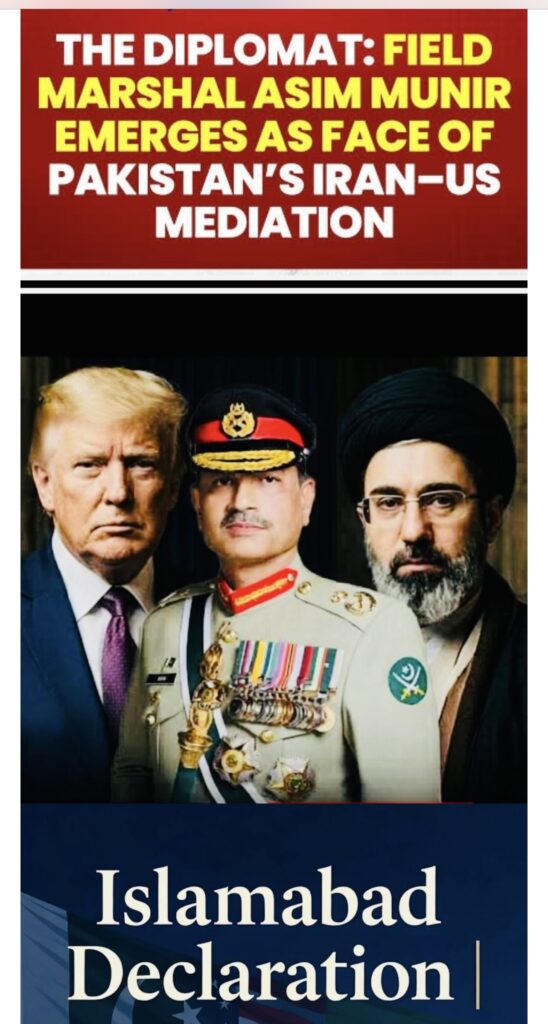
For decades relegated to the periphery of global diplomacy, Pakistan emerged this spring as the fulcrum on which a superpower confrontation pivoted. Under Field Marshal and Army Chief Syed Asim Munir, Islamabad’s long-cultivated switchboard role crystallised into decisive statecraft, converting tacit back-channels into a U.S.-Iran ceasefire deal “Islamabad Declaration” that stilled the Strait of Hormuz and steadied global energy markets. Pakistan’s recent pivotal role in brokering a ceasefire deal between the US and Iran effectively de-escalated the Strait of Hormuz crisis. Pakistan’s role as a mediator between the United States and Iran has helped improve its image around the world and brought it into the international spotlight. Pakistan played an important role in helping the United States and Iran hold talks aimed at ending their recent conflict. Pakistan’s emergence reflects its unique diplomatic positioning. Unlike several Gulf states, it does not host U.S. military bases, helping to preserve Tehran’s trust while maintaining working relations with Washington, Iran, Saudi Arabia, the UAE, Qatar, Türkiye and Egypt. Its geography – linking South Asia, the Middle East, China and the Arabian Sea – further strengthens its role as a regional connector. Islamabad maintains working channels with Washington, Tehran, Beijing and key Gulf capitals, enabling communication across multiple geopolitical divides. Pakistan’s diplomatic value is further strengthened by its close ties with China, which relies on the Middle East for more than half of its energy imports. The negotiations were held with Pakistan’s support and mediation, with a formal agreement signed in Switzerland. In the early hours of a June morning in 2026, the world exhaled. After more than 100 days of conflict that threatened to engulf the Middle East and choke global energy supplies, the United States and Iran reached a framework agreement — the 14-point Islamabad Memorandum of Understanding. Electronic signatures from President Donald Trump and his Iranian counterpart formalised the end of active hostilities, the lifting of the naval blockade, and the full reopening of the Strait of Hormuz. Prime Minister Shahbaz Sharif has also signed the document as the official mediator. For decades, Islamabad has quietly served as an essential communication conduit between the two estranged nations. This spring, under the Field Marshal and Army Chief Syed Asim Munir, Pakistan’s “switchboard” diplomacy facilitated critical high-level talks, leading to a framework agreement that saw global oil prices stabilise. This success has significantly elevated Pakistan’s international standing, shifting its perception from a regional destabiliser to a vital, trusted facilitator. Its singular geopolitical geometry – contiguous with Iran, tethered to Washington, yet unencumbered by foreign bases – proved uniquely alchemical. The immediate yield was not measured in trade flows but in intangible, compounding capital: credibility. Its unique strategic position, sharing a border with Iran while maintaining US ties without hosting American bases, proved crucial. While immediate economic benefits are modest, this reputational gain offers long-term strategic advantages, including potential investments and stronger US relations, though the deal’s fragility and slow economic normalisation present ongoing hurdles. Though economic normalisation will be glacial and the accord remains brittle, the reputational inflexion is irreversible. Pakistan did not merely avert a war; it audited the calculus of influence, recasting itself from presumed destabiliser to indispensable interlocutor in the architecture of 21st-century peace. Pakistan stands as the unheralded beneficiary of a détente it helped engineer. No state outside the Middle East stood more exposed to the conflict’s contagion: a porous, volatile border with Iran; the world’s second-largest Shia populace; acute dependence on Gulf energy; and millions of its citizens labouring across the Arab littoral. Yet from that very vulnerability, Islamabad extracted leverage. It helps to be precise about what Pakistan did and didn’t do, because the celebration runs ahead of the facts. Islamabad supplied the room, the trust and the timing. It did not write the terms that moved crude. The path to reopen Hormuz, lift the U.S. blockade, open a 60-day window on the nuclear file and release frozen Iranian funds in stages was agreed because Washington and Tehran had each run out of cheaper options, not because a mediator willed it. Pakistan is a facilitator, and a facilitator’s leverage ends the moment the principals stop needing the room. Whatever the signed text says about tolls or mine clearance, Islamabad will have no way to enforce a clause of it once the cameras leave Geneva. By transforming its anachronistic “interests section” for Tehran – a diplomatic relic of the Cold War – into a conduit for de-escalation, Pakistan converted geography into agency. The ceasefire it midwifed did more than still the Strait of Hormuz; it punctured India’s decades-long project to sequester Pakistan internationally, while burnishing Islamabad’s equity in a region central to its strategic imagination. The world’s lens refocused: a state long caricatured by militancy and insolvency now framed as an indispensable interlocutor. But acclaim abroad can curdle at home. Emboldened by external validation and inoculated from foreign censure, Pakistan’s civil-military establishment may yet transpose its diplomatic latitude into domestic impunity, deepening the very repression that hollows its legitimacy. For years, Pakistan merely kept Iran’s mail. This spring, it delivered peace – and, in doing so, posted its own claim to the architecture of a new order. Pakistan announced the framework that calmed the Strait of Hormuz, Pakistan had spent two months doing the unglamorous work of a switchboard: carrying messages when direct channels were dead, proposing a sequence that put oil and energy relief first, hosting the first high-level American-Iranian talks in decades, and shuttling through one near-collapse after another. Army Chief Field Marshal Asim Munir made the calls that mattered in the days before the April 8 deadline. When the deal held, Brent slipped below $83, and both President Donald Trump and Iranian officials went out of their way to thank Sharif and Munir by name. A country that much of the Western press had filed under “destabiliser” a year earlier was suddenly the address where the war got turned off. What made this possible was not the usual roster of great-power brokers. It was Pakistan — a nation with a long history of courage in global headlines for its internal security challenges — that stepped forward when prospects looked bleakest and delivered the most consequential peace framework in recent memory. The road was never straightforward. When the conflict erupted, Iran responded with barrages of missiles and drones that struck Gulf infrastructure, provoking fury among Pakistan’s closest Arab partners. Riyadh, Abu Dhabi, and others watched with alarm as their energy facilities and sovereignty came under direct threat. Islamabad faced an excruciating dilemma: condemn the strikes on its Arab brothers — which it did, forthrightly — while simultaneously refusing to abandon its neighbour Iran to unilateral escalation. Most capitals would have chosen sides or stayed silent. Pakistan chose the harder path of persistent engagement with everyone. The gamble was existential. Pakistan’s defence pact with Saudi Arabia, its Gulf economic lifelines, and its “all-weather” covenant with Beijing could have unravelled had the mediation been read as naïve or partisan. Yet Islamabad wagered on an asset no other state possessed: simultaneous intimacy with Tehran, contractual trust from Washington as a Major Non-NATO Ally, and unbroken credibility in Riyadh and Beijing. Geography was the key, but statesmanship turned it. The symmetry was stark. A year earlier, Donald Trump had interposed himself to arrest an Indo-Pakistani crisis laced with nuclear shadow; in 2026, Pakistan repaid that ledger on a planetary scale. Had the Strait of Hormuz – artery of one-fifth of the world’s oil – been severed, the cascade would have been civilizational: recession in Europe, famine in Asia, and a thermonuclear trilemma no doctrine could contain. Instead, Pakistan transformed a brittle April ceasefire into binding architecture. The triad that executed it was deliberate.
Field Marshal Syed Asim Munir became the human switchboard – his private channels to both Trump and Iranian commanders resuscitating talks at each point of collapse. This was a masterclass in balancing. Pakistan’s mediation of the U.S.-Iran accord is less a footnote than a fault line redrawn. For twenty years, the world’s default syntax for Islamabad was volatility – insurgency, insolvency, isolation. Pakistan maintained its principled positions: it condemned attacks on Iranian territory and leadership, just as it condemned Iranian strikes on Gulf civilian and energy infrastructure. It hosted the highest-level direct US-Iran engagement in decades in Islamabad. It worked quietly with Qatar, Türkiye, Egypt, and China while reassuring Saudi Arabia that its core interests would not be sacrificed. Few capitals possess either the access or the discipline to walk such a tightrope without falling. The dividends are already visible and will compound rapidly. With the Hormuz crisis resolved and sanctions dynamics shifting, the long-stalled Iran-Pakistan gas pipeline — Iran’s section already complete — can finally advance. Construction on the Pakistani side is expected to resume in earnest, delivering much-needed energy security, easing pressure on domestic gas shortages, and unlocking billions in bilateral trade potential. Broader economic confidence is returning: investors who fled the threat of regional war are reassessing Pakistan’s stability premium. Diplomatic capital earned in Washington, Beijing, Riyadh, and Tehran can now be deployed to accelerate other connectivity projects and attract fresh financing. Security concerns are central to Islamabad’s approach. Pakistan shares a nearly 900-kilometre border with Iran, and officials fear prolonged instability could increase cross-border violence, refugee flows and sectarian tensions. Economic factors are equally significant. Nearly 90% of Pakistan’s crude oil imports come from Gulf states, while almost all LNG supplies originate from Qatar. It’s estimated that heightened tensions could add around $600 million to Pakistan’s monthly oil import bill. More than half of the country’s roughly $30 billion in annual remittances also come from Gulf countries. Yet the true test lies ahead. The 60-day window to negotiate a final, comprehensive agreement will test implementation discipline on nuclear confidence-building, sanctions relief sequencing, and regional de-escalation. Pakistan’s interest lies in seeing this framework succeed, because sustained peace in its western neighbourhood directly serves its own security and economic revival. That grammar collapsed the instant Pakistan stopped being the headline’s object and became its author. Western editors who once reached for boilerplate on terrorism now reached for a new noun: interlocutor. The architecture of the feat was ironic: a U.S.-Pakistan relationship corroded by Afghanistan, drones, and suspicion became the very bridge across which suspicion itself was trafficked and neutralised. As security files, commercial channels, and the personal symmetry between Pakistan’s leadership and the Trump White House thawed, Islamabad minted an asset no rival could fabricate – credibility at both ends of a chasm everyone else called unbridgeable. It outflanked petrodollar capitals and European salons not with carriers or cash, but with context: a Cold War switchboard repurposed as a hotline, adjacency to Tehran, alliance with Washington, and the absence of American boots that kept it off Tehran’s targeting matrix. The immediate dividend isn’t aid or oil; it is authorship. For the first time in a generation, Pakistan is not defending its story to the world. The world is using Pakistan to explain peace. Yet narrative is not the same as solvency. Pundits parsing winners and losers fixate on Washington, Tehran, and Jerusalem. Pakistan is the consensus answer, the “unalloyed win.” But wins calcify without foundations. If Islamabad fails to collateralise this diplomatic liquidity – to convert raised profile into investment, reform, and economic velocity – the reputational spike will prove as ephemeral as a news cycle. Mediation made Pakistan legible. Governance will decide if it remains relevant. The dividend of the U.S.-Iran accord is not measured in barrels or basis points, but in the quiet repricing of Pakistan itself. Prime Minister Shehbaz Sharif and Field Marshal Syed Asim Munir did not buy leverage; they revealed it. Islamabad’s value was never capital or carrier groups, but adjacency without allegiance – a border with Iran, Major Non-NATO Ally status with Washington, no U.S. bases on its soil, and a 1971 muscle memory of smuggling Kissinger into Beijing. That cocktail of access without exposure made it the only switchboard both capitals could lift without losing face. The Strait of Hormuz was the tripwire; Pakistan became the circuit breaker. Western mastheads that once filed Pakistan under “fragile state” now filed it under “biggest winner,” not for tanks or GDP, but for proving it could reopen a closed channel when one-fifth of the world’s oil hung in the balance. Yet reputation is a derivative, not a deliverable. The fast political clock crowned Islamabad; the slow physical clock – 40 to 50 days to clear mines, insurance premiums still inflated, 85% energy import dependence – sets the terms of relief. Trump-era Washington rewards utility wrapped in deference, and Pakistan supplied both, unlocking the plausible-but-unsigned: critical minerals, digital finance rails, military-council investment lanes. The Gulf, whose security Pakistan already underwrites through its Saudi defence compact, watches with bifocal vision: gratitude for the pause, anxiety at a broker who answers Tehran’s call. Herein lies the new calculus. After this war, the Hormuz question isn’t “Will Iran shut it?” but “Who reopens it, and how fast?” Pakistan has entered that equation as a tracked variable on every risk desk, alongside tanker routes and war-risk spreads. The durability of that status rests on two brittle threads: whether the Munir-Trump rapport outlives a U.S. election, and whether the Tehran line survives the next border or sectarian spark. Stretch the timeline six to eighteen months, and three futures compete. The base case is a muddy hold – framework intact, Pakistan elevated yet transactional, imports normalising slowly. The upside demands Hormuz to clear faster than DW’s mine timeline, talks to yield tangible relief, and investment to attach itself to mediation rather than orbit it. The downside is equally likely: Israeli action in Lebanon, hardliner reassertion in Tehran, or a failed enforcement clause, and Pakistan’s reputational capital reverses at the speed it accrued, oil premiums bleeding reserves it cannot afford. Islamabad helped draft the intermission, not the ending. The pause is real. The hedging never stopped. The larger lesson is strategic. In an era of great-power competition and proxy conflicts, middle powers with credible access across rival camps can still shape outcomes. Pakistan demonstrated that a country facing serious internal challenges can nevertheless project disciplined diplomacy when its leadership aligns political will, military professionalism, and institutional memory. The same qualities that enabled this breakthrough — restraint, persistence, and the refusal to be boxed into zero-sum choices — can now be applied to Afghanistan stabilisation, regional energy corridors, and a more confident Pakistani role in global forums.
Under the leadership of Field Marshal Syed Asim Munir Pakistan’s next test is to collateralize credibility: to convert a moment of indispensability into institutions, investment, and an economic doctrine that outlives the news cycle. If it succeeds, the Islamabad Declaration will mark not just the end of a crisis, but the beginning of a doctrine – that adjacency without allegiance can be more strategic than hegemony. The world will recall it as a brilliant diplomatic efforts for a peace that politics could sustain.
History will record the Islamabad Declaration not merely as an end to one war, but as proof that principled, high-risk diplomacy by unexpected actors can still bend the arc of crisis toward peace. Pakistan took that risk when few others would. The world, and Pakistan itself, are already better for it. The “Islamabad Declaration” will not be remembered for ink on paper, but for geography turned into agency. Nevertheless, Islamabad’s role has elevated its standing as a power capable of bridging rival geopolitical blocs, even as the outcome of a final agreement remains uncertain. After the war, Pakistan has undoubtedly emerged as a major player in West Asia. One can argue that the country has seemingly gained from a Middle Eastern identity or role alongside its traditional South Asian one. While immediate security concerns vis-à-vis India and Afghanistan anchor Pakistan to its South Asian identity, its expanded footprint in West Asia has generated immense geopolitical dividends and enhanced its global standing and diplomatic clout. By transforming a Cold War relic – a diplomatic switchboard to Tehran – into a live circuit between adversaries, Pakistan did more than avert a closure of Hormuz; it redrafted its own sentence in the global ledger. For decades, Islamabad was the question. In 2026, it became the answer, proving that in an era of carriers and capital, the rarest superpower is still trust with two enemies at once. The ceasefire bought time for permanence and reputation, once repriced upward, trades with equal volatility. Under the leadership of Field Marshal Syed Asim Munir, Pakistan’s next test is to collateralise credibility: to convert a moment of indispensability into institutions, investment, and an economic doctrine that outlives the news cycle. If it succeeds, the Islamabad Declaration will mark not just the end of a crisis, but the beginning of a doctrine – that adjacency without allegiance can be more strategic than hegemony. The world will recall it as a brilliant diplomatic effort for a peace that politics could sustain ever.