The writer is an economist, anchor, geopolitical analyst
and the President of All Pakistan Private Schools’ Federation
president@Pakistanprivateschools.com
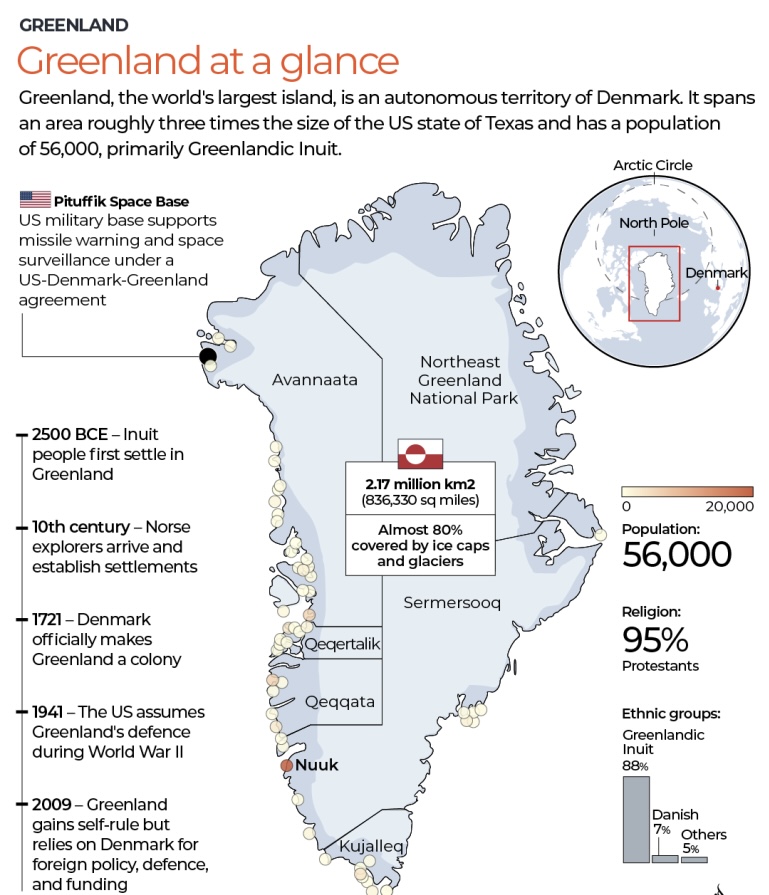
US President Donald Trump has asked senior military commanders to prepare contingency plans for a possible invasion of Greenland, as Trump has cited national security as his motivation for wanting to take Greenland. US President Donald Trump’s latest threat to seize Greenland, a semiautonomous territory of Denmark, has sent shockwaves through the international community, particularly among NATO allies. Trump’s rationale for acquiring Greenland is rooted in his claim that the US needs control of the island to guarantee American security, citing the threat from Russian and Chinese ships in the Arctic region. Greenland is one of the world’s most sparsely populated, geographically vast regions. But through a 1951 agreement with Denmark, the US military already has a significant presence on the island. The US military is stationed at the Pituffik Space Base, formerly known as Thule Air Base, in the northwestern corner of Greenland, and the 1951 pact allows Washington to set up additional “defence areas” on the island. The Thule base supports missile warning, missile defence, space surveillance missions, and satellite command and control. Nearly 650 personnel are stationed at the base, including US Air Force and Space Force members, with Canadian, Danish and Greenlandic civilian contractors. Under the 1951 deal, Danish laws and taxation don’t apply to American personnel on the base. Denmark also has a military presence in Greenland, headquartered in Nuuk, where its main tasks are surveillance and search and rescue operations, and the “assertion of sovereignty and military defense of Greenland and the Faroe Islands”, according to Danish Defence. But the US forces at Thule are comfortably stronger than the Danish military presence on the island. Many analysts believe that if the US were to use these troops to try to occupy Greenland, they could do so without much military resistance or bloodshed. Greenland is also home to mineral riches, including rare earths. According to a 2023 survey, 25 of 34 minerals deemed “critical raw materials” by the European Commission were found in Greenland. Scientists believe the island could also have significant oil and gas reserves. In the annals of geopolitical folly, few ideas have sparked as much ridicule and alarm as Donald Trump’s 2019 proposal to purchase Greenland from Denmark. Dismissed at the time as a real estate magnate’s whimsy, the notion resurfaced in speculative circles during his second term, culminating in a hypothetical 2026 scenario where the U.S. under Trump actually annexes the world’s largest island. But what if this isn’t just a punchline? What if “Trump Takes Greenland” becomes the catalyst for America’s most catastrophic military unraveling—a chain reaction that fractures NATO, forges unthinkable alliances, and turns the Atlantic alliance against its founding member? In the vacuum of U.S. credibility, a radical realignment could emerge: a new European security bloc incorporating Russia. Greenland’s strategic location between North America and the Arctic makes it a crucial site for the US ballistic missile defense system. The island is also home to the Pituffik Space Base, a US military base that plays a key role in missile warning systems and Arctic surveillance. Greenland is rich in natural resources, including rare earth minerals, uranium, and iron, which are becoming increasingly accessible as the ice melts due to climate change. The US has expressed interest in exploiting these resources, which could reduce its reliance on China. This exploration delves into the strategic, legal, and existential perils of such a move, arguing that it could indeed prove suicidal for NATO, birthing a new security bloc with Russia, the seizure of U.S. nuclear assets in Europe, and even a combined NATO assault on American soil. While speculative, this nightmare scenario underscores the fragility of post-World War II alliances in an era of populist brinkmanship. Greenland’s appeal to a Trumpian worldview is undeniable. Spanning over 800,000 square miles of ice-capped terrain, it holds vast untapped mineral resources—rare earth elements, zinc, and potentially oil—that could fuel U.S. economic dominance amid escalating tensions with China. Militarily, its position in the Arctic Circle offers unparalleled vantage for monitoring Russian submarine movements and controlling emerging shipping routes as climate change melts polar ice. The U.S. already maintains Thule Air Base there under a 1951 defense agreement with Denmark, a NATO ally. In Trump’s calculus, outright ownership would eliminate bureaucratic hurdles, allowing rapid militarization: expanded radar installations, hypersonic missile silos, and perhaps even a new naval hub to counter Moscow’s Northern Fleet. Yet, this “deal of the century” ignores the island’s autonomous status under Danish sovereignty and the indigenous Inuit population’s fierce opposition to foreign exploitation. A forced annexation—perhaps through economic coercion, diplomatic bullying, or a contrived “referendum”—would violate international law, echoing Russia’s 2014 Crimea grab. Denmark, a founding NATO member, would invoke Article 5, framing the U.S. action as an attack on its territory. The irony is poetic: the alliance designed to deter Soviet aggression could now be weaponized against Washington. Critically, this move would expose the hypocrisy at NATO’s core. The U.S. has long positioned itself as the guarantor of European security, but Trump’s isolationist “America First” ethos—amplified in a second term—has already strained transatlantic ties through tariff wars and troop withdrawal threats. Annexing Greenland would shatter any remaining trust, portraying the U.S. as an imperial bully rather than a reliable partner. European leaders, from Berlin to Paris, would decry it as a betrayal, accelerating calls for strategic autonomy. As French President Emmanuel Macron once warned, NATO risks becoming “brain dead” without mutual respect; Trump’s Greenland gambit could deliver the fatal blow. This isn’t as far-fetched as it sounds. Post-Ukraine war fatigue, coupled with economic dependencies on Russian energy (despite sanctions), has quietly thawed some EU-Moscow relations by 2026. If the U.S. alienates NATO by seizing Greenland, European nations might pivot toward a “Eurasian Security Pact” to hedge against American unpredictability. Imagine Germany, France, and the UK—NATO’s European pillars—brokering a détente with Putin or his successor. Russia, eager to fracture Western unity, could offer concessions: reduced Arctic militarization, gas pipeline guarantees, or even joint cyber defense initiatives. This new bloc would prioritize continental stability over transatlantic loyalty, effectively sidelining the U.S. Turkey, already a NATO wildcard with its S-400 purchases from Russia, might defect entirely, bolstering the pact’s southern flank. Analytically, this shift exploits NATO’s structural weaknesses. The alliance’s consensus-based decision-making has long been a liability; a U.S.-induced crisis could prompt a “NATO-minus-America” reformation. Russia’s inclusion would provide the military muscle Europe lacks—nuclear deterrence, vast ground forces, and Arctic expertise—while diluting Moscow’s revanchist impulses through integration. For the U.S., this is a nightmare: isolated in the Western Hemisphere, facing a fortified Eurasia from Lisbon to Vladivostok. Trump’s Greenland victory would thus prove Pyrrhic, trading polar real estate for global irrelevance. Central to this unraveling is the fate of America’s nuclear arsenal in Europe. Under NATO’s nuclear-sharing program, the U.S. stations approximately 100 B61 gravity bombs across five countries: Belgium, Germany, Italy, the Netherlands, and Turkey. These weapons, controlled by U.S. codes but deliverable by host nation aircraft, symbolize collective deterrence. But in a Greenland crisis, they become liabilities. If the US were to forcibly take control of Greenland, it would plunge NATO into a crisis, possibly an existential one. NATO’s Article 5 mutual defense commitment would be tested, and European allies might question the US’s reliability as a partner. European hosts, fearing U.S. instability under Trump, could seize these assets to prevent escalation. Legally, this would invoke NATO’s Article 4 consultations, but practically, it might involve unilateral action: special forces raids on bases like Incirlik in Turkey or Büchel in Germany. Germany, with its pacifist leanings and growing anti-U.S. sentiment, might lead the charge, nationalizing the nukes as “preemptive disarmament.” Italy and the Netherlands, economically intertwined with the EU, would likely follow suit to avoid sanctions or isolation. Critically, this seizure isn’t mere theft—it’s a strategic decapitation. Without European forward bases, U.S. nuclear posture weakens, emboldening adversaries like China in the Pacific. Trump, ever the escalator, might respond with threats, but domestic division—polarized Congress, public war-weariness—could paralyze retaliation. The result? A denuclearized NATO theater, forcing Europe to either develop its own arsenal (a la France’s force de frappe) or align with Russia’s umbrella in the new bloc. For America, losing these nukes is tantamount to strategic castration, exposing the homeland to unchecked threats.
The scenario’s apex horror: a fractured NATO, now reconfigured with Russian elements, launches a combined assault on U.S. interests—or even the mainland. This isn’t hyperbole; it’s the logical endpoint of mutual distrust. A US attempt to seize Greenland by force would likely mark the end of NATO, as it would undermine the alliance’s foundational principles of sovereignty, collective security, and the rules-based international order. Greenland’s strategic location in the Arctic makes it crucial for US national security, with its proximity to Russia and China, and its rich mineral deposits, including rare earth minerals. Greenland’s strategic location in the Arctic makes it a prized asset for military and economic interests. The island is rich in rare earth minerals, uranium, and iron, and its proximity to North America and Europe makes it a crucial location for early warning systems and missile defense. China and Russia have also shown interest in the Arctic region, with China conducting research and joint military exercises with Russia. The US sees Greenland as a crucial location to counterbalance their influence. Denmark’s Prime Minister Mette Frederiksen has warned that an American takeover of Greenland would mark the end of NATO, while Greenlanders themselves have expressed a desire for independence, not US control. The US already has a significant military presence in Greenland under a 1951 agreement, but Trump’s push for ownership has sparked concerns about US unilateralism and disregard for international law. Denmark’s Prime Minister Frederiksen has warned that if the US attacks a NATO country, “everything stops”. Other NATO members, like Poland, are also concerned about the implications of Trump’s actions on the alliance’s unity. However, Denmark has rejected the idea of selling Greenland, and European leaders have rallied behind Denmark, emphasizing that Greenland belongs to its people. Denmark and other European countries have warned that such a move would have serious consequences for the military alliance. NATO’s top commander, US General Alexus Grynkewich, has downplayed the crisis, stating that the alliance is “far from being in a crisis” over Trump’s threats. However, European leaders, including France, Germany, and Poland, have expressed concerns and rallied behind Denmark, saying Greenland belongs to its people. The situation is likely to escalate, with the US Secretary of State, Marco Rubio, meeting with Danish officials next week to discuss the situation. The European Union has also expressed support for Denmark and Greenland, warning against any violation of international law. Trump’s threat to seize Greenland, an autonomous territory of Denmark, has sparked concerns about the future of NATO. European leaders, including Denmark’s Prime Minister Mette Frederiksen, have warned that such a move would be a “threat to NATO’s future” and could lead to the alliance’s collapse. With Greenland annexed, U.S. forces there become targets for Danish-led sabotage, escalating to broader conflict. European-Russo forces could strike asymmetrically: cyber attacks crippling U.S. grids, submarine incursions in the Atlantic, or air sorties from Norwegian bases targeting Thule. If Trump retaliates—say, by blockading Baltic ports— the new bloc invokes collective defense, mobilizing millions. Russia provides the heavy lift: hypersonic missiles raining on East Coast cities, while European navies (UK’s carriers, France’s submarines) enforce no-fly zones over Greenland. Analytically, this war is suicidal for all involved. NATO’s original purpose—containing Russia—implodes, birthing a transcontinental behemoth that dwarfs U.S. power. America’s military superiority, reliant on alliances, evaporates; isolated, it faces attrition warfare. Casualties mount in the millions, economies collapse, and nuclear thresholds lower perilously. Trump’s “win” in Greenland triggers a self-fulfilling prophecy: by acting unilaterally, the U.S. invites the very invasion it built NATO to prevent. This hypothetical catastrophe isn’t inevitable, but it’s a stark warning. Trump’s Greenland fixation highlights how personal ambition can undermine institutional safeguards. For NATO to survive, it must evolve—perhaps through weighted voting or European funding mandates—to withstand rogue actors. Critically, the U.S. must recommit to multilateralism, recognizing that empires fall not from external foes, but internal hubris. A US move to seize Greenland could lead to a re-evaluation of NATO’s role and potentially create a new security bloc in Europe. Poland, for instance, is worried about the strain on NATO and has urged honest dialogue with the US. Trump’s move has raised concerns about Russia’s growing presence in the Arctic, with Moscow already increasing its military activity in the region. However, Denmark disputes Russia’s presence near Greenland, and experts say the US already has significant military presence in the area. The implications of a US takeover are significant for: NATO’s Credibility; Global Economy; European Security. A US attack on Greenland would undermine NATO’s Article 5 guarantee, damaging the alliance’s credibility. A NATO collapse could lead to a recession, increasing demand for gold as a safe haven. A US takeover would shift the balance of power in the Arctic, potentially emboldening Russia and China. European countries are not helpless, though. They could refuse refueling by denying the US ships refueling in European ports. Limit military cooperation by restricting the US military access to European bases. Support Denmark by Issuing statements backing Denmark and Greenland’s sovereignty.
The implications are far-reaching, with potential consequences for NATO’s very existence and the global security landscape. If the US were to take control of Greenland, it could lead to a fundamental shift in global alliances. Russia and China might respond by strengthening their ties with European nations, potentially creating a new security bloc that excludes the US. This would undermine NATO’s purpose and leave Europe vulnerable to Russian aggression. Diplomacy is key to resolving this crisis.
A US takeover of Greenland would have significant security implications for NATO countries. Russia might respond to US actions in Greenland with increased military activity in the Arctic, heightening tensions. European allies might question US commitment to collective defense, leading to a weakening of the alliance. Russia might seek to strengthen ties with other nations, potentially creating a new security bloc. The situation remains fluid, with officials from Denmark, Greenland, and the US meeting to discuss the US’s renewed push to acquire Greenland. The outcome is far from certain, but one thing is clear: the fate of Greenland has significant implications for global security and the future of NATO. Greenland’s strategic location and natural resources make it a coveted prize. Acquiring Greenland would come with significant costs, including providing welfare services to its 57,000 inhabitants. Trump’s administration has already explored options like lump-sum payments to Greenlanders, but locals have rejected the idea. The US, Russia, and China are all vying for influence in the Arctic, and Trump’s move could be seen as a bid to secure US dominance. However, this approach risks escalating tensions and destabilizing the region. Donald Trump’s latest assertion that the US must “own” Greenland to prevent Russia or China from doing so has sent shockwaves through the international community. The implications are far-reaching, with potential consequences for NATO’s very existence and the global security landscape. If the US were to take control of Greenland, it could lead to a fundamental shift in global alliances. Russia and China might respond by strengthening their ties with European nations, potentially creating a new security bloc that excludes the US. This would undermine NATO’s purpose and leave Europe vulnerable to Russian aggression. Diplomacy is key to resolving this crisis. European leaders are urging restraint, and Denmark is open to updating the defense agreement. The US should prioritize cooperation over confrontation, recognizing that its interests are best served through collective security and respect for international law. In the end, “If Trump Takes Greenland” isn’t just America’s nightmare; it’s a global suicide pact. It forces us to confront: In a world of shifting poles, is any alliance truly unbreakable? The answer, chillingly, may be no.