The writer is an economist, anchor, geopolitical analyst and the President of All Pakistan Private Schools’ Federation
president@Pakistanprivateschools.com
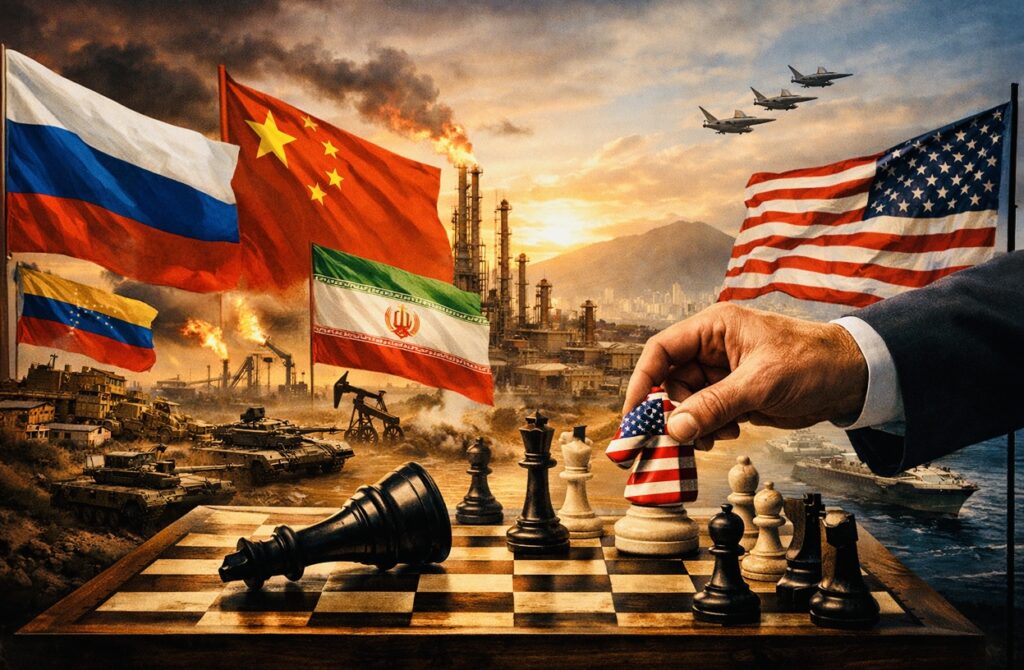
The US’s recent military operation in Venezuela, resulting in the capture of President Nicolas Maduro, has sent shockwaves across the globe. This audacious intervention has sparked global outrage, revived debates over U.S. imperialism, and signaled a potential resurgence of the Monroe Doctrine in a multipolar world. The move comes amid escalating U.S. pressure on Venezuela, including months of naval deployments in the Caribbean, seizures of oil tankers bound for Asia, and drone strikes on alleged drug-trafficking vessels. Venezuela’s strategic location and oil wealth make it a prized asset for global powers. China, Venezuela’s largest creditor and buyer of crude, stands to lose substantial economic influence, with approximately $62 billion invested in the country since 2007. Russia, which had deep military and energy ties with Maduro, views his removal as a strategic blow, potentially weakening its position in Latin America. Iran, meanwhile, risks losing a key partner and a vital hub for its regional operations. The US intervention has created a power vacuum, and the future of Venezuela’s oil and tear-earth minerals industry hangs in the balance. As the US seeks to redirect Venezuelan oil to American companies, China may need to seek alternative energy sources, potentially accelerating its de-dollarization efforts. Russia and Iran are likely to deepen their security cooperation, while China denounces the US action as a “hegemonic act” and violation of international law. Meanwhile, China and Russia have urged the US to release Maduro and called for dialogue. Delcy Rodríguez, Venezuela’s Vice President, has been accused of betraying Nicolás Maduro, with some claiming she handed him over to the Americans. Colombia’s former Vice President Francisco Santos has stated he’s “absolutely certain” Rodríguez was involved in Maduro’s capture, suggesting she may have collaborated with the US to secure her position as interim president. Rodríguez has denied these allegations, calling Maduro’s capture a “kidnapping” and demanding his release. She’s been sworn in as interim president, with her brother Jorge Rodríguez, the head of parliament, overseeing the ceremony. It’s worth noting that Delcy Rodríguez has been a key figure in Maduro’s government, serving as Vice President and Oil Minister. Her brother Jorge is also a prominent figure, heading the National Assembly. The situation is complex, with multiple stakeholders involved. This move is seen as a revival of the Monroe Doctrine, a 19th-century policy asserting US dominance in the Western Hemisphere. Venezuela’s strategic location, bordering the Caribbean Sea and the Atlantic Ocean, makes it a crucial player in regional energy security. The country holds the world’s largest proven oil reserves, approximately 303 billion barrels, making it an attractive target for US interests. China has significant investments in Venezuela, with over $62 billion in loans and investments since 2007, primarily in the energy sector. Venezuela is China’s largest oil supplier in Latin America, accounting for around 80% of its oil exports. The US operation may disrupt China’s energy security and investments in the region. The US action has raised concerns among Latin American countries, with leaders from Brazil, Mexico, Cuba, Honduras, and Chile condemning the move as a violation of sovereignty. This incident may lead to increased regional unity and self-reliance to counter US hegemony. The situation remains volatile, with potential escalation scenarios including: Increased US-China tensions, China’s investments and influence in Latin America may be threatened, leading to a stronger response from Beijing; Regional instability as other Latin American countries may experience similar US interventions or increased Chinese and Russian involvement. In response to US actions, Latin American countries may strengthen regional organizations, such as the Community of Latin American and Caribbean States (CELAC), to promote cooperation and counterbalance US influence. China’s investments in Latin America have grown significantly, with trade volume reaching $518.4 billion in 2024. Russia has also increased its presence in the region, particularly in energy and military cooperation. The US’s move in Venezuela marks a significant shift in regional dynamics, with potential far-reaching implications for global politics and energy security. The Monroe Doctrine, introduced by US President James Monroe in 1823, asserts US dominance in the Western Hemisphere, opposing European colonization and interference. This policy has been interpreted and applied variably, with some seeing it as a justification for US interventionism in Latin America. The doctrine has been used to justify US interventions in countries like Cuba, Nicaragua, and Venezuela. Latin American countries have mixed views, with some seeing it as a threat to sovereignty and others as a security guarantee. China’s investments and influence in Latin America challenge US dominance, potentially leading to increased competition. The Monroe Doctrine’s historical context and modern-day implications are complex and multifaceted. In 1823, US President James Monroe introduced the doctrine, stating that the US would not tolerate further European colonization in the Americas. In 19th-20th centuries, the doctrine was used to justify US interventions in Latin America, such as the Mexican-American War and the Cuban War of Independence. In Cold War era, the doctrine was invoked to counter Soviet influence in the region, with interventions in countries like Guatemala and Chile. In US-Latin America relations, the doctrine remains a sensitive topic, with some seeing it as a relic of US imperialism. China’s investments and presence in Latin America challenge US dominance, potentially leading to increased competition. Latin American countries are strengthening regional organizations, such as CELAC, to promote cooperation and counterbalance US influence. The US’s recent actions in Venezuela may indicate a renewed emphasis on the Monroe Doctrine, with potential implications for regional stability and global politics. The US has intervened in Latin America numerous times, citing the Monroe Doctrine. Examples include: Cuba (1898), when US support for Cuban independence from Spain; Mexico (1914), US occupation of Veracruz; Guatemala (1954), CIA-backed coup against President Jacobo Arbenz; Chile (1973), US-backed coup against President Salvador Allende; Nicaragua (1980s), support for anti-Sandinista rebels. These interventions have shaped US-Latin America relations, with many viewing the US as a meddling power. China’s investments and trade in Latin America have surged: Trade volume (2024) with $518.4 billion; Investments, over $500 billion in energy, infrastructure, and mining. China key partners are Brazil, Argentina, Chile, and Venezuela. China’s presence challenges US dominance, with potential implications for regional politics and energy security. Venezuela’s significance lies in: Oil reserves*: World’s largest proven reserves (303 billion barrels); Location with bordering the Caribbean Sea and Atlantic Ocean; Energy security, as key supplier to the US and China
The US operation in Venezuela may be linked to securing energy interests and countering China’s influence. Latin American countries are strengthening regional organizations: CELAC which promotes cooperation, integration, and self-reliance; UNASUR a regional integration and development. These efforts aim to reduce dependence on the US and promote regional stability. The US’s actions in Venezuela may escalate US-China tensions; Competition for influence in Latin America; Strengthen Russia-China ties, countering US influence globally. Impact global governance which potential shift in international norms and institutions. These factors will shape the future of US-Latin America relations and global politics. Whereas, Russia’s influence in Venezuela has been significant, with the country being one of Russia’s key allies in Latin America. Venezuela and Russia have collaborated on energy projects, with Russia’s state-owned energy giant, Rosneft, operating in Venezuela’s oil production. However, Russia’s influence in Venezuela has been impacted by the US operation that removed President Nicolás Maduro. Venezuela is a crucial partner for Russia in Latin America, with cooperation in energy, military, and technology sectors. The US operation has dealt a blow to Russia’s influence in the region, with Russia losing an ally and facing potential challenges to its interests. The US action has sparked concerns about a shift in global power dynamics, with Russia and China potentially re-evaluating their strategies in response to US assertiveness. Russia’s influence in Venezuela has taken a hit after the US operation that removed President Nicolas Maduro. Moscow had backed Maduro, seeing Venezuela as a strategic ally in Latin America, and had collaborated on energy projects and military cooperation. However, Russia’s response has been muted, likely due to its preoccupation with the war in Ukraine and limited capabilities to project power. Russia has lost a significant ally in Latin America, potentially weakening its influence in the region. The US operation may increase its “oil clout” and reinforce its dominance in the Western Hemisphere, reviving the Monroe Doctrine. The situation highlights Russia’s limited ability to project power and protect its allies, potentially emboldening the US to take similar actions.
As Trump sets his sights on Greenland, the world wonders – who’s the maestro behind this pivot? Is the Monroe Doctrine still a guiding principle, or a relic of a bygone era? The Venezuela move might just be the opening gambit in a new era of great power competition, with China, Russia and Iran recalibrating their alliances in response. The question is: who’s calling the shots? Latin America, long a U.S. backyard, may finally forge its own path—or face further division in the shadow of great-power rivalry.
The removal of Venezuelan President Nicolás Maduro has sent shockwaves through the global geopolitical landscape, particularly for China, Russia, and Iran. These nations had significant investments and strategic interests in Venezuela, which is home to the world’s largest proven oil reserves. There’re possibilities of further escalation, the situation is fluid, with possibilities of further escalation, including: Expanded Chinese military cooperation with Venezuela or increased US enforcement of existing sanctions; Deepened Russia-Iran security ties and potential military support for Venezuela; Cuba’s vulnerability to US pressure, given its dependence on Venezuelan oil. The US intervention may accelerate the formation of a counter-block, with China, Russia, and Iran strengthening their alliances and cooperation in the region. The BRICS forum, which includes these nations, may play a more significant role in shaping global economic norms and challenging US dominance. As China invested $62 billion in Venezuela since 2007; 80% of Venezuela’s oil exports go to China; Russia with deep military and energy ties with Maduro; potential loss of strategic influence in Latin America. Whereas, for Iran as a key partner in sanctions-evasion schemes; vital hub for regional operations. China, Venezuela’s largest creditor and buyer of crude, stands to lose substantial economic influence, with approximately $12 billion in outstanding debts and 80% of Venezuela’s oil exports going to China. Russia, which had deep military and energy ties with Maduro, views his removal as a strategic blow, potentially weakening its position in Latin America. Iran, meanwhile, risks losing a key partner in its sanctions-evasion schemes and a vital hub for its regional operations. Venezuela’s location in northern South America makes it a geopolitical linchpin. Bordered by Colombia to the west, Brazil to the south, Guyana to the east, and the Caribbean Sea to the north, it sits astride key maritime routes, including the Panama Canal approaches and the Gulf of Mexico shipping lanes. Its coastline stretches over 2,800 kilometers, providing access to deepwater ports ideal for oil exports and military basing. The Orinoco Belt, home to the bulk of its heavy crude reserves, spans 55,000 square kilometers and could produce up to 3 million barrels per day if fully operational—far exceeding current output of around 800,000 barrels amid sanctions and mismanagement. With Venezuela’s vast oil reserves—estimated at 303 billion barrels and rear-earth minerals , the world’s largest—now potentially under U.S. influence, the operation raises profound questions about geography, economics, security, and the risk of broader conflict. It also disrupts significant Chinese and Russian investments in Latin America, where Beijing and Moscow have deepened ties over the past two decades while the U.S. was preoccupied with conflicts in the Middle East and Afghanistan. This geography amplifies U.S. concerns under the Monroe Doctrine, proclaimed in 1823 by President James Monroe, which declared the Western Hemisphere—encompassing North and South America, roughly 42 million square kilometers—as off-limits to European (and now, implicitly, Asian or Russian) colonization or interference. Trump’s “Corollary” to the doctrine, outlined in the 2025 U.S. National Security Strategy, explicitly prioritizes hemispheric dominance, viewing Venezuela’s alliances with China, Russia, and Iran as direct threats. The operation’s proximity to U.S. territories like Puerto Rico (just 500 kilometers away) underscores how Venezuela could serve as a launchpad for adversarial influence, from missile deployments to intelligence operations. Economically, the U.S. intervention targets Venezuela’s role as a resource hub. The country exports over 90% of its oil to China, repaying an estimated $60 billion in loans extended by Beijing since 2007. This arrangement has allowed China to secure discounted heavy crude, vital for its refineries, while bypassing U.S. sanctions. Russia’s Rosneft has similarly invested around $10 billion in Venezuelan oil fields through prepayment deals, gaining stakes in assets like Citgo as collateral. Trump’s pledge to deploy U.S. firms—such as ExxonMobil or Chevron—to invest “billions” in infrastructure could boost production to pre-sanctions levels, potentially adding 2 million barrels daily to global supplies and lowering prices by 10-15%, according to energy analysts. This would enhance U.S. energy security, reduce dependence on Middle Eastern oil, and undercut OPEC’s influence. However, it risks inflating Venezuela’s already staggering debt—over $150 billion—and exacerbating inequality, as revenues might prioritize foreign investors over social programs. Broader Latin American investments by China and Russia are also at stake. China’s direct investment in the region reached $14.7 billion in 2024, with a cumulative $286 billion since 2000, focusing on Belt and Road Initiative (BRI) projects like Peru’s $3.5 billion Chancay Port and Argentina’s $980 million lithium plant. Trade with Latin America hit $500 billion in 2025, up 8% year-over-year, with Brazil alone securing $4.8 billion in deals. Russia’s footprint, though smaller at $100 million in FDI, generates $14 billion in petroleum revenues since 2022 and includes a $450 million lithium project in Bolivia. The U.S. move could deter such engagements, forcing a rerouting of supply chains and increasing costs for Beijing and Moscow by 20-30% in energy imports. For Latin America’s 33 nations, home to 670 million people, the intervention evokes memories of U.S.-backed coups in Guatemala (1954), Chile (1973), and Panama (1989). Neighbors like Colombia and Brazil have condemned the strikes, fearing refugee surges—Venezuela’s crisis has already displaced 7.7 million people—and regional instability. Colombia, hosting 2.5 million Venezuelan migrants, has braced for up to 500,000 more in 2026, straining its $3.5 billion annual aid budget. The operation heightens fears of a “domino effect,” with Trump warning that Cuba’s regime is “ready to fall” and eyeing Greenland for strategic basing. This could erode trust in multilateral bodies like the Organization of American States (OAS), where U.S. dominance is already contested. Smaller nations, reliant on Chinese infrastructure loans (e.g., Ecuador’s $5 billion dams), may face pressure to realign, risking economic retaliation from Beijing. Escalation risks are high. China, labeling the U.S. a “world judge,” has warned of “dangerous shoals” in bilateral ties, while Russia vows to protect its interests. Iran, a Maduro ally, could retaliate via proxies in the Middle East, potentially spiking oil prices to $100 per barrel. A broader conflict might involve cyberattacks on U.S. infrastructure or naval confrontations in the Caribbean, where 10,000 U.S. troops and assets like B-52 bombers remain deployed. Domestically, Venezuela’s 8.2 million-strong militia and acting President Delcy Rodríguez’s defiant stance could spark guerrilla resistance, drawing parallels to Afghanistan’s quagmire.
Globally, this tests the UN Charter’s non-intervention principle, with the Security Council convening amid calls for restraint. In response, Latin American states may accelerate efforts toward a unified security architecture. The Community of Latin American and Caribbean States (CELAC) could evolve into a defense pact, inspired by the EU’s model, to counter U.S. unilateralism. Brazil’s push for a $9.2 billion regional credit line from China in 2025 hints at economic alliances morphing into security ones, potentially including observer status for Russia and Iran. However, divisions—Argentina supports the U.S., while Cuba and Nicaragua back Maduro—complicate unity. Did America follow China, Russia, and Iran into Venezuela’s oil? No—the U.S. was historically dominant but shifted focus post-9/11, allowing rivals to fill the void. Over 20 years, China loaned $60 billion for oil, Russia invested $10 billion, and Iran supplied refined products amid sanctions. So, on the other side, who “taught” Trump about Greenland? His 2019 proposal to buy it stemmed from strategic concerns over Arctic resources and Chinese influence, advised by aides like John Bolton. The Monroe Doctrine claims the Western Hemisphere as U.S. territory, spanning 42 million square kilometers from the Arctic to Tierra del Fuego. Trump’s Corollary modernizes it for “America First” priorities like migration and energy. Maduro’s removal strains Iran-China ties by disrupting oil flows and exposing vulnerabilities in their anti-U.S. alliances. China may seek alternatives in Africa, increasing dependence on Russia, while Iran loses a Latin American foothold. Critically, this intervention smacks of neo-imperialism, prioritizing U.S. corporations over Venezuelan sovereignty and ignoring human rights abuses in allied states like Saudi Arabia. Yet, Maduro’s regime—marked by repression, with 300 political prisoners and a 2024 election rejected internationally—arguably invited external pressure. The operation’s legality is dubious, lacking UN or congressional approval, and risks entangling the U.S. in another endless occupation. As of January 7, 2026, Venezuela remains under a state of emergency, with U.S. forces poised offshore. Whether this heralds a “new era” of Monroe Doctrine enforcement or sparks a backlash accelerating multipolarity depends on diplomatic maneuvering. As the curtains close on two decades of global maneuvering, a haunting question lingers: who’s scripting America’s next act? While the US was entangled in the Middle East and Afghanistan, China and Russia quietly expanded their influence in Latin America, testing the boundaries of the Monroe Doctrine – a 19th-century policy declaring the Western Hemisphere off-limits to European powers, but implicitly claiming it as a US sphere of influence. The recent removal of Venezuela’s president raises stakes: will it reinstate US dominance, or create a power vacuum for China, Russia and Iran? The chessboard is clear: the Western Hemisphere spans ~42 million sq miles, encompassing North, Central, and South America, and the Caribbean. As Trump sets his sights on Greenland, the world wonders – who’s the maestro behind this pivot? Is the Monroe Doctrine still a guiding principle, or a relic of a bygone era? The US intervention has created a power vacuum, and the future of Venezuela’s oil industry and rear-earth minerals hang in the balance. As the US seeks to redirect Venezuelan oil and rear-earth minerals to American companies, China may need to seek alternative energy sources, potentially accelerating its de-dollarization efforts. Russia and Iran are likely to deepen their security cooperation, while China denounces the US action as a “hegemonic act” and violation of international law. This development raises questions about the implications for global governance, sovereignty, and the balance of power. Will this event embolden other nations to challenge US influence, or will it reinforce the importance of international cooperation and respect for sovereignty? The Venezuela move might just be the opening gambit in a new era of great power competition, with China, Russia and Iran recalibrating their alliances in response. The question is: who’s calling the shots? Latin America, long a U.S. backyard, may finally forge its own path—or face further division in the shadow of great-power rivalry.