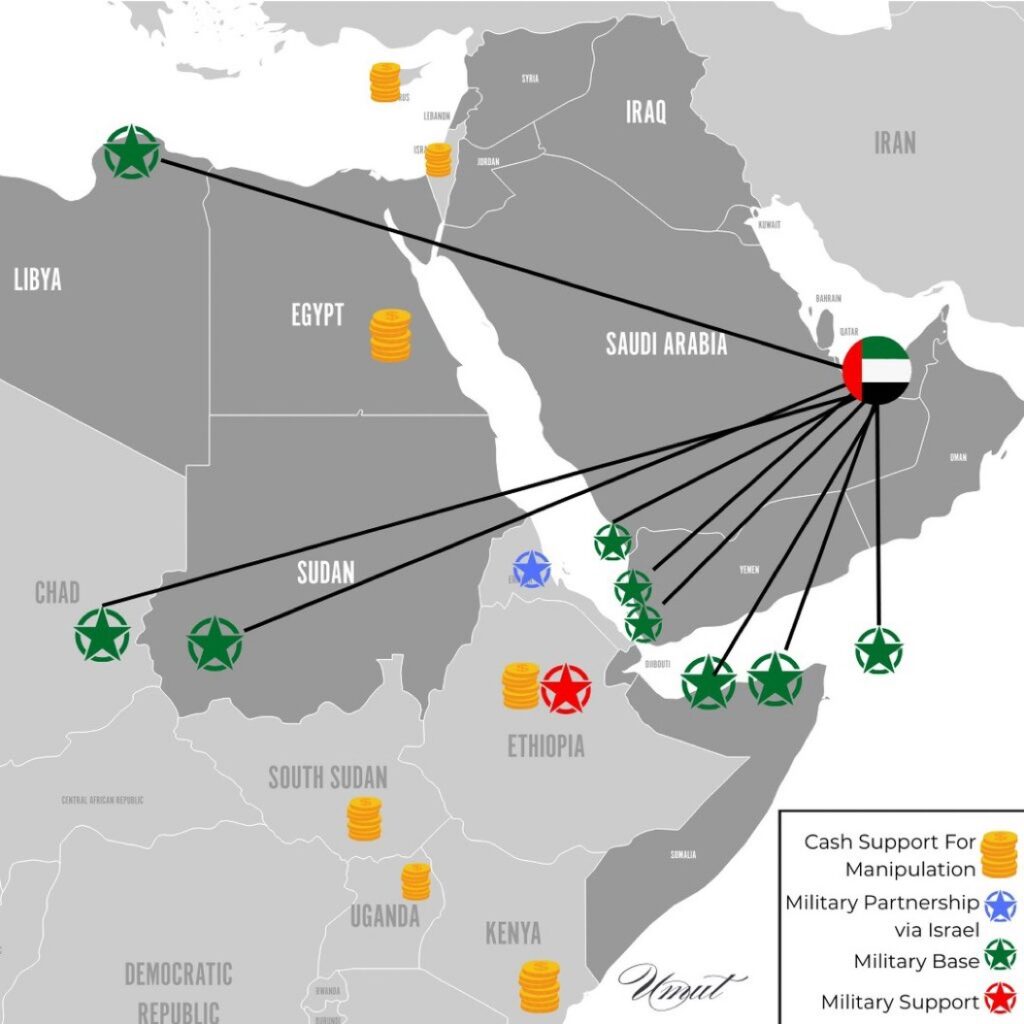

The writer is an economist, anchor, geopolitical analyst and the President of All Pakistan Private Schools’ Federationpresident@Pakistanprivateschools.com
Saudi Arabia’s airstrike on a UAE-linked weapons shipment in Yemen’s Mukalla port has sparked a major escalation between the two Gulf powers. The attack, which targeted ships carrying arms and combat vehicles for the UAE-Isreal backed Southern Transitional Council (STC), marks a significant shift in the once-strong alliance between Riyadh and Abu Dhabi. The UAE-Israel partnership has been a key factor in the Yemen conflict, with the UAE providing military support to the STC, while Israel offers advanced technology and intelligence. However, this alliance has also raised concerns about regional stability and the potential for further conflict. Their interests have diverged on key issues like oil production quotas and regional influence, with the UAE supporting separatist forces in Yemen and Saudi Arabia backing the internationally recognized government. The airstrike has led to a state of emergency in Yemen, with anti-Houthi forces declaring a 72-hour ban on border crossings and entries to airports and seaports. The UAE has announced its withdrawal of remaining forces from Yemen, citing recent developments and their potential repercussions on safety and effectiveness of counter-terrorism operations. This crisis highlights the growing rivalry between Saudi Arabia and the UAE, with implications for regional security and oil markets. The Saudi-UAE alliance, forged in response to the Arab Spring, has been marked by shifting dynamics and diverging interests. Initially united against Islamist movements, they jointly quashed Bahrain’s 2011 uprising and backed Egypt’s 2013 military coup. Their 2015 intervention in Yemen saw UAE troops lead ground operations, while Saudi air power dominated the skies. However, the 2017 Qatar boycott exposed underlying tensions, as the UAE pursued a more assertive foreign policy. By 2019, the UAE had scaled back its Yemen involvement, leveraging its influence through the STC, leaving Saudi Arabia to bear the brunt of the anti-Houthi campaign. This shift reflects the evolving priorities of Sheikh Mohammed bin Zayed (MBZ) and Crown Prince Mohammed bin Salman (MBS), who have prioritized regional ambitions over traditional alliances. The UAE’s 2020 normalization with Israel under the Abraham Accords marked a seismic shift in regional dynamics, leaving Saudi Arabia to maintain its traditional stance on Palestinian statehood. This move gave Abu Dhabi a direct diplomatic channel to Washington and Isreal, amplifying its influence. However, the UAE’s newfound autonomy has strained ties with Riyadh. The 2021 Al-Ula summit saw Saudi Arabia pressure the UAE to reconcile with Qatar, but Dubai’s reluctance to re-engage with Doha reflects ongoing tensions. Economic rivalry has intensified, with Riyadh challenging Dubai’s commercial dominance and the UAE blocking a Saudi-led OPEC deal, citing production quota concerns. These developments highlight the UAE’s assertive pursuit of economic interests, even at the cost of Gulf Cooperation Council (GCC) unity. Tensions between Saudi Arabia and the UAE escalated in December 2025, following the UAE-backed Southern Transitional Council’s (STC) seizure of oilfields in Yemen’s Hadramout province, prompting Saudi Arabia to strike a vessel in Mukalla allegedly delivering heavy weapons to separatists. This marks the first direct engagement between the partners’ interests, highlighting a significant rift in their alliance. The move comes after years of diverging interests, including the UAE’s support for the STC and Saudi Arabia’s backing of the internationally recognized government. The conflict is part of a broader pattern of competition between Riyadh and Abu Dhabi, evident in Sudan’s war where the UAE is accused of arming the Rapid Support Forces, and in Yemen, where their interests have clashed over territorial control and influence. In the five years since the signing of the Abraham Accords on September 15, 2020, the United Arab Emirates (UAE) and Israel have forged one of the most transformative alliances in the modern Middle East. What began as a U.S.-brokered normalization agreement has evolved into a multifaceted partnership encompassing military cooperation, intelligence sharing, economic integration, and joint ventures extending into Africa. As of 2025, bilateral trade has surged to over $3.2 billion annually, with projections for further growth driven by free trade agreements and investment funds. Yet, this alliance is with full of controversy: it has amplified regional tensions, particularly with Iran and within the Gulf Cooperation Council (GCC), while sidelining the Palestinian cause and contributing to perceptions of heightened instability.
The UAE-Israel partnership’s evolution, its geopolitical ramifications, and its broader significance, drawing on recent developments which sows the seeds of further conflict. The UAE’s recognition of Israel through the Abraham Accords has significantly amplified its regional influence, positioning itself as a major player in the Middle East and Africa, in partnership with UAE. This shift is largely seen as a strategic move to counterbalance Iran’s growing power and to secure economic and security interests. The UAE’s alignment with Israel and involvement in regional conflicts has heightened tensions with Iran, which views these moves as a threat to its interests. The UAE’s independent foreign policy and military expansion have also created strained relations and friction with Saudi Arabia, which seeks to maintain its regional leadership. The UAE’s growing influence has attracted attention from global powers, including the US, China, and Russia, reshaping regional dynamics. The UAE’s emergence as a key player reflects a changing regional landscape, with implications for Middle East stability and global security. The UAE-Israel partnership has led to increased military cooperation, intelligence sharing, and joint exercises, creating bolstering regional instability annd insecurity. The agreement has led to increased military cooperation, intelligence sharing, and joint exercises between the two nations, bolstering regional instability and insecurity concerns. The UAE and Israel have conducted joint naval exercises, including a multinational maritime drill in the Red Sea with the US, Bahrain, and Israel. They’ve also collaborated on defense projects, such as the SPYDER air defense system and the Hermes 900 drone. The two nations have established a joint intelligence platform, “Crystal Ball,” to combat cyberattacks and share threat intelligence. The partnership has raised concerns about escalating tensions with Iran, which views the UAE-Israel alliance as a threat. It has also strained relations with some Gulf Cooperation Council (GCC) members, like Saudi Arabia, which has taken a more cautious approach to normalization with Israel. The UAE-Israel partnership reflects a changing Middle East, where shared security concerns and economic interests are driving new alliances. The agreement has implications for global security, particularly given the UAE’s strategic location and Israel’s advanced military technology. While the UAE-Israel partnership aims to enhance regional security, it risks exacerbating instability and insecurity concerns. The alliance’s impact on the Palestinian issue and relations with Iran remains a pressing concern. December has been a revealing month for the UAE’s regional footprint. From alleged arms transfers linked to conflicts in Libya and Sudan, to power plays in Yemen that risk redrawing red lines, and strategic maneuvering across the Horn of Africa tied to Red Sea and Bab al-Mandab influence – Abu Dhabi appears to be consolidating leverage through proxies, ports, and political engineering. The ripple effects span Pakistan, Saudi Arabia, Israel, Somalia, Ethiopia, and beyond, reshaping alliances and intensifying fault lines across an already volatile region. The United Arab Emirates (UAE) has been making strategic moves in the region, expanding its influence through a combination of proxy forces, port control, and diplomatic maneuvering. December has been a pivotal month, with alleged arms transfers to conflicts in Libya and Sudan, power plays in Yemen, and strategic investments in the Horn of Africa. The UAE’s backing of the Southern Transitional Council (STC) in Yemen has sparked tensions with Saudi Arabia, which had previously led the anti-Houthi coalition. The STC’s recent gains in Hadramaut and Mahra provinces have alarmed Riyadh, prompting airstrikes against STC forces. This rift within the Gulf alliance may have far-reaching implications for regional stability. The UAE has been investing heavily in the Horn of Africa, securing strategic ports and military bases in Somalia, Eritrea, and Djibouti. This move is seen as an attempt to control key maritime routes, including the Bab al-Mandab Strait, and counter Iranian influence. The UAE’s involvement in Somalia’s internal conflicts, including support for the Rapid Support Forces (RSF) in Sudan, has raised concerns about regional destabilization. The UAE’s regional ambitions have sparked concerns among global powers. The US has expressed concerns about the UAE’s alleged arms transfers to Sudan’s RSF, while China has been strengthening its ties with the UAE, including a naval base near Abu Dhabi. Israel has also been reportedly involved in the region, with allegations of Israeli radar systems being installed in Somalia. UAE seeking to expand its regional influence and control key maritime routes. Saudi Arabia is attempting to maintain its leadership role in the Gulf alliance and counter Iranian influence. Whereas, Iran is supporting the Houthis in Yemen and seeking to expand its regional influence. Importantly, US concerned about regional stability and the UAE’s alleged arms transfers, on the other side China is strengthening ties with the UAE and seeking to expand its influence in the region. The UAE’s regional footprint is expanding, with strategic moves in the Horn of Africa and the Red Sea. They’re consolidating leverage through proxies, ports, and political engineering, reshaping alliances and intensifying fault lines. Key development include: Military Bases; Proxy Forces; and Economic Influence. UAE has established bases in countries like Eritrea, Somalia (including Puntland and Somaliland), Chad, Libya, and Egypt. UAE supports various militias, including the Rapid Support Forces (RSF) in Sudan and the Southern Transitional Council (STC) in Yemen. UAE’s investments in ports, logistics, and infrastructure projects give them significant economic leverage. In Sudan, UAE’s support for RSF has contributed to the country’s humanitarian crisis. UAE’s backing of STC has fueled conflict and fragmentation in Yemen. UAE’s presence has shifted regional dynamics, with implications for Somalia, Ethiopia, and Eritrea in Horn of Africa. The UAE’s regional moves are driven by strategic interests in securing maritime routes, countering Iranian influence, and expanding economic opportunities. They’re leveraging their wealth and diplomatic ties to build alliances and project power. Maritime Security; Countering Iran; Economic Expansion are the main key motivations. Control of Red Sea and Gulf of Aden routes is crucial for global trade and energy security. UAE seeks to limit Iranian influence in the region, particularly in Yemen and the Horn of Africa. Investments in ports, logistics, and infrastructure projects serve both strategic and economic interests. Regional Instability due to UAE’s moves risk exacerbating conflicts in Sudan, Yemen, and Somalia, which is shifting alliances. UAE’s actions may alter regional dynamics, potentially isolating Saudi Arabia or drawing in other powers like China or Russia. UAE’s control of key maritime routes could impact global trade, global implications and energy security. The UAE’s regional footprint is expanding, with strategic moves in the Horn of Africa and the Red Sea.
The UAE-Israel Partnership, indeed a double-edged sword in the shifting sands of Middle Eastern geopolitics. The UAE’s partnership with Israel in Yemen has reached a critical juncture, with Saudi Arabia’s recent airstrikes in Yemen targeting UAE-backed separatist forces marking a significant escalation. The UAE’s decision to withdraw its forces may ease tensions in the short term, but questions remain about its future support in the region!
From covert ties to overt alliance, the UAE-Israel Partnership is indeed a double-edged sword in the shifting sands of Middle Eastern geopolitics, as the Abraham Accords marked a seismic shift, with the UAE becoming the first Gulf Arab state to formally recognize Israel, followed by Bahrain, Sudan, and Morocco. Informal relations between the UAE and Israel date back decades, rooted in shared concerns over Iran’s regional ambitions. By 2025, the accords have weathered significant challenges, including the ongoing Gaza conflict that began in October 2023 and has claimed tens of thousands of lives. Despite initial strains—such as UAE criticism of potential Israeli annexation of the West Bank—the partnership has deepened, with no suspension of diplomatic ties or economic exchanges. Critically, the accords bypassed the Palestinian issue entirely, conditioning normalization on Israel’s temporary suspension of West Bank annexation plans rather than addressing core conflicts. This pragmatic approach has allowed the UAE to position itself as a modernizing force, countering Iran’s influence while securing U.S. support and Israeli technology. However, it has also drawn accusations of betrayal from Palestinian leaders and regional actors, who argue it emboldened Israeli policies in Gaza and the West Bank. At the heart of the UAE-Israel partnership lies robust military collaboration, which has intensified since 2024. Joint exercises, such as multinational naval drills in the Red Sea involving the U.S., Bahrain, and Israel, have become routine. In April 2025, UAE Mirage 2000-9 fighter jets participated in exercises with Israeli forces in Greece, signaling integrated air capabilities. Defense deals have proliferated: Israel Aerospace Industries’ SPYDER air defense system and Elbit Systems’ Hermes 900 drones are now part of UAE arsenals, with a record $2.3 billion Elbit contract in December 2025 reportedly linked to the UAE. Intelligence sharing has been equally pivotal. The “Crystal Ball” platform, a joint initiative for cyber threat intelligence, exemplifies how the two nations combat shared adversaries like Iranian cyberattacks. Leaked documents from 2025 reveal a broader secret alliance involving the UAE, Qatar, Bahrain, and Israel under U.S. auspices to counter Iran, including coordinated defense against Iranian drones and missiles in April 2024. Analytically, this cooperation enhances UAE as a threats to Iranian and its allies security, but it risks escalating regional arms races. Iran’s dismissal of joining the accords and its bolstered military ties with Russia underscore how the alliance isolates Tehran, potentially pushing it toward more aggressive postures. Such militarization bolsters instability: joint exercises and arms transfers heighten insecurity for Iran-aligned groups, contributing to a cycle of retaliation that has seen over 130 Houthi missile attacks on Israel in 2025 alone. Economically, the accords have been a boon. The UAE-Israel Comprehensive Economic Partnership Agreement (CEPA), effective since April 2023, has eliminated tariffs on 96% of goods, propelling bilateral trade from negligible pre-2020 levels to $3.2 billion in 2024—a 11% year-over-year increase. A $10 billion UAE fund announced in 2021 invests in Israeli sectors like energy, healthcare, and agri-tech, fostering joint ventures in AI and semiconductors. In 2025, Israel joined the U.S.-led Pax Silica Initiative alongside the UAE and others, aiming to secure AI and semiconductor supply chains—a move that integrates Israeli innovation with UAE capital. However, this economic interdependence may mask asymmetries. The UAE gains access to Israeli tech, but risks becoming a conduit for Israeli influence, as seen in joint ventures in Africa. Moreover, backlash—such as Arsenal FC’s partnership with Israeli firm Deel amid Gaza protests—highlights how economic ties can provoke global boycotts and reputational damage. The UAE’s alignment with Israel positions it as a key proxy in extending Israeli influence across the Middle East and Africa. In Yemen, the UAE backs southern separatists and Somaliland, have deepened ties with Israel, controlling strategic ports and countering Houthi threats. In Sudan, UAE support for armed factions aligns with Israeli interests in fragmenting states to secure Red Sea access. Israel’s December 2025 recognition of Somaliland, reportedly facilitated by UAE bases in the Horn of Africa, exemplifies this: it grants Israel military presence while advancing UAE logistics dominance. This has strained intra-Arab relations. Tensions with Saudi Arabia, which adopts a cautious stance on Israel normalization, have escalated over Yemen and economic rivalries. The partnership also exacerbates anti-Iran dynamics: the accords have realigned alliances against Tehran, prompting Iran to deepen ties with Russia and dismiss normalization. On Palestine, the accords are lambasted for marginalizing the issue. By ignoring Palestine, and the broader conflict, they arguably enabled Israel’s Gaza operations, with UAE humanitarian aid coordinated through Israeli channels providing cover without challenging the status quo, which further fuel claims that the UAE aids efforts to undermine Palestinian resistance. Globally, the partnership draws in major powers. The U.S. benefits from integrated defenses under CENTCOM, while China and Russia eye opportunities amid rivalries. The UAE-Israel Partnership, indeed a double-edged sword in the shifting sands of Middle Eastern geopolitics. The UAE’s partnership with Israel in Yemen has reached a critical juncture, with Saudi Arabia’s recent airstrikes in Yemen targeting UAE-backed separatist forces marking a significant escalation. The UAE’s decision to withdraw its forces may ease tensions in the short term, but questions remain about its future support in the region!