The writer is an economist, anchor, jurist, geopolitical analyst and the President of All Pakistan Private Schools’ Federation
president@Pakistanprivateschools.com
When Pakistan declared a national “Education Emergency” in 2024, the conversation centred almost entirely on access — the staggering 28 million children outside the school system, the crumbling public infrastructure, the funding gaps that have persisted for decades. This All Pakistan Private Schools’ Federation-APPSF’s research study 2026 published by APPSF Research and Development (R&D) has presented the most extensive doctoral-length treatment currently available of the constitutional, fiscal, regulatory, and comparative dimensions of Pakistan’s private school sector, undertaken at a moment when the Government of Pakistan has itself declared that the promise of Article 25-A cannot currently be met through public provision alone. Its central finding – that this sector already discharges the majority of that constitutional promise, at a fraction of public unit cost, while being taxed, regulated, and price-capped as though it were a threat to the very goal it is achieving – is not, on the evidence assembled across sixty-five chapters, a contested or marginal claim. It is the plain reading of the federation, government, and comparative data reviewed throughout this work. The seven-point reform framework this study proposes, its detailed costing, its provincial and thematic elaboration, and its equity safeguards, together constitute this study’s answer to the question with which it began: not whether Pakistan can afford to partner with its private school sector, but whether it can any longer afford not to. This is, without question, the most urgent dimension of the crisis. But beneath this access emergency lies a second, quieter one: a readiness emergency. Even the children who are in school — whether public or private — are largely being prepared for an economy that no longer exists. The global labour market is being reshaped at a pace with no historical precedent. Artificial intelligence is rewriting what “employable” means. Routine cognitive work — data entry, basic accounting, first-draft writing, elementary coding, customer service — is being automated at scale. What remains valuable is precisely what traditional rote-memorisation, exam-centric schooling does not teach: adaptive problem-solving, computational thinking, digital fluency, creativity, collaboration across borders and cultures, and the capacity to learn new skills continuously rather than acquire a fixed credential once. Pakistan’s public education system, hobbled by chronic underinvestment (persistently below 2% of GDP against a UNESCO-recommended benchmark of 4–6%), has had neither the fiscal space nor the institutional agility to respond to this shift. Into that vacuum has stepped, almost by default, the private school sector — now educating the clear majority of Pakistan’s enrolled schoolchildren. This article examines a dimension of that sector’s contribution that has been consistently underappreciated in domestic policy discourse: its role as the country’s de facto pioneer in building a modern education ecosystem — one that integrates advanced technology, begins the difficult work of AI literacy, and cultivates the skills a rapidly automating global economy now demands. Understanding the Modern World Challenge is very much needed. Before examining what private schools have done, it is worth being precise about what problem they are actually solving. The “challenges of the modern world” is not an abstraction — it has specific, measurable contours. The automation wave. Multiple international labour-market studies over the past decade have converged on a consistent finding: a substantial share of current job tasks — estimates vary by methodology but frequently range from a quarter to nearly half of task-hours in some economies — are technically automatable with current or near-term AI and robotics capability. This does not mean job categories disappear overnight, but it does mean the content of work is shifting rapidly toward tasks requiring judgment, creativity, interpersonal skill, and technical fluency with AI tools themselves. The skills-mismatch problem. Pakistan’s education system — public and, to a lesser degree, private — remains heavily oriented toward a Matriculation/board-examination model built around content memorisation and reproduction under timed conditions. This model was designed for an industrial and early-service economy. It is poorly matched to an economy where the most valuable skill is often not what a person already knows, but how quickly and effectively they can learn something new, evaluate AI-generated output critically, and apply judgment where automation cannot. The digital-divide-within-a-divide. Pakistan already faces a well-documented digital divide between urban and rural areas, and between higher- and lower-income households. What is less discussed is a second-order digital divide emerging within the private education sector itself — between the roughly 15% of private schools in the mid-to-upper fee bands that can self-finance computer labs, AI-assisted platforms, and STEM programming, and the 85% of private schools charging under Rs. 3,000 per month that serve the overwhelming majority of privately educated children but lack the capital to do the same. If left unaddressed, this second divide risks quietly reproducing Pakistan’s broader inequality patterns inside the very sector that has otherwise been a remarkable equaliser of access. The AI-literacy gap. Globally, education systems are beginning to treat “AI literacy” — understanding how AI tools work, their capabilities and limitations, how to use them productively and ethically, and what remains distinctly human work — as a foundational competency comparable to traditional literacy and numeracy. Pakistan has, at a policy level, barely begun this conversation. There is no national AI-in-education curriculum framework, no teacher-training pipeline for AI-assisted instruction, and no public investment strategy for the computing infrastructure such instruction would require. These four dynamics together constitute the “modern world challenge” this article is concerned with. The central argument that follows is that Pakistan’s private school sector — not by any coordinated national design, but through the ordinary logic of market responsiveness and institutional agility — has already begun addressing pieces of this challenge, and represents the fastest, most cost-effective channel through which Pakistan could scale a genuine response, provided the state chooses to partner with it rather than continue to tax and regulate it as an adversary. Private Schools as First Movers is evident: Curricular agility as a structural advantage. One of the private sector’s most consistent, if underappreciated, contributions to Pakistan’s education ecosystem has been curricular innovation. Long before the public system introduced any structured technology curriculum, private schools — beginning with the elite and upper-mid fee segments in the 1990s and 2000s, and increasingly spreading into the mid-fee segment over the past decade — introduced Cambridge O-Level and A-Level qualifications, computer studies as an examinable subject, and, more recently, elements of the International Baccalaureate framework. These international curricula are not static; their governing examination boards revise syllabi continuously to reflect evolving global competency expectations, including — in the past several years — explicit incorporation of computational thinking, data literacy, and in some subjects, guidance on the responsible use of AI tools in coursework and research. This matters because it means a meaningful segment of Pakistan’s private-schooled population is already being examined, however imperfectly, against international benchmarks that are themselves adapting to the AI era — a feedback loop the domestic Matriculation/Intermediate system, governed by comparatively slower-moving provincial boards, has not yet built. The Low-Cost Innovation Pattern. It would be a mistake to characterise this technology-adoption story as purely an elite phenomenon. One of the most striking, and least publicised, features of Pakistan’s private education sector is the emergence — entirely without subsidy — of low-cost technology adoption patterns even within the sub-Rs. 3,000/month fee band that serves the vast majority of privately enrolled students. The near-universal penetration of affordable smartphones, even in lower-income households, has enabled a meaningful minority of low-fee schools to begin incorporating basic digital literacy instruction, WhatsApp-based parent-teacher communication systems, and, increasingly, access to free or low-cost mobile learning applications covering everything from English-language practice to basic mathematics reinforcement. None of this is centrally coordinated or formally curricularized. It is bottom-up, entrepreneurial adaptation — exactly the kind of institutional behaviour a rigid, centrally administered public system structurally struggles to replicate at speed.
Administrative Technology as a Quality Lever. A second, less visible but operationally significant contribution lies in administrative technology. Private schools — again, particularly in the mid-to-upper fee bands but increasingly further down the fee distribution — have adopted learning-management systems, digital attendance and grading platforms, and AI-assisted scheduling and communication tools years ahead of comparable public-sector adoption. These tools reduce the administrative burden on teachers and school leadership, freeing instructional time, and generate the kind of granular student-performance data that — properly used — enables the sort of individualised intervention that has historically been the preserve of well-resourced school systems in high-income countries. The Emergence of AI-Assisted Instruction. The most recent, and most consequential, wave of private-sector technology adoption involves AI-assisted personalised learning and adaptive assessment tools. A growing number of higher-fee private schools have begun piloting platforms that use AI to identify individual learning gaps in real time, adjust practice material difficulty dynamically, and flag students who may be falling behind before that becomes apparent through traditional periodic testing. This is precisely the kind of individualised, responsive instruction that education researchers have long identified as one of the most powerful levers for improving learning outcomes — historically available only to students with access to private tutoring, and now, through AI, becoming available at the classroom level to any school with the technology infrastructure and teacher training to deploy it. Separately, and just as importantly, a number of schools offering O/A-Level and IB pathways have begun the early, admittedly uneven, work of introducing AI literacy directly into the curriculum — not merely as a computer-science elective, but as a cross-cutting competency: how to use AI tools productively for research and drafting, how to critically evaluate AI-generated content, and where the boundaries of appropriate AI use in academic work should lie. This work is far from complete or systematic. But it is happening, and it is happening in the private sector first.
Building the “Broader Ecosystem” is not just the Classroom. It is worth pausing on what is meant by an “education ecosystem,” because the private sector’s contribution extends well beyond individual classroom technology. An education ecosystem encompasses at least five interlocking layers: curriculum design, teacher training and professional development, assessment infrastructure, industry and employer linkages, and the physical and digital infrastructure that connects all of these. A genuinely modern, future-ready education system requires coherent investment across all five layers simultaneously — a curriculum that reflects current competency needs is of limited value if teachers are not trained to deliver it, if assessment continues to measure only memorisation, or if there is no pathway connecting what students learn to what employers actually need. Private schools have, in a fragmented but real way, begun building pieces of this ecosystem that the public system has not. Beyond curriculum and classroom technology already discussed, several private-sector institutions and school chains have begun forming direct partnerships with technology companies, educational publishers, and assessment organisations to pilot new pedagogical tools before those tools reach the broader market — effectively functioning as an informal research-and-development layer for Pakistani education that the public system, lacking both the institutional flexibility and the competitive incentive structure, has not developed. The competitive dynamic among private schools — where institutions genuinely compete for enrollment based partly on the perceived modernity and quality of their learning environment — creates an incentive for continuous improvement that a monopoly public provider structurally lacks, whatever the dedication of individual teachers and administrators within it. This ecosystem-building function is, admittedly, uneven and uncoordinated. No single private school or chain is building a complete, coherent national education ecosystem — nor should that be expected of individual private actors operating without any government facilitation framework. But collectively, and in aggregate, the sector has been demonstrating, at scale, that Pakistani schools can adopt modern pedagogical technology, can begin AI-literacy instruction, and can build employer-relevant skills programming — when the fiscal and regulatory environment permits it.
Part Four: Skills for a Different Kind of Economy. Beyond specific technologies, the deeper contribution private schools are positioned to make concerns the kind of skills Pakistani students develop. The traditional Matriculation-Intermediate pathway, still followed by the overwhelming majority of Pakistani students in both public and private schools, is built around a specific competency model: memorise defined content, reproduce it accurately under timed examination conditions, and be ranked accordingly. This model has genuine value — it builds discipline, foundational knowledge, and a degree of subject mastery. But it was designed for, and remains best suited to, an economy where jobs required workers to reliably execute known procedures. It is poorly matched to an economy increasingly organised around ambiguous, non-routine problems where the answer is not already known and must be worked out, often collaboratively, often with AI tools as a starting point rather than a final source of truth. Private schools, by virtue of their comparatively greater curricular flexibility and their disproportionate concentration of English-medium instruction (itself a significant advantage given that the dominant global AI tools, technical documentation, and international collaboration infrastructure operate primarily in English), are structurally better positioned to introduce the skill-based learning modules this shift demands: applied coding and computational thinking, robotics and hands-on STEM project work, entrepreneurship and venture-style problem-based learning, and structured practice in the kind of collaborative, ambiguous problem-solving that automation cannot easily replace.
This is not a claim that private schools currently do this uniformly or well — the reality, as with technology adoption generally, is highly uneven across the fee distribution, concentrated in the upper bands, and largely absent in the lowest-fee segment that serves the majority of privately-schooled children. It is, rather, a claim about comparative institutional capacity: given the right incentives and support, the private sector is far better positioned to pilot and scale this shift than the public system is likely to be within any policy-relevant timeframe, given the public system’s well-documented struggles simply to deliver the existing curriculum reliably. The Constraint is why the Sector Cannot Do This Alone. None of the preceding analysis should be read as an argument that private schools are, on their own, adequately solving Pakistan’s readiness emergency. They are not, and cannot be expected to, for a straightforward reason: the same fiscal and regulatory environment that constrains the broader private education sector constrains its capacity to invest in technology and future-skills programming specifically, and constrains it most severely in precisely the low-fee segment where the majority of Pakistani children — and the majority of Pakistan’s future workforce — are actually being educated. Consider the specific barriers. Computer equipment, laboratory technology, and networking infrastructure imported or purchased by private schools face the same commercial tax treatment as any other commercial enterprise — full GST, no input-tax adjustment, and, where equipment is imported, standard customs duty, with no exemption category recognising educational technology as distinct from ordinary commercial goods. There is no public digital-infrastructure inclusion mechanism through which private schools — even those serving predominantly low-income communities and thus arguably most in need of support — can access shared broadband connectivity, licensed digital content, or subsidised hardware programs of the kind increasingly common in comparator countries. And there is no national AI-in-education curriculum framework at all, let alone one developed in partnership with the sector already furthest along in beginning this work — meaning that whatever AI-literacy instruction is happening in Pakistani private schools today is happening ad hoc, unevenly, and without any shared national standard or quality benchmark.
The consequence is predictable and already visible: a widening internal digital divide, in which the roughly 15% of private schools able to self-finance modern technology and AI-assisted instruction pull further ahead, while the 85% of schools serving low- and middle-income families — the schools this article’s broader research has shown deliver comparable or superior core learning outcomes to the public system at a fraction of the cost — are left further behind, not because they lack the institutional agility to adapt, but because they lack the capital. This is not merely an equity concern, though it is that. It is also, more fundamentally, a national economic-competitiveness concern. If Pakistan’s future workforce readiness is disproportionately determined by which fee band a family could afford when their child was five years old, the country is not building a broadly skilled, AI-ready population — it is building a narrow one, with the attendant risks to social cohesion, economic mobility, and long-term competitiveness that pattern implies. What Genuine Partnership Would Look Like: If the diagnosis is that private schools have demonstrated real, if uneven, capacity to lead on technology, AI, and future-skills adoption — but are structurally constrained from scaling that capacity, particularly into the low-fee segment — the policy prescription follows directly: government should treat the private sector as the primary delivery partner for a national technology-and-AI-readiness strategy, not as a bystander to be regulated while the public system slowly, and expensively, attempts to build parallel capacity from scratch.
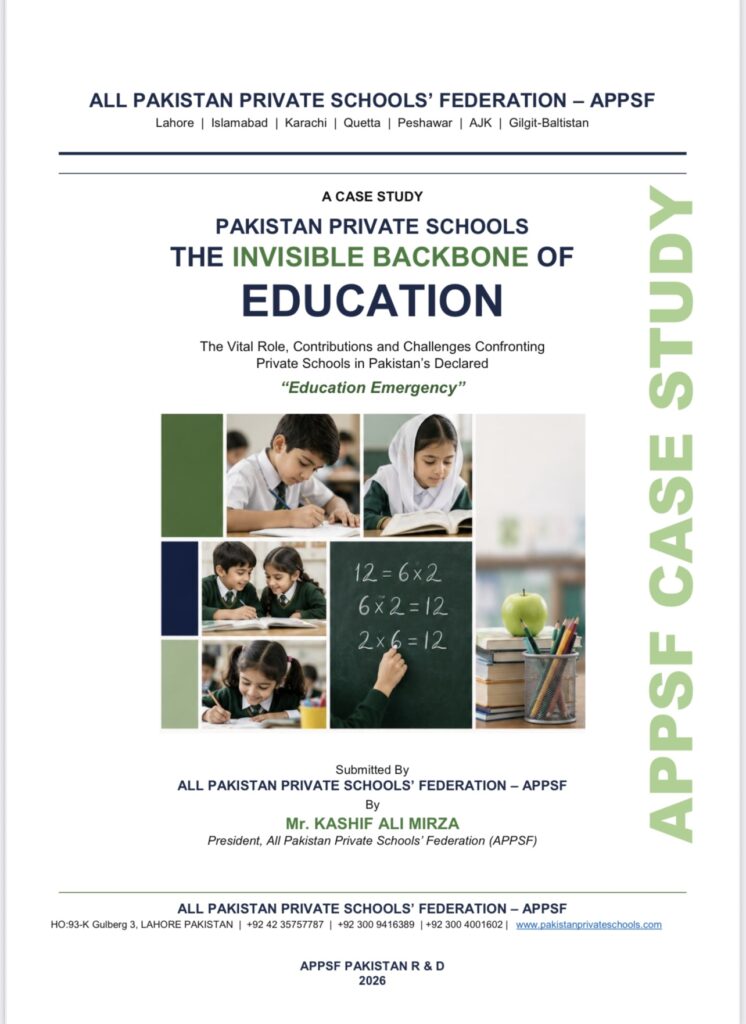
An APPSF 2026 Case Study on Regulatory Overreach, Fiscal Exclusion, and the Policy Case for a Partnership-Based Model of Private Education Delivery. Examining Their Vital Role, Contributions, and the Challenges Amid Pakistan’s Declared “Education Emergency”. Assessing Contributions, Challenges, and Policy Failures in Pakistan!
Concretely, this would mean several things. First, fiscal relief specifically targeted at educational technology: removing GST and import duty on core digital-learning hardware and software for registered schools, extending the same zero-rating logic already justified on broader education-as-essential-service grounds to the technology layer specifically. Second, a co-developed national AI-literacy and digital-skills curriculum module — not imposed top-down by a ministry with limited technical capacity in this specific domain, but genuinely co-designed with the private-sector institutions and international examination boards already furthest along in this work, then made available as an optional or eventually standard module across both public and private streams. Third, and most importantly from an equity standpoint, targeted digital-infrastructure grants and shared connectivity programs specifically prioritising the low-fee segment — ensuring that the technology gains already visible in the upper tiers of private education do not simply bypass the 85% of schools, and tens of millions of children, that constitute the sector’s actual majority. International precedent for each element of this approach already exists. The UK’s Academy-trust schools pilot AI-assisted learning tools within a broader national digital-education strategy, benefiting from full per-pupil public funding that removes the capital barrier smaller Pakistani schools currently face. Japan’s national curriculum guidelines, administered by MEXT, incorporate computational and data literacy as a standard component, while still preserving meaningful school-level curricular autonomy for private institutions to adapt delivery. Singapore’s government-aided schools — historically community-founded institutions not unlike Pakistan’s own missionary and trust-school heritage — receive direct public co-financing specifically for digital and STEM infrastructure, on the explicit rationale that technology readiness is now a core dimension of the education outcome the state is obligated to secure, not an optional extra left to individual institutional fundraising capacity. None of these is a radical or unprecedented policy instrument. They represent, in each case, a state choosing to fund the technology-readiness gap directly rather than either ignoring it or attempting to regulate private schools into somehow closing it unaided — an approach as fiscally unrealistic as expecting private schools to fund the entire out-of-school-children crisis without any public support, discussed at length elsewhere in this broader body of research. The Cost of Inaction is worth being direct about what is at stake if this gap continues to go unaddressed. Pakistan already faces a documented and persistent youth-employment challenge, with labour-market entrants frequently reporting a mismatch between the skills their education provided and the skills employers are seeking — a mismatch that predates the AI transition and will only widen as that transition accelerates. A generation of Pakistani students moving through an education system that has not meaningfully integrated AI literacy, computational thinking, or adaptive problem-solving competencies risks entering a labour market for which it is simply unprepared, at exactly the moment the country’s large and growing youth population represents its most significant potential economic asset.
The private sector’s demonstrated, if partial and uneven, head start on this transition is not a reason for policy complacency — it is the opposite. It is evidence that the underlying institutional capacity to build a modern, technology-integrated, AI-aware education system already exists within Pakistan’s borders, at scale, and has already been market-tested by tens of millions of families making real enrollment choices. The question facing policymakers is not whether such capacity can be built — it demonstrably can, because a meaningful slice of it already has been — but whether the state will choose to fund, facilitate, and scale that existing capacity into the low-fee segment where the majority of Pakistan’s children, and Pakistan’s future workforce, are actually being educated. The private school sector’s contribution to Pakistan’s technology, AI, and skills-readiness challenge mirrors, in miniature, its broader contribution to Pakistan’s education system as a whole: substantial, market-driven, largely uncredited, and currently constrained rather than supported by public policy. Just as the sector has absorbed the majority of Pakistan’s enrollment growth without direct public financing, it has also, without any coordinated national strategy or dedicated government support, become the country’s de facto pioneer in classroom technology adoption, the earliest experimenter with AI-assisted instruction, and the most structurally agile segment of the education system for building the skills a rapidly automating global economy now demands. Realizing this potential at the scale Pakistan actually needs — reaching not merely the upper-fee private schools already furthest along, but the 85% of the sector serving low- and middle-income families, and eventually the public system as well — requires the same fundamental policy shift that this body of research argues for throughout: from treating private education as a commercial activity to be taxed and regulated, toward treating it as a constitutional and economic partner to be funded, facilitated, and held accountable for outcomes. Nowhere is the cost of getting this wrong higher than in the domain of technology and future-skills readiness, where the gap between a prepared and an unprepared generation will not be measured in years, but in the entire economic trajectory of the country over the coming decades. Pakistan does not need to invent the institutional capacity to meet the modern world’s challenges from scratch. It needs to recognise, fund, and scale the capacity its private school sector has already begun building — before the digital divide within Pakistani education hardens into a permanent feature of Pakistani inequality.