The writer is an economist, anchor, jurist, geopolitical analyst and the President of All Pakistan Private Schools’ Federation
president@Pakistanprivateschools.com
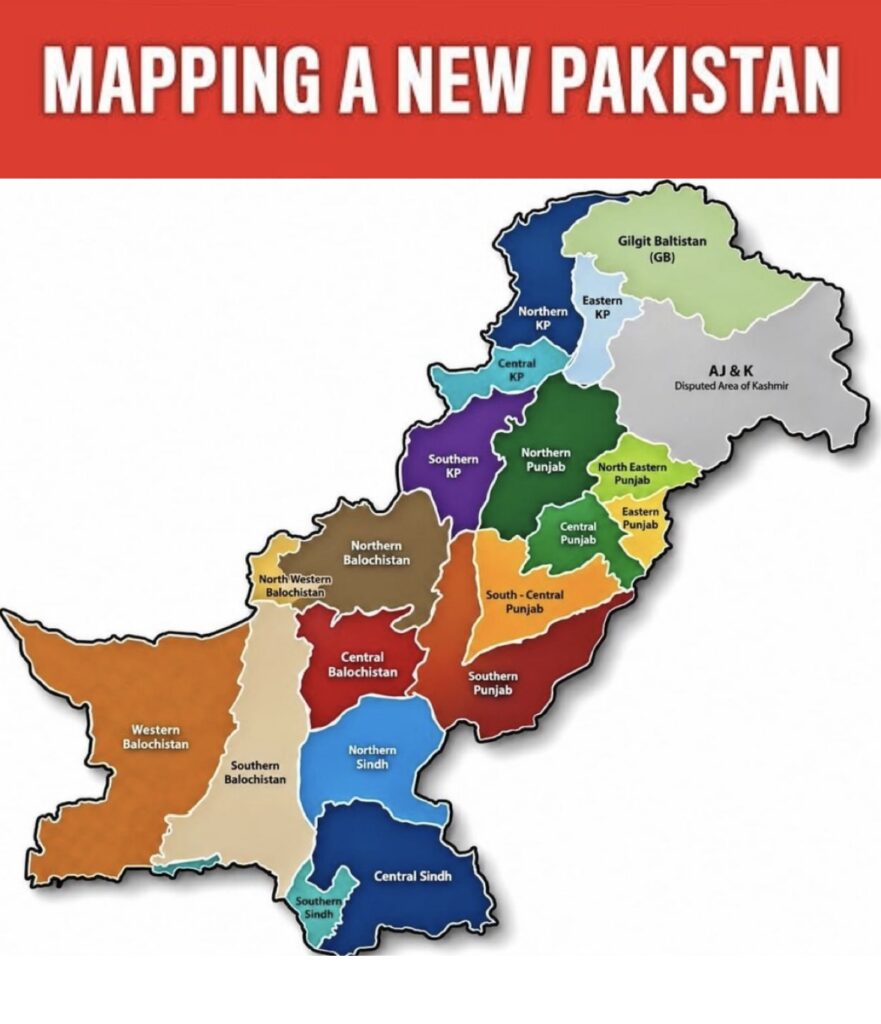
As Pakistan grapples with the challenges of a rapidly growing population exceeding 250 million, its outdated administrative structure threatens to undermine the very fabric of the nation. The country’s four provinces, Punjab, Sindh, Khyber Pakhtunkhwa, and Balochistan, are struggling to deliver basic services, maintain law and order, and ensure equitable resource distribution. The writing is on the wall: Pakistan urgently needs new provinces to revitalise its governance and public service delivery, as the country faces mounting challenges in delivering public services, maintaining law and order, and ensuring equitable resource distribution. Pakistan is not facing a leadership crisis, but a geography crisis. We are trying to govern 250-plus million people, 38 administrative divisions, and a landmass of 880,000 sq km with a colonial blueprint built for 75 million. The math no longer works. Punjab alone is 120 million people — bigger than Germany, Japan, and Mexico. It has 36 districts run from one desk in Lahore. Balochistan is the size of Germany but has the population of Lahore. Sindh bleeds between Karachi and the interior. GB remains constitutionally stateless despite Supreme Court orders. The result is predictable: delayed hospitals, absent teachers, clogged courts, and a state that is present everywhere in law and absent everywhere on the ground. Our neighbours solved this decades ago. India has 28 states; Indonesia has 38 provinces; Turkey has 81; Even war-torn Afghanistan has 34( Whereas, Pakistan has only 4. This is not about dividing Pakistan but about saving it. The status quo is not neutral. It is actively producing inequality, neglect, and unrest. Pakistan now stands at a fork: redesign the federation for the 21st century, or watch an oversized, outdated system suffocate the nation it was meant to serve. New provinces are not a luxury. They are survival infrastructure. The current administrative structure—comprising four provinces (Punjab, Sindh, Khyber Pakhtunkhwa, and Balochistan), the federal capital territory of Islamabad, and the semi-autonomous regions of Azad Jammu and Kashmir (AJK) and Gilgit-Baltistan—struggles to meet the needs of a diverse and rapidly growing populace. Pakistan is divided into several administrative divisions. There are 38 administrative divisions in total, which are further subdivided into districts, tehsils, and finally union councils, including: Punjab 10; Sindh 6; Khyber Pakhtunkhwa 7; Balochistan 8; Gilgit-Baltistan 3; and Azad Kashmir with 3 divisions. According to the 2023 Census, there are 129 cities. Punjab alone, with an estimated population of over 120 million, is larger than many sovereign nations, rendering its governance unwieldy and inefficient. The call for creating new provinces has gained traction as a potential solution to these systemic issues, promising improved administration, localised decision-making, and better public service delivery. This column argues that Pakistan urgently requires provincial restructuring to address its governance woes. By drawing comparisons with regional neighbours like Afghanistan, India, and Indonesia, as well as developed nations such as the United States and Germany, it becomes evident that smaller, manageable administrative units enhance efficiency and responsiveness. However, resistance from political elites, bureaucratic inertia, and the failure to implement key reforms—such as those recommended by the Sartaj Aziz Committee for Gilgit-Baltistan—pose significant hurdles. A comprehensive strategy, rooted in stakeholder consultation and empowerment of local governments, is essential to unlock Pakistan’s potential as an inclusive and efficient federal state. Pakistan’s current provincial structure is a relic of colonial administration, formalized under the 1973 Constitution. Punjab, spanning 205,344 square kilometers and housing over half of Pakistan’s population, exemplifies the governance challenges posed by oversized administrative units. Its sheer scale—larger than countries like Greece (131,957 sq km) or Bangladesh (147,570 sq km)—creates a disconnect between policymakers in Lahore and citizens in distant districts like Bahawalpur or Dera Ghazi Khan. A 2023 World Bank report on South Asian governance noted that Punjab’s administrative complexity contributes to delays in infrastructure projects, uneven healthcare access, and inconsistent law enforcement. For instance, the province’s 36 districts are overseen by a single provincial government, straining its capacity to address localised needs effectively. Contrast this with Sindh (140,914 sq km, 50 million people), Khyber Pakhtunkhwa (101,741 sq km, 40 million), and Balochistan (347,190 sq km, 15 million). While Balochistan’s vast geography and sparse population present unique challenges, its governance issues stem more from underdevelopment and central neglect than size alone. Sindh and Khyber Pakhtunkhwa, though smaller than Punjab, still grapple with ethnic and regional disparities that could be mitigated by further subdivision. The creation of new provinces by converting existing administrative divisions—such as Punjab’s nine divisions (e.g., Multan, Faisalabad, Rawalpindi)—or merging districts into coherent units could streamline governance and bring decision-making closer to the people. The idea is not new. In 2015, the Pakistan Muslim League-Nawaz (PML-N) government established the Sartaj Aziz Committee to explore Gilgit-Baltistan’s status, recommending provisional provincial status pending resolution of the Kashmir dispute. Similarly, calls for a South Punjab province have persisted for decades, driven by linguistic and economic grievances. Pakistan’s neighbours offer valuable insights into the benefits of smaller administrative units. Comparisons with Afghanistan (34 provinces), India (28 states), Indonesia (38 provinces), Turkey (81 provinces), and developed nations affirm that smaller units work. China’s 23 provinces (plus autonomous regions) manage 1.4 billion people effectively, suggesting Pakistan’s 250 million can sustain 8-10 provinces; or provinces can be established on the basis of 38 administrative divisions. With Punjab’s divisions, Sindh’s Hyderabad region, and Balochistan’s ethnic zones as candidates, Pakistan could double its provinces, aligning with regional norms. Afghanistan, with a population of 41 million (2025 estimate) spread across 652,864 sq km, is divided into 34 provinces. Despite its instability, this structure allows for localised governance tailored to diverse ethnic groups like Pashtuns, Tajiks, and Hazaras. Each province, averaging 1.2 million people, has its own governor and council, enabling quicker responses to security and development needs. A 2024 UN Development Programme (UNDP) report praised Afghanistan’s provincial system for facilitating targeted aid distribution, even amidst conflict—a stark contrast to Pakistan’s centralised approach. India, with 1.44 billion people (2025 estimate) and 3.287 million sq km, operates 28 states and 8 union territories. States like Kerala (34,630 sq km, 35 million) and Tamil Nadu (130,058 sq km, 77 million) demonstrate how manageable units can excel in governance. Kerala’s literacy rate of 96% and life expectancy of 77 years (2023 data) far surpass Pakistan’s national averages (59% and 67 years, respectively), thanks to decentralised policies empowering local bodies. India’s states have fiscal autonomy under the 7th Schedule of its Constitution, allowing them to tailor budgets to regional priorities—a model Pakistan could adapt to address disparities between urban Karachi and rural Sindh. Indonesia, a sprawling archipelago of 280 million people (2025 estimate) across 1.9 million sq km, manages 38 provinces. Provinces like Bali (5,780 sq km, 4.5 million) leverage their autonomy to boost tourism and infrastructure, contributing 3% to Indonesia’s GDP despite their small size (2024 IMF data). Turkey, with 81 provinces for 85 million people (2025 estimate), exemplifies granularity in governance. Each province, averaging 1 million people, has elected governors and councils, ensuring efficient public service delivery. Istanbul Province (5,461 sq km, 15 million) rivals Punjab in population density but benefits from focused administration, achieving a GDP per capita of $12,000 (2024) compared to Punjab’s $1,500. These examples underscore a key lesson: smaller units enhance accountability and responsiveness. Pakistan, with only four provinces for 2450 million people, averages 60 million per province—far exceeding the 1-40 million range in these countries. Reducing this ratio through new provinces could mirror their successes in equitable resource distribution and service delivery. Developed countries further illustrate the efficacy of decentralised governance. The United States, with 331 million people (2025 estimate) across 9.8 million sq km, comprises 50 states. States like California (423,970 sq km, 39 million) wield significant autonomy, managing budgets larger than many nations’ GDPs ($3.6 trillion in 2024). California’s decentralised healthcare system, bolstered by state-level innovation, contrasts with Pakistan’s overburdened federal framework, where Punjab’s 120 million rely on a single provincial health ministry. The U.S. model of federalism—where states experiment with policies like renewable energy or education reform—offers Pakistan a blueprint for devolving power without undermining national unity. Germany, with 84 million people (2025 estimate) across 357,582 sq km, operates 16 states (Bundesländer). Bavaria (70,548 sq km, 13 million) exemplifies how regional identity and governance coexist within a federal structure. Its GDP per capita of $55,000 (2024) reflects robust local administration, dwarfing Pakistan’s national average of $1,600. Germany’s states control education, policing, and taxation, ensuring tailored solutions—a stark contrast to Pakistan’s centralized bureaucracy, where federal-provincial tussles delay projects like the Diamer-Bhasha Dam. These nations demonstrate that federalism thrives on balance: a strong centre complemented by empowered subnational units.
Pakistan’s current structure tilts too heavily toward Islamabad, stifling provincial initiative and local governance. Gilgit-Baltistan (GB) epitomises Pakistan’s governance failures and the potential of provincial restructuring. With 72,971 sq km and an estimated 1.9 million people (2025), GB remains in constitutional limbo, neither a full province nor fully autonomous. A 2022 survey by the Pakistan Institute of Development Economics (PIDE) found that 68% of South Punjab residents supported a separate province, citing neglect in education and healthcare funding compared to central Punjab. Yet, progress remains stalled, highlighting the need for a broader national conversation on provincial restructuring. The 2015 Sartaj Aziz Committee recommended provisional provincial status, including representation in Parliament and federal bodies like the National Finance Commission (NFC). The Supreme Court’s 2019 ruling reinforced this, affirming GB residents’ citizenship rights and urging legislative action within a fortnight. Yet, as of March 2025, no concrete steps have materialised beyond the 2018 Gilgit-Baltistan Order, which transferred some powers to the local assembly but stopped short of provincial status. GB’s exclusion from the NFC and lack of parliamentary seats perpetuate its underdevelopment. A 2024 Asian Development Bank (ADB) report noted that GB’s hydropower potential—over 40,000 MW—remains untapped due to federal neglect, while its tourism sector languishes without provincial autonomy to attract investment. The Supreme Court’s jurisdiction now extends to GB, but without full provincial integration, residents lack equal access to justice or resources. This inertia reflects broader resistance to new provinces, driven by fears of altering Pakistan’s Kashmir stance—a concern the Aziz Committee addressed by proposing provisional status pending a final settlement. The push for new provinces faces entrenched opposition. Regional political elites, particularly in Punjab and Sindh, view subdivision as a threat to their influence. Mainstream parties have already endorsed the idea of new provinces in principle. The PML-N and Pakistan Peoples Party (PPP), dominant in Punjab and Sindh respectively, have historically resisted proposals like South Punjab or Hazara provinces, fearing vote-bank erosion. A 2023 Gallup Pakistan poll found that 55% of Punjab’s political leaders opposed new provinces, citing “administrative complexity” and “national unity”—arguments critics dismiss as self-serving. Bureaucratic interference compounds the issue. The 18th Amendment (2010) devolved powers to provinces, but its promise of empowered local governments remains unfulfilled. The 2021 Punjab Local Government Act and similar laws in other provinces centralise control under provincial bureaucracies, undermining elected councils. A 2024 PIDE study estimated that local governments receive less than 10% of provincial budgets, with financial ambiguities favouring bureaucrats over grassroots leaders. This centralisation risks pushing Pakistan toward a unitary system, contradicting its federal ethos. Breaking this deadlock requires a parliamentary committee, as suggested by governance experts in 2023, to consult stakeholders—politicians, media, civil society, and intelligentsia—and draft a roadmap. Pakistan’s public service delivery lags regionally and globally. The 2024 Human Development Index (HDI) ranks Pakistan 164th (0.544), behind India (134th, 0.644) and Indonesia (112th, 0.705). Healthcare access exemplifies the crisis: Punjab’s doctor-to-patient ratio is 1:1,800 (2023 WHO data), worse than India’s 1:1,000, with rural areas like Rajanpur faring worse. Education fares no better, with a 2024 UNESCO report noting Pakistan’s 22 million out-of-school children—40% in Punjab—due to inadequate provincial oversight. New provinces could address these gaps. Smaller units, like a proposed South Punjab province (est. 40 million people), could prioritize regional needs—e.g., cotton-based industries or irrigation—over Punjab’s urban-centric focus. A 2023 ADB simulation suggested that dividing Punjab into three provinces could cut administrative response times by 30%, boosting service delivery. Law and order, too, would benefit: Khyber Pakhtunkhwa’s 2018 FATA merger reduced militancy by 25% (2024 Interior Ministry data) through localized policing, a model replicable elsewhere. Pakistan’s governance crisis demands bold reform. Creating new provinces—starting with South Punjab, Hazara, and GB—offers a path to efficiency and inclusion. Provincial restructuring must pair with robus local governance. Articles 32 and 140A of the Constitution mandate local government systems, but implementation falters. The 2001 Devolution Plan under Musharraf empowered districts, only to be reversed by subsequent regimes. Today, local bodies lack fiscal autonomy, relying on provincial handouts. A 2024 Transparency International report flagged bureaucratic corruption as a key barrier, with 15% of local funds misappropriated annually. Countries like Indonesia and Germany thrive because provinces delegate to municipalities. Pakistan’s 129 district councils and 619 urban councils (2023 data) could mirror this, but only if provinces relinquish control. Failure to do so risks a unitary drift, where Islamabad and provincial capitals monopolise power, alienating citizens. A parliamentary committee should: Engage political parties, media, and civil society to build consensus, addressing elite resistance with data-driven arguments; Amend Article 1 of the Constitution to define new provinces, ensuring fiscal shares via the NFC; Allocate 25% of provincial budgets to local governments, per 2024 PIDE recommendations, with clear financial oversight; and Implement GB’s provisional status as a test case, leveraging Supreme Court rulings and Aziz Committee insights. Pakistan’s administrative structure is a bottleneck to its development. New provinces promise better governance, equitable resources, and responsive services, mirroring successes in Turkey, India, Indonesia, and beyond. Yet, without political will, bureaucratic reform, and local empowerment, this vision risks remaining a theoretical exercise. The failure to act on Gilgit-Baltistan’s status is a cautionary tale—Pakistan cannot afford more missed opportunities. A reimagined federal structure, rooted in inclusivity and efficiency, is not just desirable but essential for a prosperous future.
Pakistan stands at this precipice, where outdated laws, entrenched inefficiencies, feeble accountability, and an economic architecture ill-suited to the modern world must be dismantled and rebuilt, not merely patched or repainted with new faces. The vision requires bold reforms, driven by political will, bureaucratic overhaul, and local empowerment. The status quo is no longer tenable – Pakistan must choose between stagnation and a reimagined federal structure that prioritizes inclusivity, efficiency, and the well-being of its citizens. The question is no longer whether change is needed, but whether this generation possesses the wisdom and resolve to choose reinvention over ruin.
The case for new provinces is not ideological but administrative, fiscal, and moral. Smaller units mean faster decisions; Closer governments mean better accountability; and Local budgets mean schools get built before they collapse. So, the system reset means outdated laws, poor governance, weak accountability, ineffective bureaucracy and unproductive economic structure should be rearranged according to modern requirements. Until the system develops the ability to change itself, changing faces will not change the results much. Strong countries are not made of individuals, but of strong systems. Strong countries are not built by changing faces every five years. They are built by changing systems once, and letting that system work for the next hundred. This is what India, Indonesia, Germany, and even China understood: governance must match scale. But maps alone will not save us. Without political will to confront elite resistance, without a bureaucratic overhaul to end the 12-NOC culture, and without empowering local governments with real money and real power under Articles 32 and 140A, new provinces will become new bureaucracies. Gilgit-Baltistan is our test case; South Punjab is our warning; 28 million out-of-school children are our deadline. Pakistan must now choose. We can keep patching a 1973 structure to serve a 2026 population and call it patriotism. Or we can have the courage to restructure — to trade the comfort of the familiar for the efficiency of the functional. A nation of 250 million cannot be run like a district. It is time to build a federation fit for its people. Because until the system learns how to change itself, changing prime ministers will never change Pakistan. The true test of a nation’s destiny lies not in the charisma of its leaders or the promises of its politics, but in its willingness to confront a haunting truth: the status quo is a slow poison, and clinging to it ensures only stagnation while a bolder path beckons—a reimagined federal structure forged through unflinching political will, ruthless bureaucratic overhaul, and genuine local empowerment. Pakistan stands at this precipice, where outdated laws, entrenched inefficiencies, feeble accountability, and an economic architecture ill-suited to the modern world must be dismantled and rebuilt, not merely patched or repainted with new faces. For until a system acquires the rare and courageous capacity to transform itself from within, the rotation of individuals will remain a tragic illusion of progress, yielding the same cycles of disappointment. In the end, great countries are never the accidental sum of strong personalities; they are the deliberate creation of resilient, inclusive, and adaptive systems that outlast any single ruler and elevate the well-being of every citizen. The question is no longer whether change is needed, but whether this generation possesses the wisdom and resolve to choose reinvention over ruin. As Pakistan grapples with the challenges of a rapidly growing population, its outdated administrative structure threatens to undermine the nation’s progress. The need for new provinces has become increasingly urgent, promising improved governance, localised decision-making, and enhanced public service delivery. By embracing provincial restructuring, Pakistan can unlock its potential as an inclusive and efficient federal state, mirroring the successes of regional neighbors like India and Indonesia. However, this vision requires bold reform, driven by political will, bureaucratic overhaul, and local empowerment. The status quo is no longer tenable – Pakistan must choose between stagnation and a reimagined federal structure that prioritises inclusivity, efficiency, and the well-being of its citizens.