The writer is an economist, anchor, geopolitical analyst
and the President of All Pakistan Private Schools’ Federation
president@Pakistanprivateschools.com
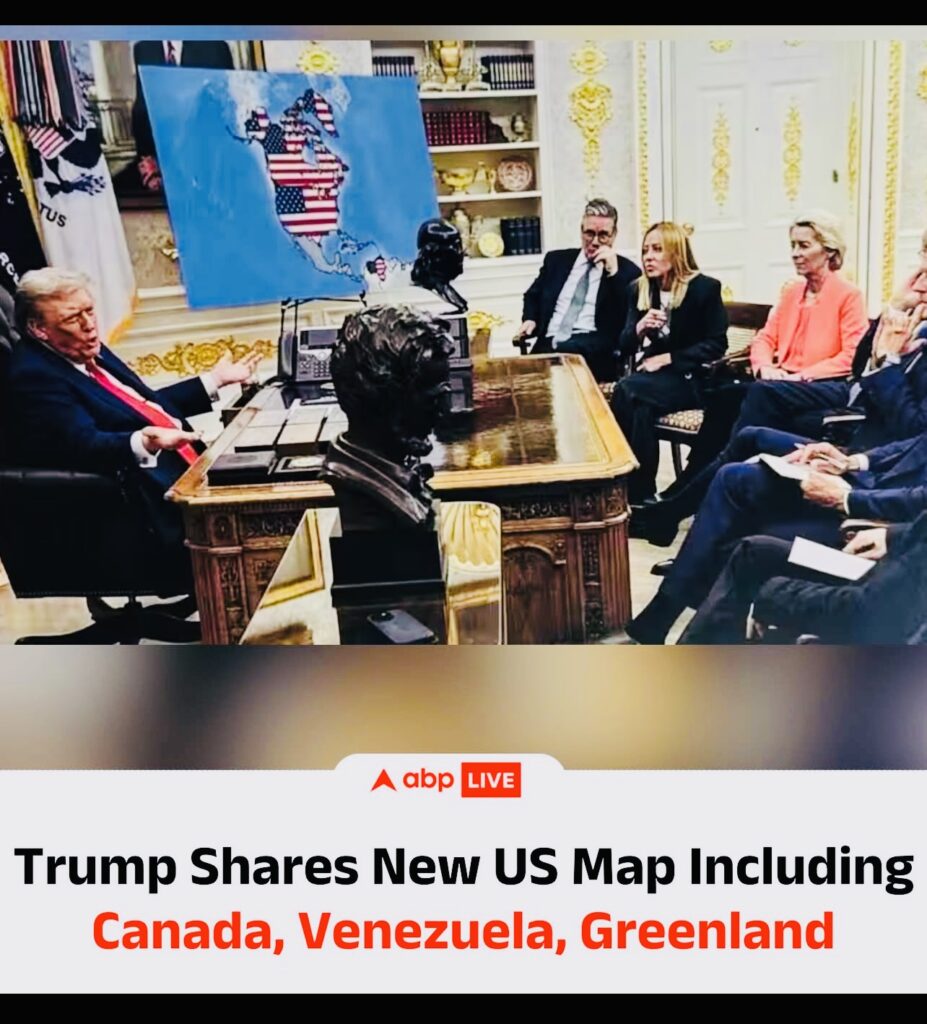
In the annals of modern diplomacy, wherein the caprices of potentates oft shape the destinies of nations, there hath arisen a spectacle most extraordinary and fraught with peril. Behold, the President of the United States, Donald Trump, in this year of our Lord 2026, hath unveiled upon the digital agora of social media an image—a map, altered by the artifices of artificial intelligence—wherein the sovereign realms of Canada and Greenland are subsumed beneath the starry banner of the American Union. Nay, not content with these northern expanses, the fabrication extendeth even unto Venezuela, that troubled republic of the southern climes, all draped in the hues of Old Glory. The specter of imperialism has reared its head once more, as Donald Trump’s latest cartographic endeavors have ignited a firestorm of global unease. The US President’s audacious claims on Canada and Greenland have sent shockwaves through the international community, with many interpreting his actions as a brazen attempt to expand American dominion. Trump’s territorial ambitions, as evidenced by his new map, have sparked fury among allies and raised concerns about the resurgence of American imperialism. Donald Trump has shared images showing Canada and Greenland as part of the US territory, reigniting a long-standing dispute over his desire to expand US influence in the Arctic. Greenland is central to Trump’s strategic arguments because it is located in the Arctic, controls newly emerging sea lanes and has large deposits of rare earth minerals that are considered crucial for modern technology. The island’s location is crucial for missile defense and Arctic security. Canadian Prime Minister Mark Carney. “The middle powers must act together because if we’re not at the table, we’re on the menu.” In Davos, Canada’s Prime Minister Mark Carney said his nation stands with Greenland amid Trump’s pursuit of the world’s largest island, sharply criticizing the US-led global order. Carney said that the old rules-based global order is over and a new harsh reality has dawned where major powers are weaponizing tariffs and supply chains. The Canadian Prime Minister’s speech in Davis was not just a speech, but a moment in history. When the loftiness of idealism and the solidity of realism merged into one tone, one of the most memorable political speeches in history emerged. It came at a time when the symbols of the international order that were once considered the guarantors of justice, law, and collective conscience after World War II have become virtually meaningless. Institutions like the United Nations, which were established to protect weak states, are now reduced to mere formal statements and ineffective resolutions. The balance of power has been replaced by open aggression, and world politics is once again being based on the principle of blind force. He stated in a very blunt and uncompromising tone that if small countries do not stand in the face of big powers with mutual unity, they will not be able to defend their survival. If they are not present at the table, they will be on the menu. US President Donald Trump has threatened to impose a 100% tariff on Canadian goods if Canada proceeds with a trade deal with China. Trump stated that if Canadian Prime Minister Mark Carney thinks he’ll allow Canada to become a “drop-off port” for Chinese goods entering the US, he’s “sorely mistaken”. Trump warned that China would “eat Canada alive” and destroy its businesses, social fabric, and way of life. This threat comes after Canada and China agreed to lower tariffs on electric vehicles and canola, aiming to rebuild ties and boost trade. Trump had previously withdrawn an invitation for Canada to join his “Board of Peace” initiative following Carney’s speech at the World Economic Forum in Davos. Trump also made reference to Canada, where he repeatedly claimed that economic imbalances make the relationship unworkable without major changes. Canadian officials, however, have strongly rejected these statements and reaffirmed the country’s sovereignty. European leaders, including France’s Emmanuel Macron and Italy’s Giorgia Meloni, have called for respect for international law and territorial sovereignty. Denmark has reiterated that Greenland’s future will be determined only by its people, not by any external force. The incident underscores growing geopolitical tensions in the Arctic, where global powers are competing for resources, security and influence, all of which are being exacerbated by climate change and strategic shifts. At such a critical and decisive juncture, this speech was not just a series of words, but the announcement of a roadmap for the future of weak nations. The world order is not going through a gradual change, but a decisive rupture. This audacious phantasmagoria, posted amidst deliberations with European sovereigns, hath ignited a conflagration of alarm across the globe, evoking the spectre of imperialism long thought banished to the dusty tomes of history. What doth this portend for the fragile edifice of international order? Shall we witness the resurgence of manifest destiny, cloaked in the garb of jest, yet pregnant with the seeds of conquest? Let us, with the sobriety of scholars and the vigilance of sentinels, dissect its implications, weigh its significance, and ponder the avenues of defence, commerce, and alliance that may yet preserve the autonomy of imperilled states. The global implications of this cartographic provocation are profound, extending far beyond the mere jest of a statesman known for his rhetorical flourishes. In an age wherein the boundaries of nations are sanctified by treaties and the collective will of the United Nations, such a depiction—albeit artificial—serveth as a clarion call to the dormant fears of annexation and hegemony. Greenland, that vast isle of ice and strategic import, lieth at the crossroads of the Arctic, a realm burgeoning with mineral wealth and pivotal for the navigation of northern seas. Its inclusion in Trump’s envisioned domain reviveth memories of his erstwhile overtures to purchase the territory from Denmark, a proposal dismissed as folly yet now resurrected in visual form. Canada, our northern neighbour of vast prairies and unyielding tundras, standeth as a bulwark of liberal democracy, its sovereignty intertwined with that of the United States through bonds of trade and defence. To enfold it within American borders, even in jest, undermineth the very foundations of North American amity, stirring apprehensions among NATO allies that the Pax Americana may devolve into a rapacious empire. Venezuela’s addition, amidst its internal tumults, hinteth at a broader Latin American ambition, perchance a revival of the Monroe Doctrine in its most aggressive guise. Thus, the map doth not merely redraw lines upon paper; it challengest the post-war consensus, wherein the sovereignty of nations is held inviolate, and kindleth a dread that the United States, under Trump’s renewed stewardship, may pursue territorial aggrandisement under the pretext of security or economic exigency. The significance of this episode lieth not solely in its immediate provocation but in its revelation of deeper fissures within the geopolitical firmament. Imperialism, that ancient vice of empires from Rome to Britannia, hath ever been justified by the mantle of civilisation or necessity. Here, Trump’s map bespeaketh a nostalgia for American exceptionalism, wherein the republic expandeth not by consent but by fiat, echoing the annexations of yore—Texas, Hawaii, and the Philippines. Yet, in this enlightened era, such designs clash with the principles of self-determination enshrined in the Charter of the United Nations.
Trump’s new map, though born of artifice, casteth a long shadow upon the commonwealth of nations. It summoneth the ghosts of empires past, compelling us to question whether the pursuit of greatness be not the harbinger of downfall. Shall Canada and Greenland succumb to the siren’s call of integration, or shall they rally the free world against this imperial mirage? The choices before us—defence fortified, trade diversified, alliances reimagined—demand wisdom unclouded by fear. Let us, in the spirit of Burke and Mill, critique this folly not with rancour but with reason, lest the map of tomorrow be drawn in blood rather than ink.
The implications of such a move are far-reaching, with potential consequences for global stability and the balance of power. Trump’s aggressive expansion has put the North Atlantic Treaty Organization (NATO) in a precarious position, with some experts arguing that his actions could lead to the alliance’s demise. Canada faces a difficult decision, balancing its relationship with the US against its commitment to international law and sovereignty. Trump’s moves may drive Canada and Greenland towards forming new alliances with China and Russia, potentially reshaping global geopolitics. The map, which includes Canada and Greenland as part of the US, has been met with widespread criticism and concern. Critically, one must interrogate the motive: Is this a mere caprice, a digital whimsy to rally his adherents, or a trial balloon for policies yet unspoken? The Arctic’s thawing, driven by the inexorable march of climate alteration, rendereth Greenland a prize of inestimable value, its rare earths and shipping lanes coveted by great powers. Canada’s inclusion may stem from covetousness of its resources—oil, timber, and freshwater—or a desire to fortify against perceived threats from the Orient. The significance, then, is a harbinger of multipolar tensions: As the United States asserts dominance, it alienateth allies, compelling them to seek succour elsewhere, and thus accelerateth the erosion of Western hegemony. For Canada and her NATO confederates, the paths of defence and trade present a labyrinth of thorny choices. In matters martial, the North Atlantic Treaty Organisation standeth as the primary shield, its Article Five invoking collective defence against aggression. Yet, should the aggressor be the alliance’s paramount member—the United States itself—what recourse remaineth? Canada, with its meagre military expenditures, must perforce augment its forces, perchance fortifying the Arctic with augmented patrols and alliances sub-regional, such as with Denmark and Norway. Trade, that lifeblood of nations, offereth both vulnerability and leverage. The United States-Mexico-Canada Agreement bindeth the economies in Gordian knots; disruption thereof could precipitate economic woe, yet diversification beckoneth. Canada may deepen ties with the European Union, whose Comprehensive Economic and Trade Agreement provideth an alternative conduit for goods and capital. NATO nations, from the Baltic shores to the Iberian peninsula, must contemplate enhanced intra-alliance procurement, eschewing American armaments in favour of indigenous or allied manufactures, lest dependency breed subservience. Critically, one must ponder: Doth this map presage tariffs or blockades, as Trump hath wielded aforetime? If so, resilience through supply chain redundancy and strategic stockpiles becometh imperative. Amidst these tempests, the possibilities of new alliances shimmer upon the horizon, fraught with peril and promise. The estrangement from Washington may propel Canada and her ilk towards unorthodox pacts, wherein erstwhile adversaries become bedfellows. China, that ascending colossus of the East, proffereth an alluring option: Its Belt and Road Initiative could furnish infrastructure and markets, supplanting American dominance in trade. Yet, alliance with the Middle Kingdom carrieth the taint of authoritarianism, its human rights ledger a stain upon any compact. Russia, master of the Siberian wastes, sharereth Arctic interests; a détente could yield joint resource exploitation, countering American encroachment. Imagine, if thou wilt, a northern entente: Canada, Greenland (under Danish auspices), and Russia forging a pact for Arctic stewardship, with China as financier. Such realignments would shatter the bipolar mould, birthing a world of fluid coalitions. However, critically, one must beware the Faustian bargain: Alignment with autocracies may erode democratic virtues, inviting espionage and influence peddling. NATO, already strained by Trump’s caprices, could fracture, with eastern members cleaving to Washington whilst western ones drift eastward. The role of China and Russia, then, is dual-edged: As options, they offer counterpoise to imperialism; as alliances, they risk subjugation of a subtler sort. Trump’s actions could undermine international law and set a dangerous precedent for other nations. The international community has condemned Trump’s territorial claims, with many seeing it as a return to 19th-century imperialism. The move has fueled global uncertainty, with investors and policymakers alike unsure of the US’s next move. As the situation continues to unfold, several questions arise: Will Trump follow through on his threats, or is this a negotiating tactic? How will Canada and Greenland respond to US pressure? What implications will this have for NATO and global stability? The Canadian Prime Minister’s speech in Davos was a watershed moment, merging idealism and realism to forge a path for vulnerable nations. As institutions like the United Nations falter, and power dynamics shift towards aggression, the Prime Minister’s words served as a clarifying call to action. He underscored the imperative for small countries to unite, lest they succumb to the whims of larger powers. The speech’s resonance is amplified by France’s subsequent outreach to China, with President Macron advocating for robust European trade ties with Beijing. This convergence reflects a broader trend: middle powers like Canada, France, and Germany are reevaluating alliances, prioritizing strategic autonomy, and championing human rights and sovereignty. The transatlantic relationship between the EU and the US is experiencing significant strain under Trump’s presidency, with his aggressive trade policies and territorial claims sparking widespread concern. Trump’s actions, including imposing tariffs on EU nations and claiming Greenland, have led to an emergency EU summit and discussions about reducing reliance on US security guarantees. European leaders are seeking greater autonomy in defense, trade, and technology, with initiatives like the Anti-Coercion Instrument and increased defense spending. The EU is exploring alternative partnerships, including trade deals with Mercosur, Mexico, and Indonesia, to reduce dependence on the US. Trump’s actions have raised questions about the durability of NATO, with European leaders rethinking their strategic priorities. The situation remains fluid, with ongoing negotiations and potential for further escalation. The transatlantic relationship between the EU and the US is experiencing significant strain under Trump’s presidency, with his aggressive trade policies and territorial claims sparking widespread concern. Trump’s actions, including imposing tariffs on EU nations and claiming Greenland, have led to an emergency EU summit and discussions about reducing reliance on US security guarantees. European leaders are seeking greater autonomy in defense, trade, and technology, with initiatives like the Anti-Coercion Instrument and increased defense spending. The EU is exploring new Alliances and alternative partnerships, including trade deals with Mercosur, Mexico, and Indonesia, to reduce dependence on the US. Trump’s actions also have raised questions about the durability of NATO, with European leaders rethinking their strategic priorities.
In the twilight of this tumultuous epoch, wherein the caprices of ambition doth veil themselves in the guise of jesting artifice, we behold the resurrection of imperialism’s spectre, not as a relic entombed in history’s vault, but as a living phantom haunting the councils of nations. Trump’s audacious cartography, annexing Canada and Greenland to the American fold, summoneth forth a profound interrogation of sovereignty’s sanctity: Shall the mighty, in their quest for dominion o’er Arctic treasures and hemispheric sway, trample the covenants of yore, or shall the confederacy of lesser powers—forged in the crucible of Carney’s clarion call at Davos—erect bulwarks of unity against such rapine? Nay, let us ponder, with the sage’s discernment and the foresight, whether this provocation heraldeth not mere folly, but a cataclysmic rupture in the fragile tapestry of global amity, wherein alliances fray, autocracies allure, and the very ethos of self-determination hangeth precariously upon the precipice of oblivion; for if the map be redrawn in ink today, tomorrow’s boundaries may well be etched in the crimson of conflict, beseeching us to choose betwixt submission and the bold rebirth of a multipolar equilibrium. Trump’s new map, though born of artifice, casteth a long shadow upon the commonwealth of nations. It summoneth the ghosts of empires past, compelling us to question whether the pursuit of greatness be not the harbinger of downfall. Shall Canada and Greenland succumb to the siren’s call of integration, or shall they rally the free world against this imperial mirage? The choices before us—defence fortified, trade diversified, alliances reimagined—demand wisdom unclouded by fear. Let us, critique this folly not with rancour but with reason, lest the map of tomorrow be drawn in blood rather than ink.