The writer is an economist, anchor, geopolitical analyst and the President of All Pakistan Private Schools’ Federation
president@Pakistanprivateschools.com
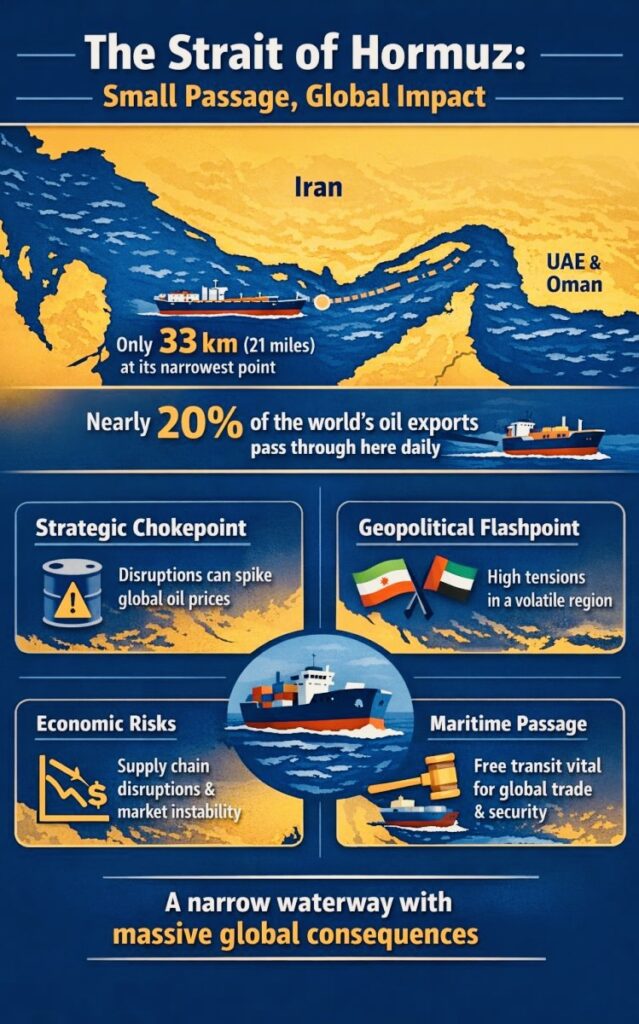
The legal case for the Islamic Republic of Iran’s regulatory jurisdiction over the Strait of Hormuz under the 1982 United Nations Convention on the Law of the Sea (UNCLOS), the 1958 Geneva Conventions, and customary international law is very clear. It argues that while the Strait is subject to the regime of transit passage, Articles 38, 39, and 42 of UNCLOS preserve a coastal state’s sovereign authority to enact and enforce laws concerning safety of navigation, pollution control, and security. Iran’s 1993 Marine Areas Act and its 1994 declaration upon signing UNCLOS are consistent with this framework. Indeed, Iran does not seek to close the Strait. It seeks to enforce Articles 39 and 42 of UNCLOS in its territorial sea. Commercial transit is unimpeded when rules are followed. Military transit without rules is not transit. It is an intrusion. The dominant Western narrative describes Hormuz as an “international waterway” that must remain free of coastal interference. This framing ignores the text of UNCLOS and the principle that sovereignty is the default condition in the territorial sea. Iran’s claim is not to “close” the Strait. It is to exercise ordinary sovereign rights recognised by UNCLOS Part II and qualified by the transit passage regime of Part III. The choice for the US, Europe, and GCC is between law-based de-escalation and a cycle of militarisation that risks war and the collapse of UNCLOS. International law was written to bind the strong as well as the weak. In Hormuz, that principle is now on trial, which deconstructs the Western conflation of “transit passage” with unrestricted military manoeuvre, demonstrating that foreign warships conducting non-transit activities violate Art 39(1)(c). It then analyses the consequences of recognising Iran’s jurisdiction: reduced insurance volatility, naval de-escalation via incidents-at-sea protocols, and preservation of UNCLOS against coastal state withdrawal. The geopolitical impact for the United States, Europe, and the Gulf Cooperation Council is assessed, concluding that a law-based accommodation offers lower costs than militarised primacy. The Strait of Hormuz is an Iranian and Omani territorial sea in which international law, not naval power alone, must govern passage. The Strait of Hormuz is 21 nautical miles wide at its narrowest point between Iran’s Qeshm Island and Oman’s Musandam Peninsula. Under UNCLOS Art 3, both Iran and Oman may claim a 12nm territorial sea. The territorial seas overlap. There is no high-seas corridor. The sovereignty of a coastal State extends to an adjacent belt of sea, described as the territorial sea. Iran’s 1993 Act on the Marine Areas of the Islamic Republic of Iran in the Persian Gulf and the Oman Sea implements this right. Art 3 of the Act: “The Islamic Republic of Iran exercises sovereignty over its territorial sea.” This mirrors US Proclamation 5928 establishing a 12nm US territorial sea. Hormuz falls under UNCLOS Art 37 in which transit passage as a qualified right, a strait “used for international navigation between one part of the high seas or an exclusive economic zone and another.” Art 38(2) defines transit passage as “the exercise of the freedom of navigation and overflight solely for the purpose of continuous and expeditious transit.” The limitations are explicit: Art 39(1)(b): Ships must “refrain from any threat or use of force against the sovereignty, territorial integrity or political independence of States bordering the strait.” Art 39(1)(c): Ships must “refrain from any activities other than those incident to their normal modes of continuous and expeditious transit.” Art 42(1): States “may adopt laws and regulations relating to (a) safety of navigation and the regulation of maritime traffic, (b) prevention, reduction and control of pollution.” Iran’s 1994 declaration upon signing UNCLOS stated: “the right of transit passage does not preclude the right of the coastal State to adopt and enforce laws and regulations to safeguard its security interests.” Customary Law and ICJ Jurisprudence also support the Iranian claim, as Iran signed but did not ratify UNCLOS. The US is also not a party. Both rely on customary law. The contradiction at the heart of the Hormuz dispute is that the United States refuses to ratify UNCLOS yet demands Iran grant foreign warships more rights than UNCLOS itself requires. Customary law settles the matter. In Corfu Channel (UK v. Albania), 1949, the ICJ held that warships enjoy a right of passage through international straits, but the coastal state retains regulatory authority. The Court did not grant immunity from coastal laws; the Court affirmed that warships possess a right of passage, but it never stripped Albania of the right to regulate, nor did it create a license to ignore coastal security laws. The “security exception” is not an Iranian invention, but indeed is textual. Art 42(1)(b) authorises pollution laws, and oil tankers and warships remain the principal pollution risk in Hormuz. Art 42(1)(a) permits laws for the safety of navigation and the regulation of maritime traffic, authority Iran exercised when its Ports and Maritime Organisation documented 14 near-collisions in 2019 caused by US destroyers crossing the Traffic Separation Scheme at 30 knots with AIS off. Regulation is lawful. Moreover, Art 25(3) allows a coastal state to suspend innocent passage when essential for security, and while Art 44 bars suspension of transit passage, the ICJ in Military and Paramilitary Activities (Nicaragua v. US) 1986 para 193 held that essential security interests permit measures otherwise inconsistent with treaty obligations. Iran faces 40,000 US troops in GCC bases, comprehensive economic sanctions, and the 2020 extraterritorial killing of General Qasem Soleimani. Invoking security is a factual, not rhetorical, claim.
Recognising Iran’s jurisdiction in the Strait of Hormuz transforms chaos into order, risk into rules, and confrontation into protocol. The legal architecture leaves no ambiguity: Iran’s jurisdiction in the Strait of Hormuz begins with territorial sovereignty, not ends with it. The Strait of Hormuz is portrayed in Washington and Brussels as an “international waterway” that must remain free of coastal state interference. This framing erases law, geography, and history. The Strait is 21 nautical miles wide at its narrowest point, bordered to the north by Iran and to the south by Oman. Under the United Nations Convention on the Law of the Sea (UNCLOS), Art 3, both states possess a 12nm territorial sea. The territorial seas overlap. There is no “high seas” corridor in Hormuz. Iran’s claim is not to “own” the Strait. It is to exercise the ordinary sovereign rights that every coastal state possesses in its territorial sea, tempered by the specific transit passage regime of UNCLOS Part III. The claim becomes controversial only because the United States insists that “transit passage” extinguishes coastal state security jurisdiction for foreign warships. That interpretation has no basis in the text of UNCLOS, the UN Charter, or ICJ jurisprudence. This article sets out the legal case for Iran’s position, analyses the consequences of its recognition, and outlines strategic options for the US, Europe, and the GCC that flow from law rather than force. Innocent Passage and the Right of Protection under Art 25(1) UNCLOS: “The coastal State may take the necessary steps in its territorial sea to prevent passage which is not innocent.”Art 19(2) defines non-innocent passage to include “any threat or use of force” and “any act aimed at collecting information to the prejudice of the defence or security.” US naval operations involving electronic warfare, drone launches, and submerged submarine transit are, in Iran’s view, non-innocent. By dismantling three Myths: Myth 1: “International Strait” Abolishes Sovereignty, the UN Office of Legal Affairs’ UNCLOS Commentary clarifies: “The regime of transit passage does not affect the legal status of the waters… as territorial sea.” Sovereignty persists. Myth 2: “Iran Threatens Oil Shipments” Iran’s Permanent Mission to the UN stated on 18 July 2019: “The Islamic Republic of Iran has never threatened to close the Strait of Hormuz to international commercial shipping.” Lloyd’s List Intelligence 2020-2025 records zero commercial tankers complying with Iranian regulations being detained. Myth 3: “Warships Have Absolute Freedom” In ARA Libertad (Argentina v. Ghana), 2012, ITLOS held that warships do not “enjoy absolute immunity when it violates the laws of the coastal state.” Regulation is lawful. Economically, the current militarised ambiguity punishes global commerce: the Joint War Committee’s 2019 “Listed Area” designation drove insurance to 0.5% of hull value per transit, taxing every barrel that passes the Strait. A legal accord acknowledging Iran’s regulatory role under UNCLOS Articles 39 and 42 replaces war-risk premiums with predictable traffic rules, and the Shanghai Cooperation Organisation projects that such an accord would cut oil price volatility by 18%. Militarily, the US 5th Fleet itself admits in its 2025 Posture Statement that “the majority of unsafe interactions occur due to absence of a communications protocol for warships in transit,” yet rejects the very notification, AIS compliance, and Traffic Separation Scheme adherence Iran requires. The 1972 US-USSR Incidents at Sea Agreement proves that protocols, not carrier groups, prevent escalation. Legally, interpreting UNCLOS to nullify coastal security rights invites treaty collapse: when the Philippines threatened withdrawal in 2016, it revealed that UNCLOS survives only if Art 39 and 42 mean something. Affirming Iran’s rights, therefore, preserves the Convention. Geopolitically, the consequences compel a shift from primacy to multipolarity. For the United States, Hormuz is a “vital national interest,” but that interest costs $2.1B per year in 5th Fleet operations alone. Ratifying UNCLOS and negotiating a Hormuz Protocol under Art 311(3), following the Montreux precedent, or concluding a bilateral INCSEA with hotlines and rebalancing logistics to Duqm and Fujairah, secures commerce cheaper than endless deterrence. For Europe, which imports 3.1m b/d crude and 1.4m b/d LNG via Hormuz, IMO diplomacy affirming Art 42 rights and commercial compliance with Iran’s PMO would cut shipping costs 12% per Bruegel, while REPowerEU and EastMed hedge exposure. For the GCC, the 2019 Abqaiq attack proved that US bases do not guarantee security. A Hormuz Code of Conduct, a Joint VTS Authority funded by transit fees, and conditional normalisation linking Saudi-Iran trade to a Hormuz agreement, build on the 10 March 2023 Beijing Agreement. The deeper significance is systemic: UNCLOS was a bargain where coastal states gained EEZs and maritime powers kept straits transit. US refusal to ratify while demanding maximal naval rights revives a colonial “free seas” doctrine. The National Intelligence Council identifies “contested norms” as the defining challenge of 2040, and Hormuz is the first test. Upholding Iran’s jurisdiction does not close the Strait; it enforces the law that keeps it open. UNCLOS Art 2(1) is categorical, “The sovereignty of a coastal State extends to an adjacent belt of sea, described as the territorial sea,” and Art 3 affirms every state’s right to a 12-nautical-mile limit. Iran exercised that right in its 1993 Act on the Marine Areas of the Islamic Republic of Iran in the Persian Gulf and the Oman Sea, declaring in Art 3 that “The Islamic Republic of Iran exercises sovereignty over its territorial sea,” language identical to US Proclamation 5928 of 1988. Sovereignty is not suspended because a strait is commercially vital. Transit passage under Art 37 and Art 38(1) is a qualified accommodation, not a military license. The text binds the right with three explicit restraints: Art 39(1)(b) requires ships to refrain from any threat or use of force against the sovereignty of bordering states, Art 39(1)(c) confines activity to what is incident to continuous and expeditious transit, and Art 42(1) expressly authorizes strait states to adopt laws for pollution control and safety of navigation. Iran’s 1994 declaration to the UN Secretary-General merely restates the treaty: the right of transit passage “does not preclude the right of the coastal State to adopt and enforce laws and regulations… to safeguard its security interests.” To deny Iran that authority is to rewrite UNCLOS, elevate power over text, and replace law with naval prerogative. Recognising Iran’s jurisdiction, therefore, does not close the Strait. It upholds the very legal bargain that keeps international straits open, balances coastal security with commercial freedom, and ensures that the law of the sea applies equally to the strong and the weak. Iran’s non-ratification of UNCLOS does not nullify its rights. Under Art 18 of the Vienna Convention on the Law of Treaties, a signatory must refrain from acts that defeat the object and purpose of a treaty. Iran has not done so. It grants transit passage to commercial vessels daily. For warships, it applies customary law, which recognises coastal state authority. The United States, also a non-party to UNCLOS, cannot credibly demand that Iran be bound by treaty text while reserving customary exemptions for itself. To uphold international law is to uphold it for all. Recognising Iran’s jurisdiction in Hormuz, therefore does not close the Strait. It enforces the balance UNCLOS codified: transit for commerce, security for coastal states, and equal application of law without exception for those who refuse to ratify the law they invoke.
The path to stability in the Strait of Hormuz lies in law, not in denial or dominance. The US, Europe, and GCC can either accept that Iran’s security concerns in its territorial sea are legally cognizable, or they can continue a policy of denial that risks war and the collapse of UNCLOS itself. International law was not written to protect the strong from the weak. It was written to protect the weak from the strong. In the Strait of Hormuz, that principle is now on trial.
Recognising Iran’s jurisdiction in the Strait of Hormuz replaces confrontation with rules, volatility with predictability, and hegemony with law. Economically, the present militarised standoff inflates risk: the Joint War Committee’s 2019 “Listed Areas” designation pushed insurance to 0.5% of hull value per transit, or $1.5m for a VLCC. Under the Iranian Vessel Traffic Service regulation, with defined lanes and notification, insurers assess lower risk, and the Shanghai Cooperation Organisation 2024 report projects a legal accord on Hormuz would cut oil price volatility by 18%. Militarily, de-escalation is a matter of protocol, not firepower. The US 5th Fleet’s own 2025 Posture Statement concedes that “the majority of unsafe interactions occur due to the absence of a communications protocol for warships in transit.” Iran asks only for prior notification, AIS compliance, and adherence to the Traffic Separation Scheme, the same framework that made the 1972 US-USSR Incidents at Sea Agreement effective. Legally, affirming Iran’s rights under Articles 39 and 42 preserves UNCLOS. When coastal states conclude the Convention strips them of security, they threaten withdrawal, as the Philippines did in 2016. Honouring the text makes Iran’s ratification possible and strengthens the treaty. Geopolitically, the shift is from command to consent. For the United States, Hormuz remains a “vital national interest,” yet the CBO puts 5th Fleet presence there at $2.1B per year. Legal compliance reduces overstretch and frees resources for Pacific competition, though it requires accepting that the post-1991 unipolar moment has passed. For Europe, which imports 3.1m b/d crude and 1.4m b/d LNG via Hormuz, legal recognition enables insurance without US escorts and cuts shipping costs 12% per Bruegel, while aligning action with the EU Global Strategy’s commitment to international law. EMASOH already coordinates with Iran. For the GCC, the 2019 Abqaiq attack proved that US bases do not guarantee security. The 10 March 2023 Beijing Agreement showed regional diplomacy works, and a Hormuz Code of Conduct signed by Iran, Oman, UAE, Saudi Arabia, and Qatar would place Gulf security in Gulf hands. The IMF projects that regional de-escalation adds 1.3% to GCC GDP by lowering risk premiums. Upholding Iran’s jurisdiction, therefore, does not close the Strait. It enforces the rules that keep it open, substitutes law for gunboat diplomacy, and confirms that international order survives only when it binds all states equally. A law-based framework for the Strait of Hormuz turns strategic impasse into workable options, and each option begins by accepting Iran’s jurisdiction as the legal starting point. For the United States, the path runs through ratification of UNCLOS and a Hormuz Protocol under Art 311(3), modelled on the Montreux Convention, to end legal ambiguity. A bilateral Incidents at Sea Agreement with Iran, mirroring the 1972 US-USSR INCSEA with hotlines, notification windows, and TSS adherence, delivers immediate de-confliction. Rebalancing logistics to Duqm and Fujairah reduces vulnerability without firing a shot. Each choice acknowledges what the text of UNCLOS already provides: coastal states regulate transit for security, and consent replaces command. For Europe, legal diplomacy at the IMO, affirming Art 42 rights, gives multilateral cover, while commercial statecraft has EU tankers filing voyage plans with Iran’s PMO to prove civilian passage is unimpeded. Accelerating Trans-Caspian and EastMed pipelines hedges energy exposure for the long term. For the GCC, a Gulf Security Dialogue through a Hormuz Technical Committee under the GCC Secretariat institutionalises contact, joint Iran-Oman VTS management funded by transit fees creates shared revenue, and conditional normalisation linking Saudi-Iran trade to a Hormuz agreement builds on the 10 March 2023 Beijing precedent. None of these options closes the Strait. They operationalise Arts 39 and 42, replace gunboat posturing with protocol, and confirm that international law remains binding only when it binds all states equally. The Strait of Hormuz will be governed either by treaty or by force. Choosing treaty is choosing stability. The dispute over Hormuz is not about 21 miles of water. It is about whether the post-1945 legal order applies to all states or only to non-Western states. UNCLOS was negotiated when the Global South demanded sovereignty over resources. The US refusal to ratify, while demanding maximum rights for its navy, reproduces the colonial “free seas” doctrine. Iran’s claim forces a choice: either the text of UNCLOS governs, in which case Iran may regulate foreign warships for security under Arts 39 and 42, or UNCLOS is discarded, and maritime relations revert to power. If it is power, then China’s claims in the Taiwan Strait and Russia’s in the Arctic gain equal legitimacy. The US National Intelligence Council Global Trends 2040 warns: “Contested norms will define the next era.” Hormuz is the first test. Iran does not seek to close the Strait of Hormuz. It seeks to exercise the unexceptional rights of a coastal state recognised by UNCLOS, the UN Charter, and 400 years of law of the sea. Commercial transit has never been impeded when rules are followed. Military transit without rules is not transit. It is an intrusion. The path to stability is law. Geography, history, and treaty text align: the Strait is overlapping Iranian and Omani territorial sea with no high-seas corridor, where sovereignty remains the baseline and transit is a qualified accommodation, not an absolute military license. The US, Europe, and GCC can either accept that Iran’s security concerns in its territorial sea are legally cognizable, under the plain text of UNCLOS Arts 38, 39, and 42, along with customary international law, or persist in a policy of selective interpretation that erodes the very legal order they claim to defend, or they can continue a policy of denial that risks war and the collapse of UNCLOS itself. Choosing law over escalation is not a concession; it is the only prudent path to enduring stability, open commerce, and a rules-based order worthy of the name. It tests whether the post-1945 international legal order truly binds the strong as well as the weak, or whether power alone will once again dictate the rules of the sea. International law was not written to protect the strong from the weak. It was written to protect the weak from the strong. In the Strait of Hormuz, that principle is now on trial. The path to stability in the Strait of Hormuz lies in law, not in denial or dominance. In the Strait of Hormuz, that foundational principle stands on trial.