The writer is an economist, anchor, geopolitical analyst
and the President of All Pakistan Private Schools’ Federation
president@Pakistanprivateschools.com
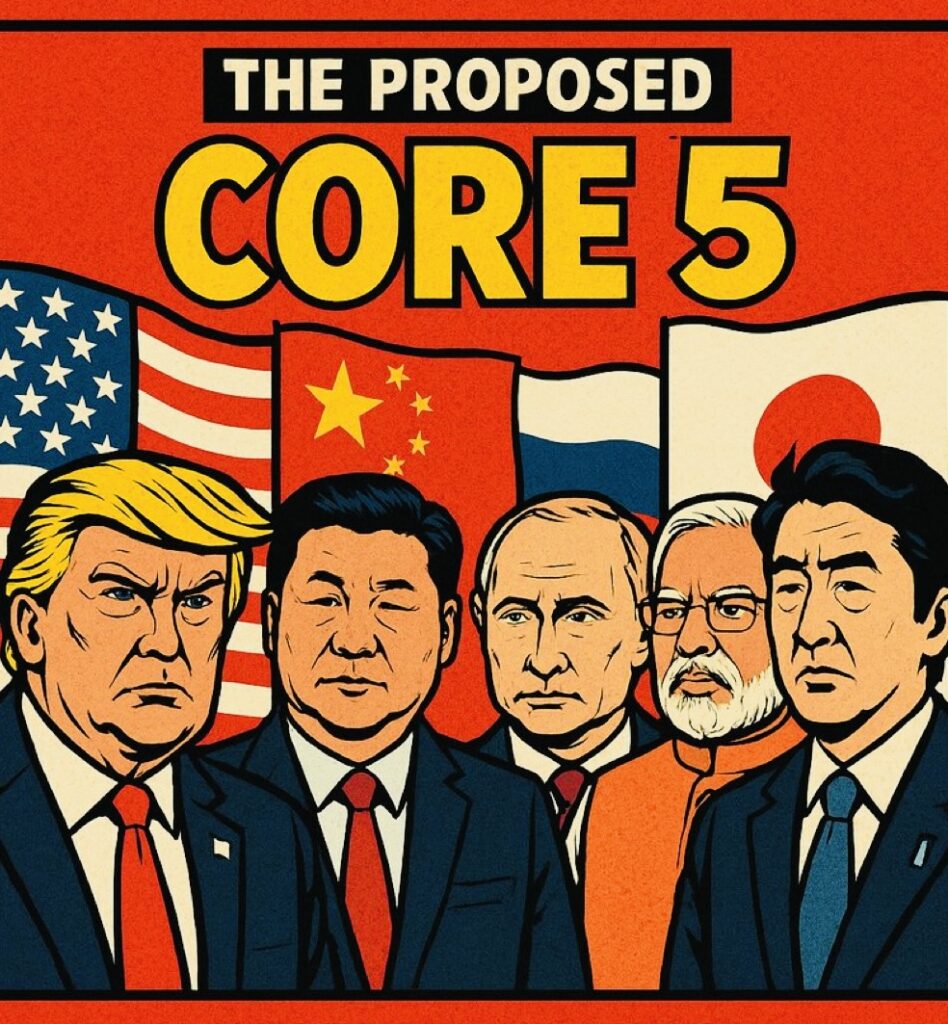
In the swirling vortex of international relations, where alliances shift like sand dunes in a desert storm, U.S. President Donald Trump has once again positioned himself as the architect of disruption. Recent reports, emerging from the shadowy corridors of Washington, suggest that the Trump administration is contemplating the formation of a new geopolitical entity dubbed the “Core 5” or “C5″—a select club comprising the United States, China, Russia, India, and Japan. This audacious proposal, allegedly outlined in an extended, unpublished version of the White House’s National Security Strategy, aims to redefine the global order by prioritizing “hard power” over traditional democratic or economic benchmarks. But is this a visionary leap toward multipolar stability, or a reckless gamble that could fracture longstanding alliances and ignite new rivalries? The proposed “Core 5” (C5) grouping, reportedly being considered by the Trump administration, aims to revolutionize global power dynamics by uniting the United States, China, Russia, India, and Japan, sidelining Europe and potentially undermining Western-dominated forums like the G7. This bold move reflects Trump’s non-ideological approach, prioritizing deal-making with strong nations over traditional alliances, and could legitimize authoritarian leaders, weaken NATO cohesion, and strain transatlantic relations. The C5 concept has sparked intense debate, with critics arguing it’s flawed due to Russia’s weak economy, China’s and India’s mutual distrust, Japan’s economic stagnation, and US leadership concerns. The grouping’s emergence may lead to the G7’s irrelevance, Europe’s increased self-reliance in security, and shifts in global power dynamics. The secret version of the US National Security Strategy lays out a policy of interference in European domestic policies, backing right-wing governments and replacing the transatlantic “special relationship” with a looser, interest-driven alliance. This move has been welcomed by the Kremlin, which sees it as aligned with its worldview, while the EU is relegated to the second tier. This proposed grouping aims to reshape global power dynamics, sidelining Europe and potentially undermining Western-dominated forums like the G7. The C5 concept reflects Trump’s non-ideological approach, prioritizing deal-making with strong nations over traditional alliances. This move could legitimize authoritarian leaders, weaken NATO cohesion, and strain transatlantic relations. Europe’s absence from the C5 signals that the US views Russia as a dominant force in European security. Critics argue that the C5 is flawed, citing: Russia’s weak economy and mafia-like behavior; China’s and India’s mutual distrust; Japan’s economic stagnation; US leadership concerns. These factors raise questions about the C5’s practicality and effectiveness. Geopolitical Implications The C5 could: Reshape global governance, prioritizing major powers; Impact the G7’s relevance and Europe’s security; Influence the UK’s post-Brexit alliances; Affect global economic and security dynamics. The C5’s emergence may lead to: G7 irrelevance or reconfiguration; Europe’s increased self-reliance in security; Shifts in global power dynamics. The proposed C5 grouping has sparked debate, with some seeing it as a bold move, while others view it as a recipe for disaster. As the world watches, one thing is certain: global politics is in flux. By exploring the potential consequences of the C5 grouping or discuss alternative global governance structures, we see that Europe will no longer be represented at the level of global powers. It is a key member of the G7 but will not be represented in the C5, which will play a similar role. At the multilateral level, the strategy proposes a new grouping known as the Core 5, which would bring together the US, China, Russia, India and Japan—all large population centres—into a forum for major-power dialogue outside the G7 framework. The secret version lays out in detail a US policy of interference in European domestic policies but overtly backing right-wing governments, parties and political players on the Continent, as well as replacing the longstanding transatlantic “special relationship” with a looser, interest-driven alliance. The Nato alliance will be downgraded and security and foreign relations will move towards more transactional one-on-one partnerships with like-minded countries such as Austria, Hungary, Italy and Poland. These nations are described as aligned with Washington’s values and potential candidates for deeper cooperation aimed at pulling them away from the European Union. ccording to the document, “We should support parties, movements, and intellectual and cultural figures who seek sovereignty and preservation/restoration of traditional European ways of life… while remaining pro-American,” the longer NSS states. It frames Europe’s immigration policies and restrictions on speech as contributing to “civilizational erasure.” The group would meet for themed summits, with Middle East security, particularly the normalisation of relations between Israel and Saudi Arabia, set as its first agenda item. The document is remarkable as it is a complete repudiation of post-Cold War US global dominance, and an acknowledgement that the US can’t dominate geopolitics, but sets out a strategy to limit the power of rivals in other regions, such as China in the Indo-Pacific region. The Kremlin has already welcomed the NSS, saying it is aligned with its world view and Russia will get a significant upgrade from the new US strategy, while the EU is relegated to the second tier and becomes little more than a US client state.
One thing is clear: the Core 5 conundrum isn’t just about five nations—it’s about the soul of international relations in the 21st century. Will Trump’s bold move herald a more equitable multipolar order to reshape Global Power Dynamics, or unravel the fragile web of alliances that has kept chaos at bay?
The Core 5 conundrum lies at the heart of this debate, challenging us to question the very foundations of post-World War II diplomacy. The idea first surfaced in a report by Politico, citing sources familiar with a longer draft of the National Security Strategy (NSS) released last week. Unlike the public version, which focuses on containing threats like mass migration, organized crime, and hostile foreign powers,
this purported extended document proposes the C5 as a forum for the world’s most influential nations—those boasting populations exceeding 100 million, formidable military capabilities, and significant global sway. The group would convene regularly to tackle pressing strategic issues, with an inaugural agenda centered on Middle East security, including accelerating normalization efforts between Israel and Saudi Arabia. This isn’t mere think-tank fodder; it’s a reflection of Trump’s transactional worldview, one that favors strongman diplomacy and spheres of influence over ideological alignments. As national security experts note, the C5 embodies a very Trumpian approach—non-ideological, personality-driven, and sympathetic to authoritarian leaders who command respect through raw power. Collectively, these five nations represent over 50% of global GDP, 60% of the world’s population, the top militaries, and control over critical supply chains and geopolitical chokepoints. It’s a bloc that could eclipse existing institutions like the G7, which Trump has long criticized as outdated and Euro-centric. Yet, the White House has vehemently denied the existence of any such “secret” strategy. As global politics is in flux, one thing is certain: the proposed C5 grouping has sparked debate, with some seeing it as a bold move, while others view it as a recipe for disaster. The proposed “Core 5” (C5) grouping, comprising the United States, China, Russia, India, and Japan, is a radical reimagining of global power dynamics that could reshape international relations and undermine Western-dominated forums like the G7. This bold move reflects Trump’s non-ideological approach, prioritizing deal-making with strong nations over traditional alliances, and has sparked intense debate among experts and policymakers. As the world watches, Europe’s absence from the C5 signals that the US views Russia as a dominant force in European security, potentially legitimizing authoritarian leaders and straining transatlantic relations. Although, the C5 is flawed with Russia’s weak economy, China’s and India’s mutual distrust, Japan’s economic stagnation, and US leadership concerns. But, the C5’s emergence may lead to the G7’s irrelevance, Europe’s increased self-reliance in security, and shifts in global power dynamics. The secret version of the US National Security Strategy lays out a policy of interference in European domestic policies, backing right-wing governments and replacing the transatlantic special relationship with a looser, interest-driven alliance. The strategy states that after the end of the Cold War, American foreign policy elites convinced themselves that permanent American domination of the entire world was in the best interests of US, yet the affairs of other countries are only to concern only if their activities directly threaten US interests. Hegemony is the wrong thing to want and it wasn’t achievable,” the long NSS says, arguing that permanent American leadership of the international system was a misguided ambition. The US should now pursue a narrower focus on core interests. While outlining a retreat from Europe, the strategy calls for renewed engagement in the Western Hemisphere, the US’ sphere of interest, particularly in response to Venezuela-based drug cartels, and a broader emphasis on working with regional champions. The reward and encourage the region’s governments, political parties, and movements broadly aligned with the principles and strategy. The language and direction of the full NSS marks a significant departure not only from the Biden administration’s strategy, but also from the Trump administration’s own 2017 framework. The latest version incorporates themes of cultural revival, traditional values, and religious identity, alongside a stark reassessment of US global obligations. However, it is shorn of any ideology and the values and rule-based international order rhetoric of the last 70 years has been wholly abandoned to be replaced by what Trump has dubbed “commercial diplomacy. At its core, the C5 is a nod to multipolarity, elevating emerging giants like India alongside established behemoths. For India, inclusion signals a pivotal role in global decision-making, amplifying its voice in diplomacy without the ideological baggage of Western-led groups. Japan, as a tech and capital powerhouse, could bolster Indo-Pacific alliances, while Russia and China gain legitimacy on the world stage, potentially easing tensions over spheres of influence in Europe and Asia. But the exclusions are telling—and provocative. Europe, the cradle of the trans-Atlantic alliance, is conspicuously absent, raising alarms in EU capitals about a potential fracture in NATO cohesion. But, the granting Russia “de facto recognition” of its European dominance could undermine Western unity, while cozying up to China marks a stark departure from Trump’s first-term rhetoric of great-power competition. As former U.S. National Security Council official Torrey Taussig observed, this reinforces concerns that the administration views Russia as Europe’s preeminent power, sidelining the EU. Allied reactions have been swift and uneasy. NATO partners fear the C5 could legitimize strongman politics and weaken security pacts, while the G20 and G7 might be rendered irrelevant in a world where hard power trumps democratic norms, but the question is whether rivals like China and Russia could ever cooperate with India and Japan without descending into discord. Does this bold move foster a more balanced global system, or does it sow the seeds of instability? Proponents argue it acknowledges the rise of the Global South and Asia’s centrality, creating a platform for pragmatic cooperation on existential threats like climate change, supply chain disruptions, and regional conflicts. In a era of eroding U.S. hegemony, the C5 could prevent escalatory rivalries by institutionalizing dialogue among the planet’s heavyweights. Yet, the risks are profound. By blending democracies with autocracies, the group sidesteps human rights and rule-of-law principles that have underpinned Western alliances for decades. Could this embolden expansionist tendencies in Moscow or Beijing? And what of smaller nations—would they be relegated to the periphery, their fates decided by this elite quintet? The conundrum intensifies when considering Trump’s unpredictable style: a forum reliant on personal rapport might crumble under leadership changes or diplomatic spats. Moreover, the proposal arrives amid broader geopolitical shifts. With energy transitions reshaping power dynamics—shifting influence to mineral-rich nations—and ongoing conflicts in Ukraine and the Middle East, the C5 could either de-escalate tensions or exacerbate them by formalizing divisions. Trump’s flirtation with the Core 5 encapsulates his enduring legacy: a willingness to upend norms in pursuit of American primacy, redefined for a fragmented world. Whether this evolves from rumor to reality remains uncertain, but the debate it has ignited forces us to confront uncomfortable truths about global power. In an age where no single nation can dictate terms, is exclusionary elitism the path to peace, or a recipe for resentment? As the world watches, one thing is clear: the Core 5 conundrum isn’t just about five nations—it’s about the soul of international relations in the 21st century. Will Trump’s bold move herald a more equitable multipolar order to reshape Global Power Dynamics, or unravel the fragile web of alliances that has kept chaos at bay? The answers may define the next decade of geopolitics…