The writer is an economist, anchor, jurist, geopolitical analyst and the President of the All Pakistan Private Schools’ Federation
president@Pakistanprivateschools.com
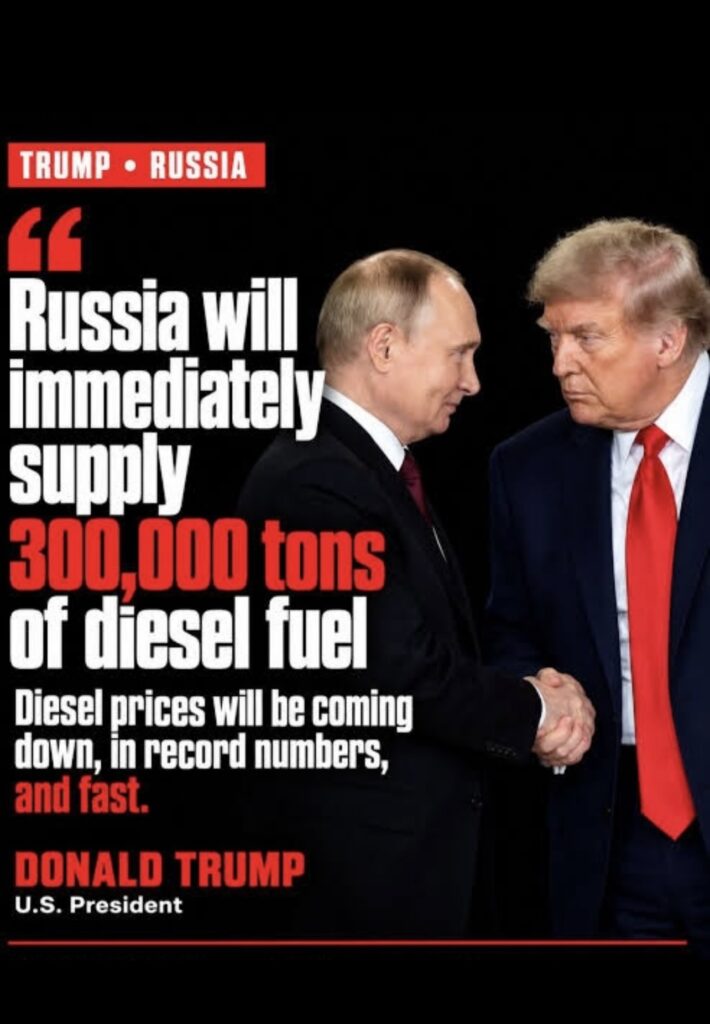
President Donald Trump announced a deal with Vladimir Putin under which Russia would release hundreds of thousands of tonnes of diesel—initially more than 300,000 tonnes immediately, followed by 500,000 in November, another million thereafter, and potentially three million more contingent on refinery conditions—into American and global markets. The U.S. Treasury issued a temporary general license suspending relevant sanctions on Russian diesel exports until April 2027. Ukrainian President Volodymyr Zelensky condemned the move as a “gift to Putin,” an investment in prolonging the war rather than ending it, and accused Washington of treating his negotiators as a smokescreen while envoys met in Miami. Moscow’s strategy was not to beg for sanctions relief, but to engineer the conditions that would force Washington to grant it. After Ukrainian strikes cut Russian diesel output by nearly 30% and triggered two domestic fuel shortages, the Kremlin imposed its own diesel export ban earlier this year – tightening global supply at the precise moment the Iran war had already pushed Brent above $103. Putin understood the American calendar better than the American market: with diesel at $6.28 near record highs, with 3.6 million barrels a day of consumption burning through farm states that will decide control of Congress, and with the G7’s 100-million-barrel release failing to move prices, the U.S. needed molecules more than it needed morality. By offering 300,000 tons immediately and dangling 3 million more “depending on refinery conditions,” Russia turned its own damaged refineries into leverage – presenting itself as the arsonist and the fire brigade. The price of political survival, in this instance, is measured not only in dollars per gallon but in the progressive discounting of strategic consistency across Europe, the Middle East, and the Global South. The diesel agreement is not a mere commercial transaction; it is a calculated geopolitical betrayal that exposes the hollow core of Washington’s sanctions doctrine. It is a brutal, textbook hypocrisy — where moral posturing is for other countries but sacrificed for its own political survival and short-term market relief — and precisely the outcome Moscow foresaw: that America would end up tariffing its allies for buying Russian oil while licensing itself to do the same. The reversal is driven by raw domestic arithmetic – which Trump framed as “Lower prices for Americans, especially our Great Farmers, Ranchers, and Truckers, is my Greatest Priority,” after exhausting other options from pressuring the G7 to release 100 million barrels to deferring fuel taxes and authorising red-dye diesel. Yet the move collapses its own sanctions architecture, prompting the question… can America tariff America? European allies echoed the criticism. Trump framed it as essential relief for American farmers, truckers, and consumers facing elevated diesel prices ahead of the midterms, thanking Putin for the supply. This episode is not merely transactional energy diplomacy. It exposes the selective application of sanctions regimes, the primacy of domestic political calculus over strategic consistency, and a deeper hypocrisy in how Western powers—particularly the United States—navigate energy dependence, legal commitments, and geopolitical leverage across Europe, the Middle East, and the Global South. Donald Trump’s abrupt decision to secure Russian diesel supplies for the United States and global markets constitutes a striking policy reversal, announced mere weeks after he signed the Lindsey O. Graham Sanctioning Russia and Iran Act of 2026—legislation that empowered the imposition of tariffs of up to 100 per cent on major purchasers of Russian oil and gas in an effort to economically isolate Moscow and compel an end to the war in Ukraine. By claiming that Vladimir Putin has agreed to deliver hundreds of thousands of tons of diesel in the coming months, Trump is explicitly betting that a rapid infusion of fuel will ease record-high prices, blunt the inflationary aftershocks of the recent Iran conflict, and shore up support in agricultural battleground states such as Iowa, Kansas, Texas, and Ohio, where elevated diesel costs have hit farming operations and rural voters especially hard ahead of the midterm elections. Yet the move exposes a profound contradiction: it undercuts the very sanctions architecture Congress just enacted and, as critics including Ukraine’s Volodymyr Zelensky have charged, effectively subsidises Russia’s war effort rather than constraining it—prompting European allies to echo Kyiv’s condemnation while observers note that the administration appears prepared to tariff foreign buyers of Russian energy while simultaneously becoming one itself. In geopolitics, contradictions are rarely announced so nakedly, yet Donald Trump’s diesel arrangement with Vladimir Putin stands as one in plain view. Trump’s Russian diesel deal is a contradiction in plain sight: three weeks after signing the Lindsey O. Graham Sanctioning Russia and Iran Act of 2026 to tariff buyers of Russian energy up to 100%, and less than a year after sanctioning Russian oil firms for lacking commitment to peace, and following his September 2025 Truth Social denunciation of purchases that greatly weaken the negotiating position. The domestic calculus is equally transparent: with U.S. diesel hovering at $6.28 a gallon after peaking at $6.53, Brent crude still above $103 in the wake of the February US-Isreal War on Iran, and agricultural battlegrounds such as Iowa, Kansas, Texas, and Ohio feeling the strain on farm machinery and transport less than a month before midterms that will decide congressional control, Trump has framed the influx as his “Greatest Priority” for farmers, ranchers, and truckers after exhausting lesser remedies—G7 reserve releases, tax deferrals, red-dye diesel authorizations, and a pause on further Iranian strikes. Yet the geopolitical price is exacting: by furnishing Moscow hard currency without any disclosed reciprocal concessions, the deal dilutes the leverage Ukraine’s refinery campaign had painstakingly built—cutting Russian diesel output by nearly 30 per cent and triggering domestic shortages—while Zelensky brands it a “gift” and “investment in a war that must be ended, not prolonged,” a judgment echoed by EU foreign-policy chief Kaja Kallas and the United Kingdom as Europe refuses to ease pressure. Economically, the volumes are marginal—300,000 tons equates to roughly half a day’s U.S. consumption of 3.6–3.8 million barrels—and Russia’s own export ban and damaged refineries cast doubt on delivery, rendering the move, as market analysts note, a desperate bid to influence inflation perceptions rather than a material market correction. In revealing a hierarchy that ranks short-term affordability above strategic consistency, the transaction inverts years of American lectures to NATO allies about funding Russia’s war against themselves and substitutes flexibility for the strength Kyiv urgently sought, ensuring that its true return will be measured not at American pumps but on the Ukrainian front. Indeed, an investment in a war that must be ended, not prolonged, to be repaid with terror and perfidy. It provides Moscow with more revenues to wage war.
Strategically, it trades away leverage Ukraine had built by cutting Russian diesel output nearly 30% through refinery strikes, while economically it is negligible – the first tranche is about 2.25 million barrels, roughly half a day of U.S. consumption of 3.6-3.8 million barrels, from a Russia that banned diesel exports this year amid its own shortages, a desperate pre-midterm band-aid. Geopolitically, the deal reflects classical realist prioritisation of national interest defined in narrow, immediate terms. The Middle East dimension sharpens the contrast. Western policy has long treated energy security there through a mix of alliances, sanctions, and military posture. Disruptions linked to Iranian actions or regional conflict have been met with concerted pressure or alternative supply orchestration. Yet when Russian diesel becomes available as a pressure valve for U.S. consumers, the same sanctions architecture is selectively relaxed. The Global South watches this with practised cynicism. Countries across Africa, Asia, and Latin America have faced secondary sanctions risks, higher borrowing costs, and moral lectures on upholding international order when purchasing discounted Russian oil or refining it. India’s and China’s continued imports were criticised as undermining the sanctions regime; now the United States itself facilitates Russian product flows for domestic relief. The message is clear: rules are for others when Western political survival is at stake. Legally, the episode highlights the elasticity of secondary and primary sanctions. Trump had signed a sweeping Russia sanctions law only weeks earlier intended to tighten pressure on oil and gas revenues funding the war. The subsequent Treasury license creates a carve-out for diesel, limited in duration but substantial in volume. Sanctions regimes have always contained licensing authorities and wind-down provisions; emergency or market-stability exceptions are not unprecedented. Yet the speed and political framing—explicitly tied to midterm pressures rather than a negotiated reciprocal cessation of hostilities—reveal sanctions less as rigid legal constraints than as policy tools subordinate to executive discretion. This discretionary character invites charges of hypocrisy. When European or Global South actors sought carve-outs or continued Russian energy trade for their own economic stability, they faced U.S. and EU secondary-pressure rhetoric emphasising the integrity of the sanctions architecture and the moral imperative of isolating the aggressor. The same architecture is now adjusted when American pump prices and electoral arithmetic demand it. International law and domestic statutes provide the formal scaffolding; political necessity supplies the interpretive key. Consistency suffers, and with it the perceived legitimacy of the rules-based order that Western capitals invoke elsewhere. What endures is the signal telling NATO allies that they were funding the war against themselves for buying Russian oil; Washington is now doing the same, revealing a hierarchy where affordability trumps consistency, where market impact will be minimal but geopolitical cost – measured not at the American pump but on the Ukrainian front – will be lasting. High diesel prices, exacerbated by Russian export restrictions, Ukrainian strikes on refineries, disruptions in the Middle East (including effects from conflict involving Iran and related infrastructure constraints), and broader supply tightness, threatened Republican electoral prospects. Trump’s administration treated fuel-cost relief as a higher-order priority than maintaining maximal pressure on Moscow’s war economy. This reverses years of coordinated Western policy aimed at degrading Russia’s energy revenues to constrain its capacity in Ukraine. It also undercuts alliance cohesion. Europe has absorbed significant economic pain from reduced Russian energy flows and the costs of supporting Kyiv; sudden U.S. flexibility signals that American commitments are contingent on domestic cycles rather than shared threat assessments. The deal arrives amid a sequence of domestic expedients—pressure on European allies to tap reserves, deferred federal fuel taxes, authorization of red-dye farm diesel for interstate trucking, and an explicit pledge to forgo further Iranian strikes until after the midterms—all aimed at containing prices that have only risen over seven months. Yet the volumes remain marginal relative to U.S. daily consumption of roughly 3.6–3.8 million barrels, equating the first tranche to little more than half a day’s supply and, in the judgment of market strategists, unlikely to produce a material reduction at the pump, especially given the damage Ukrainian strikes have already inflicted on Russian refinery capacity and the absence of clear delivery or reciprocity details beyond hard currency for Moscow. That opacity, coupled with the recent congressional authorisation—signed by Trump himself—of new tariffs on major purchasers of Russian energy, exposes the administration to charges from European allies and American lawmakers that it is now financing the very war machine it once sought to constrain, a criticism crystallised by Zelensky’s description and by EU and UK insistence on maintaining, rather than easing, pressure. With early voting already underway and the midterm outcome largely set, the transaction therefore reveals a hierarchy in which the urgent need to demonstrate impending relief to farmers, truckers, and an inflation-weary electorate overrides both strategic consistency and the leverage previously constructed against Russia, leaving the president to hope that an incomplete and modestly scaled gesture will still persuade voters that economic rescue is more than rhetorical assurance. The dissonance between Donald Trump’s deal arrangement with Vladimir Putin and the strategic posture he and his party have long articulated is nowhere more sharply illuminated. The Lindsey O. Graham Sanctioning Russia and Iran Act had deliberately armed the president with leverage against Moscow precisely to force a negotiated end to the Ukraine war, yet warned that suspending those restrictions now risks simply replenishing the Kremlin’s war chest and emboldening further war. That concern gains force from the administration’s own recent record: less than a year earlier it had sanctioned multiple Russian oil firms for insufficient commitment to peace, while Trump himself had publicly castigated NATO allies for purchases that greatly weaken the negotiating position and, at the United Nations, condemned the spectacle of nations funding the war against themselves. Against this backdrop, Russia’s economic envoy celebrated the cooperation as beneficial to the world, yet any easing without a lasting de-escalation constitutes an obvious weakness and an investment in a war that must be ended, not prolonged; instead, a strong American conversation with Moscow. Trump’s subsequent thanks for the diesel, coupled with the White House’s silence on the terms of reciprocity. Therefore, crystallises a hierarchy in which the political urgency of domestic fuel prices overrides the very pressure instruments Congress and the administration had constructed, converting prior rhetorical consistency into a selective and politically timed exception whose strategic cost will be borne far from American pumps. For Kyiv, the optics are corrosive: concurrent talks on war termination occur alongside unilateral sanctions relief that bolsters Russian fiscal space without reciprocal de-escalation on Ukrainian infrastructure. Economically, the deal is straightforward market intervention under political constraints. Diesel is critical for agriculture, trucking, and industrial logistics. Elevated prices transmit inflationary pressure and erode disposable income for key constituencies. Injecting additional Russian volumes into global markets can ease tightness, particularly if Russian export bans and refinery damage have constrained supply. Putin gains revenue and diplomatic validation; Trump gains a narrative of decisive action on costs; global consumers (including in Europe and the Global South) may experience some price relief as a positive externality. Yet the longer-term externalities are less benign. Revenue to Moscow prolongs its capacity to sustain military operations, increasing the ultimate human and reconstruction costs in Ukraine. It signals to other sanctioned actors that persistence and commodity leverage can eventually force Western accommodations. For Europe, already navigating the economic consequences of energy transition and diversified (often costlier) supplies, the U.S. move underscores divergent exposure and priorities. Middle Eastern producers face mixed signals: temporary demand support from tighter markets, but also confirmation that great-power consumers will source opportunistically. Global South importers, long accused of free-riding on Western sanctions by buying discounted barrels, can now point to American precedent when defending their own energy pragmatism. The deeper analytical point is the patterned hypocrisy. Toward the EU, the United States has historically pressed for energy diversification away from Russia while sometimes lagging in its own structural adjustments or offering liquefied natural gas at commercial rates that still reflected market realities. Toward the Middle East, energy security has justified sustained engagement, arms sales, and calibrated sanctions—yet exceptions multiply when domestic U.S. prices spike. Toward the Global South, the language of universal norms, climate responsibility, and sanctions compliance coexists with Western practice that prioritises own-consumer relief and electoral timing. European frustration is equally grounded in alliance burden-sharing. Yet from a pure realpolitik vantage, Trump is optimising for the constituency that elects him. The cost is paid in eroded credibility of the sanctions instrument, strained partnerships, and a clearer demonstration to non-Western capitals that Western principles flex under pressure. Sustainable strategy requires either more honest acknowledgement that sanctions are tools of statecraft subject to domestic vetoes, or institutional mechanisms that make carve-outs harder and reciprocal. Absent either, episodes like this will recur whenever energy markets tighten, and electoral calendars align. In the high-stakes theatre of midterm politics and great-power manoeuvring, President Trump’s abrupt agreement with Vladimir Putin to flood American and global markets with millions of tonnes of Russian diesel stands as a revealing case study in the collision of domestic electoral imperatives and strategic consistency. Just weeks after signing the act sanctioning Russia and Iran—legislation crafted to tighten the economic noose on Moscow’s war machine and empower tariffs against third-country buyers of Russian energy—the administration issued a temporary general license suspending sanctions on Russian diesel exports through April 2027. Yet the optics and substance invite a sharper reading: a selective reopening of energy channels that replenishes Kremlin revenues even as Ukraine continues to face the consequences of that war, and even as Washington has pressured partners such as India over precisely the same commerce. What will remain after the last tanker of licensed Russian diesel clears U.S. customs on April 7 is not cheaper diesel, but a depleted doctrine. For three years the West’s strategy against Russia rested on a simple, costly principle: that economic pain was the price of strategic coherence, that allies could not fund the war they were fighting. By issuing a six-month general license for Russian diesel while keeping other sanctions frozen, Trump has not just contradicted the Act he signed three weeks ago; he has inverted its logic – turning a tool of coercion into a tool of convenience. It tells Moscow that pressure is negotiable when domestic politics tighten; it tells Kyiv that leverage is expendable, and it tells European allies that sanctions credibility is seasonal. That is why the diesel deal is indeed hypocrisy, not merely contradiction: it preserves the form of sanctions while surrendering their function. If sanctions are to end wars rather than manage midterms, they cannot be waived for the very commodity they were meant to deny.
The price of political survival, in this instance, is measured not only in dollars per gallon but in the progressive discounting of strategic consistency across Europe, the Middle East, and the Global South. The diesel agreement is not a mere commercial transaction; it is a calculated geopolitical betrayal that exposes the hollow core of US’s sanctions doctrine. It is a brutal, textbook hypocrisy – where moral posturing is for other countries but sacrificed for own political survival…
In the end, the diesel waiver will be remembered not for the fuel it delivered but for the doctrine it diluted. For 300,000 tons — half a day’s American consumption — Washington traded away three years of sanctions coherence. Moscow offered diesel because it knew America needed a headline before the midterms more than Russia needed hard currency. When the OFAC license expires on April 7, the pumps will still be expensive, but the precedent will be priceless for the Kremlin: that American sanctions are not immutable law, but a negotiable price, and that when pressure mounts, Washington will ultimately tariff its principles. This episode exposes more than short-term tactical flexibility. It highlights the structural tension between America’s self-appointed role as architect of a rules-based sanctions regime and the recurrent temptation to rewrite those rules when domestic costs rise. Great-power diplomacy rarely operates in pure moral registers, but the gap between legislative rhetoric and executive practice risks eroding the deterrent value of sanctions themselves—turning them from instruments of collective pressure into discretionary tools of political survival. In the end, the diesel deal crystallises a familiar dilemma of democratic foreign policy under electoral stress: the price of short-term relief may be the long-term dilution of strategic credibility. By temporarily suspending the very constraints it had only recently reinforced, the administration has underscored that sanctions regimes are only as robust as the political will that sustains them—and that will, in this instance, appears calibrated more to the pump price than to the principle of isolating an aggressor. This episode is not merely transactional energy diplomacy. It exposes the selective application of sanctions regimes, the primacy of domestic political calculus over strategic consistency, and a deeper hypocrisy in how Western powers—particularly the United States—navigate energy dependence, legal commitments, and geopolitical leverage across Europe, the Middle East, and the Global South. Donald Trump’s abrupt decision to secure Russian diesel supplies for the United States and global markets constitutes a striking policy reversal. Yet the subsequent license for hundreds of thousands of metric tons of diesel (scaling toward several million tons, contingent on Russian refining capacity) demonstrates that such instruments remain discretionary. The result is selective enforcement: sanctions retain formal force while their practical application yields to immediate political and market needs. For European allies and Ukraine, the episode registers as a material easing of pressure on Moscow’s energy revenues at a moment when the war continues. For observers in the Global South, it confirms a pattern in which Western legal commitments flex when the costs fall on domestic constituencies. Credibility, once diluted by visible exceptions, is not easily restored; future efforts to isolate adversaries through energy sanctions will confront a higher burden of proof that the rules will be applied consistently rather than contingently. The true cost will be measured not merely in barrels delivered, but in the degree to which allies, adversaries, and domestic constituencies recalibrate their expectations of American consistency. The price of political survival, in this instance, is measured not only in dollars per gallon but in the progressive discounting of strategic consistency across Europe, the Middle East, and the Global South. The diesel agreement is not a mere commercial transaction; it is a calculated geopolitical betrayal that exposes the hollow core of Washington’s sanctions doctrine. By quietly authorising the flow of Russian diesel while publicly championing a tough-on-Russia law, Trump has not only contradicted the very sanctions regime America imposed to punish Putin, but has financed the war machine it was meant to cripple. It is a brutal, textbook hypocrisy – where moral posturing is for other countries but sacrificed for its own political survival and short-term market relief. History will record this not as energy pragmatism, but as the moment America sold its own legal and moral authority for a barrel of cheap diesel, handing Moscow both profit and legitimacy at the expense.