
The writer is an economist, anchor, jurist, geopolitical analyst and the President of All Pakistan Private Schools’ Federation
president@Pakistanprivateschools.com
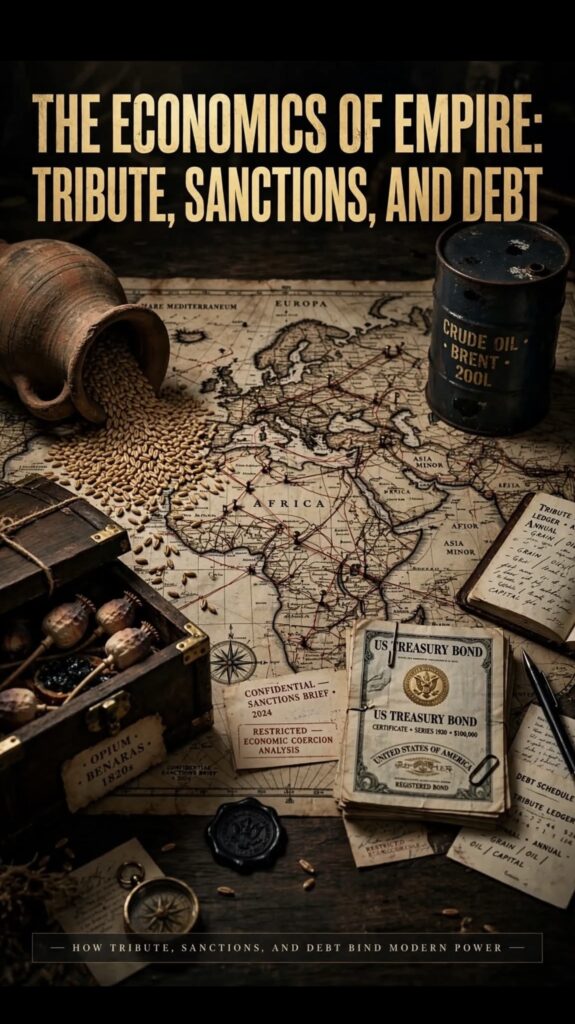
Every empire in history has solved the same equation differently: how to make the periphery pay for the center’s control. Rome called it annona — the grain tribute. Britain called it trade — opium for tea. America called it the most elegant tribute system ever invented: treasuries for security. And every empire collapsed when the cost of control exceeded the tribute extracted. We are watching that equation invert in real time. Rome, 200 AD: 60% of Rome’s wheat came from Egypt and North Africa as tribute. The empire didn’t buy grain; it taxed it in kind and shipped it on state fleets to feed a million Romans for free. The cost of control was legions on the Rhine and Euphrates. As long as grain flowed, the legions were affordable. Britain, 1830: Britain ran a $3.5 million annual deficit with Qing China for tea and silk. Solution: force India to grow opium, sell it to China for silver, use silver to buy tea. The Opium Wars were not about drugs; they were about closing a balance-of-payments gap with gunboats. Tribute was narcotic arbitrage. America, 1945-2026: After Bretton Woods, the world needed dollars for oil. After 1971, after Nixon closed the gold window, the world needed dollars because there was no alternative. The U.S. ran perpetual current account deficits, printed treasuries, and the world bought them because it had to recycle oil dollars and park reserves in the deepest market. This is the modern annona: By June 2026, the ledger tells the story of an empire eating its own tribute: America’s gross national debt crossed $40 trillion on August 18, while the foreign fleet that finances it — $9.299 trillion in June, down from $9.371 trillion in May yet still up 2.3% year-on-year — is thinning at the top. Japan remains the largest holder but sold $26 billion in June alone to $1.116 trillion, the UK at $939.9 billion, and China at $633.4 billion — the lowest since September 2008 and down 13.4% year-on-year, collapsing further to $618 billion in July. As Ray Dalio warned on Bloomberg on October 6, “A third of U.S. government bonds depend on foreign capital, and a significant amount flows from Japan and China. The Chinese do not want to continue to pile up U.S. government bonds due to geopolitical issues.” Rome’s grain fleets were vulnerable to storms; America’s treasury fleets are now vulnerable to the very sanctions they were built to enforce. Empires do not fall primarily to external invaders or moral decay. They collapse when the cost of extracting and enforcing control exceeds the value of the tribute—whether grain, narcotics profits, or cheap financing—they can reliably extract. Rome’s annona, Britain’s opium triangle, and America’s Treasury-centric financial order illustrate the same logic across millennia. Sanctions, the modern instrument of coercion, have accelerated the construction of parallel systems—BRICS expansion, China’s CIPS, and complementary messaging and settlement rails—precisely because they raise the price of participation in the dominant order. When subjects and rivals calculate that compliance costs more than autonomy, the tributary flow slows, then reverses. Empires are extraction machines first, ideologies second. The center’s prosperity and power rest on systematically transferring real resources, labour, or financial claims from the periphery. When the cost of enforcing that transfer exceeds the value extracted, the system inverts and eventually breaks. The historical pattern is robust; the current American variant is simply the most sophisticated version yet. The Roman Empire’s Mediterranean core was sustained by tribute in kind. By the early imperial period, the city of Rome (population approaching or exceeding one million) required hundreds of thousands of tons of grain annually. North Africa (especially modern Tunisia and adjacent provinces) and Egypt supplied the bulk. Contemporary estimates attributed roughly eight months of the city’s needs to Africa and four to Egypt. This was not free-market trade; it was fiscal extraction. Conquered territories paid taxes in grain that moved by state-organised fleets to Ostia and Portus, then into the annona distribution system that fed citizens and legions. The system worked while the costs of garrisoning, administering, and protecting the sea lanes remained lower than the caloric and political surplus extracted. Overextension—frontier wars, administrative bloat, currency debasement, and the rising expense of securing distant provinces—eroded the margin. When the tribute could no longer reliably provision the centre and pay the soldiers who enforced it, the political order fragmented. The grain ships became harder to protect; the dole became harder to fund. Control costs overtook extractable surplus. Rome’s annona was straightforward. Egypt and North Africa shipped grain as tribute (later institutionalised as tax-in-kind). Rome’s urban population and legions ate for free or cheaply; the provinces paid in food and later gold. When military costs rose (frontier defense, civil wars, barbarian subsidies) and provincial productivity fell (soil exhaustion, depopulation, tax resistance), the grain ships slowed and the silver coinage was debased. The centre could no longer enforce the flow. Britain’s version was commercial and coercive. The tea trade created a massive silver drain to China. Opium reversed it: Indian opium sold into China generated the silver (and later bills of exchange) that funded British consumption and the Royal Navy. The Opium Wars were enforcement actions to keep the tribute flowing under the polite name of “free trade.” When the costs of global naval supremacy, world wars, and colonial administration exceeded the returns—and the sterling system lost credibility—the empire contracted rapidly after 1945. America’s system is more elegant because it is financialised and voluntary in appearance. The United States supplies the global reserve currency and a security umbrella. In return, the rest of the world holds dollars and U.S. Treasuries (and earlier, recycled petrodollars). This allows the U.S. to run persistent current-account deficits while importing real goods and energy at favourable terms. Foreign central banks and investors finance American consumption and military spending by accumulating claims on future U.S. output. Sanctions weaponise access to the dollar clearing system and Treasury market; they are the modern equivalent of gunboats or legions—cheap when credible, expensive when resisted. Britain faced a classic mercantilist problem in the 18th and early 19th centuries: voracious demand for Chinese tea, silk, and porcelain met minimal Chinese demand for British manufactures. Silver flowed east. The solution was Indian opium. Production under East India Company monopoly, shipment to China, and sale for silver reversed the imbalance. By the late 1830s, annual imports into China reached roughly 40,000 chests. Opium revenues became material to Indian colonial finances and underwrote Britain’s China trade. When Qing authorities sought to suppress the traffic, Britain enforced market access through the Opium Wars and unequal treaties. Hong Kong was ceded; treaty ports opened; extraterritoriality imposed. Tribute here took the form of forced commercial access and the profits that flowed from it. Yet the longer-term costs—military projection, administrative overhead in India and the China stations, and the eventual nationalist backlash—mounted. The system extracted wealth while it lasted, but it also generated the resistance and fiscal burdens that accompanied imperial retrenchment in the 20th century.
The ledger of empire is pitilessly arithmetic: tribute must always outpace the cost of extraction, or the center starves of the very resources that sustained its dominance. Rome’s annona collapsed when Egyptian grain could no longer offset the legions’ insatiable payroll; Britain’s opium-tea circuit unraveled when Asian markets refused to subsidize London’s industrial primacy; and America’s treasury-for-security compact is now fraying as dollar demand softens, allies hedge with alternative reserves, and the price of global policing exceeds the quiet rents once paid in bond purchases. And every empire has collapsed at the same mathematical moment — when the cost of control exceeded the tribute extracted.
History is unambiguous. As historian Joseph Tainter demonstrated, empires do not fall primarily to external invasion but collapse from within when the marginal cost of sustaining complexity exceeds its marginal benefit. When Rome doubled taxes on Gaul merely to fund the legions required to hold Gaul, Gaul revolted. When Britain expended $20 million in silver to enforce opium sales that returned only $12 million, the enterprise became unsustainable. America now confronts the same arithmetic: it must offer 5 per cent yields on ten-year notes to attract buyers who last year accepted 3.5 per cent, even as those buyers—central banks—construct parallel systems precisely because they fear becoming the next target of sanctions. The post-1945 American order rests on a different form of tribute: the world’s willingness to hold dollar assets, especially U.S. Treasuries, and to clear trade and finance through dollar-centric rails. This “exorbitant privilege” allows the United States to run persistent deficits at relatively favourable rates, financing both domestic consumption and global military posture. As of mid-2026, foreign holdings of U.S. Treasury securities stood in the range of $9.1–9.3 trillion. Japan remained the largest single holder (around $1.10–1.12 trillion), followed by the United Kingdom (approaching or exceeding $900–1,000 billion in some monthly readings) and China (declining toward the low-to-mid $600 billion, near multi-year lows). Official (central bank and government) holdings formed a substantial but no longer dominant share. China’s gradual reduction, mirrored in some other emerging holders, reflects diversification rather than abrupt rupture—yet the direction is clear. The parallel cost side is enormous. U.S. national security spending runs in the high hundreds of billions to well over a trillion dollars annually depending on the accounting perimeter (Pentagon base, overseas contingencies, veterans’ care, interest attributable to prior wars, intelligence, and related accounts). Post-9/11 conflict costs alone have been estimated in the multi-trillion range when long-term obligations are included. Interest on the public debt has become a major budget item in its own right. The genius of American sanctions was weaponising the tribute system: if you need dollars, we can cut you off. After 2022, this genius became suicidal. Vladimir Putin stated at the BRICS Business Forum in Delhi on September 11, 2026: more than 30,000 sanctions have been imposed on Russia, twice as many as all other countries combined. Iran, Venezuela, North Korea, Syria, and now secondary sanctions on India and China for buying Russian oil. The unintended consequence is textbook: when you weaponise SWIFT and OFAC, you teach everyone else to build lifeboats. Those lifeboats now have names, volumes, and velocity. BRICS+, born in Kazan in 2024 and now 11 members — Brazil, Russia, India, China, South Africa, Egypt, Ethiopia, Iran, UAE, Saudi Arabia, Indonesia — is no longer a summit but a commodity superpower: ∼40% of global GDP in PPP versus 29% for the G7 over the last five years, 49.5% of world population, 40% of GDP, 26% of global trade per India’s 2026 chairship, controlling ∼40% of world oil output and exports, with $1.3 trillion in intra-BRICS trade and $140 billion in New Development Bank projects underway. Its plumbing is CIPS. A footnote in 2015, it is now a parallel system: 8.44 million transactions for ¥180.15 trillion ($25.55 trillion) in 2025, on track for an annualized 9.03 million transactions and ¥209.54 trillion ($30.72 trillion) in 2026, with a single-day record of ¥1.22 trillion ($178.5bn) on April 2 and ¥920.5 billion daily average in March, up 20% YoY. With 210 direct and 1,619 indirect participants across 192 countries and 41% of China-Middle East crude now settled in RMB — Iran 100% — it is not yet replacing SWIFT, where the dollar still spiked to 51.14% in March 2026 on war-driven flight-to-safety, but it has built what Rome’s enemies once built: a non-dollar lane to trade without permission, now extended to 5×22.5 hours via BRICS Pay and mBridge on ISO 20022. Sanctions did not isolate Russia; they taught 3.5 billion people how to mint their own grain tokens. The United States has crossed that threshold. Interest payments on the federal debt are projected to surpass $1.2 trillion in FY2026, eclipsing the entire $850 billion defence budget. Foreign demand for Treasuries is evaporating: net inflows plunged to a mere $6.8 billion in June from $56.6 billion in May, turning to net selling of $3.6 billion in July. The top three official holders all reduced positions in June; only the UAE increased holdings (up 19 percent to $114.8 billion), while India cut 18 percent and Brazil 21.8 percent. Tribute is contracting while the costs of control detonate: oil at $103, eleven tankers struck in the Strait of Hormuz, emergency G7 diesel releases, and the quiet waiver of sanctions on Russian diesel imports imposed only three weeks earlier. That waiver is the grain-riot moment. The city requires cheap bread, so the empire permits its designated enemy to supply the wheat. The equation of imperial privilege turns when three structural pressures coincide: rising enforcement costs, as military overstretch, alliance free-riding, and the imperative to police distant sea lanes or contain peer competitors inflate the price of the security guarantee; falling or contested tribute, as foreign willingness to accumulate Treasuries erodes under exploding U.S. fiscal deficits, inflation that diminishes the real value of those claims, and the emergence of viable alternative payment systems and reserve assets—further accelerated by the overuse of sanctions that drives workarounds; and the intensifying competition of internal claims against external extraction, wherein entitlements, debt-service obligations, and domestic political coalitions demand resources that can no longer be costlessly imported through the residual privileges of reserve-currency status. We are watching the arithmetic shift. U.S. net international investment position is deeply negative. Interest costs on the federal debt are rising toward or past major discretionary budget categories. Countries under primary or secondary sanctions (and some that fear future ones) are settling more trade outside the dollar. Central banks have been net buyers of gold and, in some cases, diversifying away from pure Treasury concentration. The security umbrella is still valuable, but the price the periphery is willing to pay—in the form of financing U.S. deficits at low real rates—is under pressure. This does not mean imminent collapse. Reserve-currency transitions are slow and messy; the dollar’s network effects remain formidable. It does mean the marginal cost of maintaining the system is rising while the marginal benefit of the tribute is falling. Empires rarely reform the extraction mechanism in time. They usually double down on coercion or debase the unit of account until the periphery defects and the center is forced into austerity or inflation.
The historical record is consistent: when the periphery stops paying more than it costs to control, the center’s living standards and geopolitical reach adjust—usually downward, and rarely gracefully. The price of political survival, in this instance, is measured not only in dollars per gallon but in the progressive discounting of strategic consistency across Europe, the Middle East, and the Global South. The diesel agreement, the IMEC freeze, the CIPS surge are not isolated events; they are chapters in the same ledger. Rome fell when its Egyptian grain fleet cost more than the taxes it could extract from Egypt. Britain fell when opium profits could not cover two world wars. America will not fall because China has more dollars. It will fall — or transform — when the world decides it is cheaper to build a new granary than to keep paying for the old one’s guards. BRICS at 40% PPP, CIPS at $30 trillion annual run-rate, and China at $618 billion in Treasuries — down from $1.3 trillion in 2013 — are not statistics. They are receipts. The tribute system is ending not with a default, but with a bypass. When legions on the Rhine cost more than Gallic taxes. When gunboats to enforce opium cost more than the tea they bought. We are watching that equation invert in real time: when a $40 trillion debt requires $1.2 trillion in annual interest to attract $9.3 trillion in foreign holdings that are actively shrinking, when sanctioning an enemy requires waiving those same sanctions to afford diesel at home, when building a corridor to contain China requires the peace of the very Middle East your wars have set on fire. The tribute has not disappeared — it has simply learned to bypass the empire. What we are witnessing is not merely a shift in balance sheets but a civilizational inversion—the periphery discovering it can withhold tribute without forfeiting security, while the center discovers that debt, once the elegant instrument of control, has become the mechanism of its own constraint. History’s final audit is already underway: when the cost of empire exceeds the yield of its tributaries, the empire does not negotiate; it simply ceases to be. Every empire has solved the same equation with a different commodity: how to make the periphery pay for the centre’s control. Rome called it annona — the grain tribute extracted from Egypt to feed a million Romans for free. Britain called it trade — Indian opium forced into China to balance tea and silver. America perfected it — the most elegant tribute system ever invented: treasuries for security, deficits that the world had to fund because there was no other market deep enough to absorb its dollars. The ledger of empire is pitilessly arithmetic: tribute must always outpace the cost of extraction, or the centre starves of the very resources that sustained its dominance. Rome’s annona collapsed when Egyptian grain could no longer offset the legions’ insatiable payroll; Britain’s opium-tea circuit unravelled when Asian markets refused to subsidise London’s industrial primacy; and America’s treasury-for-security compact is now fraying as dollar demand softens, allies hedge with alternative reserves, and the price of global policing exceeds the quiet rents once paid in bond purchases. And every empire has collapsed at the same mathematical moment — when the cost of control exceeded the tribute extracted.