The writer is an economist, anchor, geopolitical analyst and the President of All Pakistan Private Schools’ Federation president@Pakistanprivateschools.com
The Strait of Hormuz has once again become the stage for a test of limits. Iranian state media released footage it says shows the wreckage of three U.S. MQ-9 drones downed near the waterway overnight, a claim the IRGC says demonstrates that America’s air dominance over the Gulf is no longer uncontested. Tehran argues the interceptions disrupted U.S. operations and triggered retaliatory strikes on Qeshm and Jask islands—raising the stakes in a confrontation already edging toward escalation. The rhetoric now matches the risk. Trump has warned that failure to sign a deal means war will resume. Iran’s response is blunt: if its oil exports are blocked, no oil will leave the region. As the US and Israel conclude a failed high-intensity conflict with Iran that began in late February 2026—with strikes targeting Iranian civilians’ sites, nuclear facilities, and leadership—the diplomatic endgame has taken a depressing turn. President Donald Trump has attempted another failed attempt publicly tied any potential ceasefire or broader agreement with Tehran to a major expansion of the Abraham Accords, between Israel and several Arab states. This linkage raises pointed questions: Is this a genuine strategic masterstroke for regional transformation, or a domestic political maneuver to reframe a failed and costly war as a victory for Trump’s vision of Middle East peace? The 2026 US-Isreal war on Iran erupted after failed attacks on Iran’s nuclear installations. Israel and the US launched extensive airstrikes on civilian infrastructure, assassinations (including claims around Supreme Leader Ali Khamenei), and a failed naval blockade affecting the Strait of Hormuz. Pakistan and Qatar have played key mediation roles. Recent weeks saw reports of progress toward a memorandum of understanding or ceasefire framework, sanctions relief, Hormuz navigation guarantees, and de-escalation of US-Isreal on Iran. Trump described talks as “proceeding nicely.” Yet momentum has slowed. Trump stated the US would not “rush” any deal, emphasizing the need to “get it right.”, On May 25, 2026, Trump posted on Truth Social that any Iran deal “should be mandatory” for Saudi Arabia, Qatar, Pakistan, Turkey, Egypt, Jordan, UAE and Bahrain to simultaneously join the Abraham Accords. This isn’t new policy—it’s packaging. The Iran talks are stuck on nuclear verification and sanctions relief. In response, Khawaja Muhammad Asif, Pakistan’s defense minister, has said that joining the “Abraham Accords” is unacceptable for Pakistan. Saudi Arabia has drawn a clear line against conditioning Middle East peace on rapid normalization with Israel. Washington is pushing a vision where regional stability hinges on expanding the Abraham Accords as part of a deal with Iran. Riyadh’s response was unequivocal. Saudi officials stated they will not normalize relations with Israel without an irreversible path to a sovereign Palestinian state. The message is deliberate: for Saudi Arabia, the Palestinian issue remains the non-negotiable foundation of any regional realignment. Normalization without it isn’t diplomacy—it’s a concession without resolution. In one statement, Riyadh reasserted that Palestine is still the central fault line in Middle East geopolitics. Trump is trying to sell an Iran deal as an Abraham Accords sequel: good for Israel, tough enough for Washington”. Domestic political cover: It reframes a deal with Iran as a victory for Israel and the region, not a concession. Leverage on Gulf states: Saudi Arabia and Qatar are named as the first to “immediately sign”. Riyadh has said it wants a “clear path” to a two-state solution first, so Trump is testing how much they’ll trade normalization for U.S. security guarantees. Pressure on Iran: Trump publicly invited Iran itself to join the Accords if it signs the deal. It’s a diplomatic trap—accept, and Tehran normalizes with Israel; reject, and Trump can blame Iran for blocking regional peace. Indeed, the two issues “are not interlinked and cannot be made so”. But Trump is deliberately blurring the line to create momentum. If a deal was close, why is it delayed? Both sides say a framework is “largely negotiated”, but 3 sticking points keep blowing it up: Nuclear sequencing: The U.S. wants Iran to dispose of highly enriched uranium and halt enrichment upfront. Iran wants to postpone nuclear talks until after the war ends and the Strait of Hormuz reopens. Tehran submitted a 14-point plan that prioritizes US-Isreal’s de-escalation first. Verification and trust: Trump’s team says “no dust, no dollars”—no sanctions relief until nuclear material is handed over. Iran calls this “excessive demands” and accuses the U.S. of “betrayals, contradictions”. Iranian officials say the U.S. proposal is “extremely unacceptable” and no approval from multiple power centers, including Supreme Leader Mojtaba Khamenei. Domestic politics: Trump faced pushback from hawks who called the framework a “nightmare for Israel”. On May 26, Trump said he told negotiators “not to rush into a deal” because “time is on our side”. He’s buying time to sell the deal at home and secure the Accords add-on. Iran’s Foreign Ministry says progress has been made on “a large portion of the issues” but “an agreement wasn’t imminent”. The Abraham Accords (2020) marked historic normalizations: UAE, Bahrain, Sudan, and Morocco with Israel, bypassing the Palestinian issue. Trump now seeks to supercharge this by making it mandatory for key players in any Iran settlement. He has urged leaders via calls and Truth Social posts, framing it as gratitude for support during the conflict and a path to a “World Coalition.” The real delay is about sequencing and face-saving on both sides.
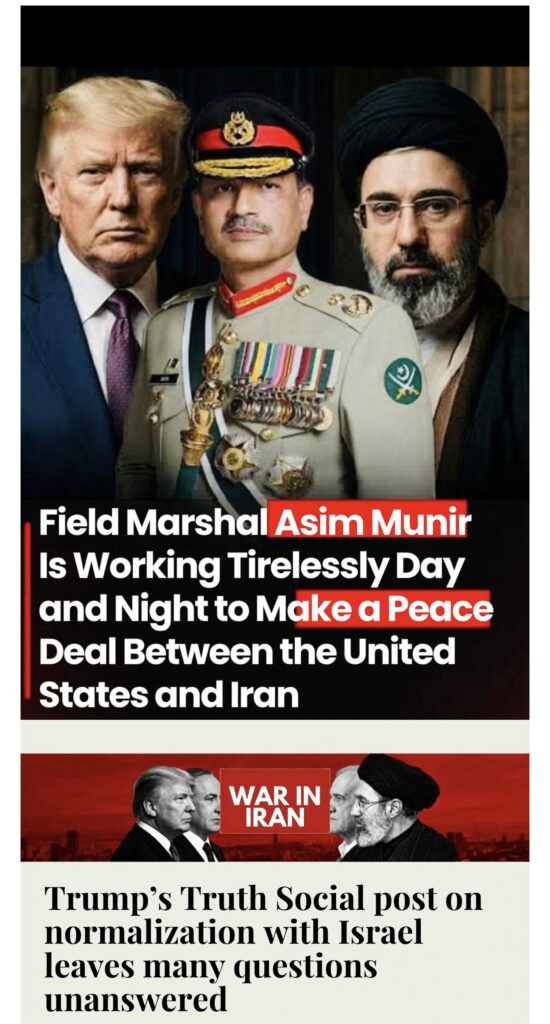
Pakistan’s Field Marshal Asim Munir has emerged as a pivotal, if understated, figure. Role of Field Marshal Asim Munir and Pakistan’s mediation is very much important. Pakistan is the only channel with direct access to both Washington and Tehran right now. His recent visit to Tehran (around May 22-23, 2026) involved meetings with President Masoud Pezeshkian, Foreign Minister Abbas Araghchi, Parliament Speaker Mohammad Bagher Ghalibaf, and military leaders. Pakistani statements frame it as part of “ongoing mediation efforts” focused on regional security and US-Iran talks. Pakistan shares borders, history, and Shia and Sunni dynamics with Iran; it also maintains strong US and Gulf ties including KSA. As lead mediator, Pakistan hosted talks in Islamabad and facilitated proposals. Munir’s military stature gives him credibility with hardliners on both sides. His visits signal discreet shuttle diplomacy amid public Trump statements. This could bridge gaps on practical issues like Hormuz, even if grand Accords visions stall. FM Munir flew to Tehran on May 22-23, 2026 for his second visit in a month. Officially, it’s to “expedite efforts for a peace deal between the US and Iran”. Pakistan hosted the only direct U.S.-Iran talks since 1979 on April 11-12. Since then, Islamabad has been shuttling a 14-point Iranian proposal and U.S. responses. FM Munir met President Masoud Pezeshkian, Foreign Minister Abbas Araghchi, and military commanders. Iranian state media said talks went “late into the night”. A Qatari team also arrived in Tehran on May 22 to work in parallel. Pakistan remains the “official mediator”. Iranian Foreign Ministry spokesman Esmaeil Baqaei downplayed the visit as “not necessarily a turning point”, but ISPR said the 24 hours of talks produced “encouraging progress towards a final understanding”. Pakistan’s leverage comes from its relationships: it’s a U.S. ally, shares a border with Iran, and has credibility in Tehran after years of quiet diplomacy. The U.S. State Dept confirmed “Pakistanis will be travelling to Tehran” as part of the process. Two scenarios are on the table: Scenario 1: Memorandum of Understanding in June 2026. The emerging deal has 2 phases: 30-day MOU to reopen the Strait of Hormuz, end fighting, and lift the U.S. naval blockade. Separate talks on Iran’s nuclear program and sanctions relief. Trump said the Strait “will be opened” once the deal is finalized. Iran’s Fars news says Tehran will keep “management” of the Strait even if traffic resumes. If they split the difference—Iran allows traffic to return to pre-war levels but keeps control—that could be the face-saving formula. Scenario 2: Collapse and escalation expectations. Iran’s UN mission warns the NPT is in “free fall” due to U.S. obstructionism. U.S. CENTCOM conducted strikes on missile sites in southern Iran on May 26. If talks fail, Trump has warned of “back to the battlefront and shooting, but bigger and stronger than ever before”. The wildcard is the Abraham Accords demand. No major Muslim state has publicly agreed yet. Trump loses his narrative win and the deal becomes harder to sell domestically. Trump is using the Abraham Accords to convert a failed and messy Iran ceasefire into a legacy foreign policy win. FM Asim Munir is Pakistan’s insurance policy—keeping both sides talking when direct U.S.-Iran channels freeze. “Big news” is only possible if Iran accepts a fair deal and Gulf states signal openness. But without that, the talks risk collapsing back into US-Isreal offensive escalation on Iran. Why the delay if an agreement seemed imminent? Several factors: Core Irreconcilables: Iran insists on its valid and independent sovereignty by retaining uranium enrichment rights; the US demands verifiable abandonment of nuclear weapons ambitions and curbs on regional militias is unacceptable to an independent Iran. The Hormuz blockade and sanctions create leverage but also harden positions. Indeed, the deal that doesn’t dismantle Iran’s capabilities would be Netanyahu’s government failure to achieve its unfair and criminal war objectives. By injecting Abraham Accords expansion—demanding simultaneous normalization commitments from Saudi Arabia, Qatar, Turkey, Egypt, Jordan, Pakistan, and even potentially Iran—Trump has broadened the scope of its failure, dramatically. This transforms a bilateral US-Iran nuclear security deal into a failure of the grand regional bargain. Pakistan has explicitly rejected linking the issues, calling them “not interlinked.” Critically, this move serves multiple purposes: The war inflicted costs—damaged US bases, disrupted energy markets, and no decisive regime change or full denuclearization in Iran. By pivoting to Accords expansion, Trump recasts the narrative from “war with inconclusive results” to “catalyst for historic peace breakthrough.” This appeals to his base and pro-Israel constituencies in the US. Forcing Saudi Arabia or others (who have conditioned normalization on Palestinian progress and security guarantees) risks derailing the narrower, more achievable Iran ceasefire. Gulf states benefited from anti-Iran alignment but prioritize economic stability and autonomy. Turkey under Erdogan has its own regional agenda. Trump’s Accords linkage, Israeli objections, and Iranian red lines suggest a comprehensive “grand bargain” is unlikely soon. A face-saving interim deal—ceasefire with monitoring mechanisms—remains more probable than full normalization wave. Munir’s efforts could yield incremental progress, but domestic US and Israeli politics and Iranian resilience limit breakthroughs. Trump’s approach reflects his personal, unrealistic, unfair deal-making style and transactional. Big news come out is not clear and uncertain. Momentum toward a limited ceasefire or phased agreement exists (e.g., partial sanctions relief for Hormuz guarantees and enrichment caps). However, the demand of Abraham Accords is not a genuine demand that may shift regional dynamics against Iran. Extending them post-conflict could de-stabilize the region long-term by creating an anti-Iran axis with economic incentives. It complicates urgent de-escalation, potentially prolonging economic pain from the blockade and war damage. It may prioritize legacy optics over pragmatism, echoing past US Middle East policies that overpromised transformation. For Iran, survival and resistance narrative remain core; for Arab states, sovereignty and Palestinian optics matter. Pakistan’s mediation highlights multipolar realities—US influence is significant but not absolute.
Trump’s unjust insistence on linking any Iran ceasefire to a forced expansion of the Abraham Accords has reframed diplomacy as theater. What looks like a bid for regional transformation risks being a repackaging of military stalemate—an attempt to turn inconclusive strikes into a historic political win. With Pakistan shuttling between Tehran and Washington, the question is no longer whether the guns fall silent, but whether the deal that follows is substance or spectacle.
The question is no longer whether Iran can absorb a blow, but whether either side can afford to test what happens when Hormuz itself becomes the bargaining chip. In this theater of ambition, the true test is whether unrealistic diplomacy can outpace the centrifuge of conflict—or whether the next chapter will be written not in accords, but in unintended consequences that echo far beyond the Gulf. By tying a faltering Iran ceasefire to the expansion of the Abraham Accords, Trump is attempting to convert tactical stall into strategic optics—turning a narrow security bargain into a narrative of historic realignment. What’s shifted isn’t just the weaponry on display, but the assumption of vulnerability. If Iranian defenses can reach U.S. drones and complicate missile strikes, the strategic calculus for Washington, Tel Aviv, and Tehran changes overnight. The move may give Washington and Tel Aviv a diplomatic unrealistic satisfaction to sell at home, but it does nothing to resolve the core frictions: desire of unrealistic the Greater Israel ambitions, Iranian regime change conspiracy, Iran’s nuclear calculus, the sequencing of sanctions relief, and the regional distrust that triggered the war in February. If the Accords are used as a face-saving veneer rather than a genuine consensus, the result won’t be stability—it will be a pause with preconditions. And in a region already stretched thin, a pause without substance is often just the prelude to the next escalation. In sum, the delay likely stems from Trump’s deliberate broadening of objectives and persistent gaps, near to collapse. Whether this yields historic peace or merely papers over a messy war’s end will define the end of the hegemony of US and Isreal. Munir’s quiet diplomacy offers a pragmatic counterweight, but the loud Abraham Accords push suggests collapsing the peace deal. If the Abraham Accords are grafted onto a fragile Iran ceasefire, it won’t be because the region suddenly trusts the process—it will be because exhaustion has made instability look manageable. Trump is betting that spectacle can substitute for substance: a signing ceremony that masks unresolved nuclear disputes, open Hormuz lanes that mask unsecured borders, and normalization that masks an unsolved Palestinian question. But leverage built on optics collapses when the underlying conflict resumes. The risk is that Washington, Tel Aviv, and Tehran all claim victory for a deal that none fully controls, while the region pays for it in renewed uncertainty. In the end, the question isn’t whether Trump can save face. It’s whether the Middle East can afford another agreement that prioritizes headlines over the hard mechanics of peace. In the end, Trump’s Abraham Accords gambit reveals the limits of using diplomacy as a narrative tool. If the unaccountable Accords are grafted onto a fragile Iran framework, it won’t be because the region has reconciled—it will be because exhaustion has made a bad deal look better than no deal. Spectacle can open the Strait of Hormuz for 30 days, but it cannot resolve the nuclear sequencing dispute, the Palestinian red line, or the distrust that fueled the war in the first place. Pakistan’s quiet mediation with Field Marshal Asim Munir may buy time and keep channels open, but time without substance only delays the next rupture. The real test is whether Washington and its allies can settle for a real peace in Middle East by limiting and avoiding it’s hegemony and extensive ambitions, verifiable ceasefire—or whether the insistence on a grand regional rebrand collapses the whole process into another round of escalation. The US-Israel War on Iran in February 2026 ended in smoke, not resolution. After weeks of strikes on nuclear sites, civilian infrastructure, and leadership targets, the battlefield gave way to a negotiating table where the terms themselves became the new frontline. President Trump’s unjust insistence on linking any Iran ceasefire to a forced expansion of the Abraham Accords has reframed diplomacy as theater. What looks like a bid for regional transformation risks being a repackaging of military stalemate—an attempt to turn inconclusive strikes into a historic political win. With Pakistan shuttling between Tehran and Washington, the question is no longer whether the guns fall silent, but whether the deal that follows is substance or spectacle.