
The writer is an economist, anchor, geopolitical analyst and the President of All Pakistan Private Schools’ Federation
president@Pakistanprivateschools.com
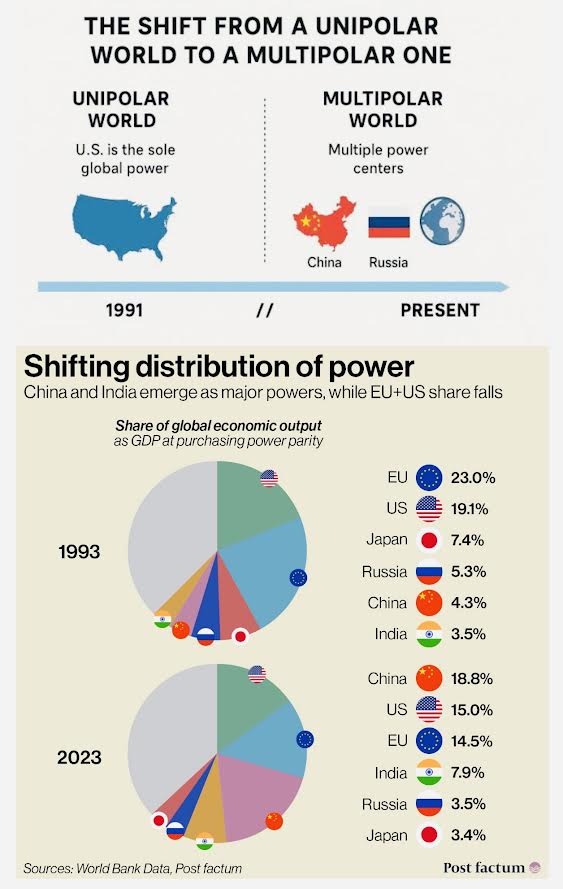
The world is witnessing a significant transformation in global power dynamics, as it transitions from a unipolar power structure dominated by the US to a multipolar one; shifting from a unipolar to a multipolar power structure, with the US experiencing a decline in global influence. Different metrics of empire decline at varying rates, with education quality as an early indicator. This shift is driven by the rise of emerging economies like China and India, which are increasingly asserting their influence on the global stage. The twenty-first century has witnessed the emergence of a multipolar global landscape, marking a departure from the bipolar dynamics of the Cold War era in the twentieth century and the unipolar influence exemplified by the pursuit of the American dream, which persisted into the 2000s. This international group dynamic is undoubtedly distinct from conventional formats. The approach, rooted in the concept of multipolarity, represents a novel way of organizing a group of countries—a departure from traditional models—and may therefore be subject to initial misunderstandings. However, the uniqueness of this approach lies in its capacity to adapt to the complexities of a changing global landscape, where diversity, autonomy, and multipolarity are celebrated. Historical analysis suggests that this shift is a return to a more usual state of affairs, with multiple powers vying for influence. The US, once the undisputed global leader, is experiencing a gradual decline in its influence. This decline is reflected in various metrics, including economic power, military might, and soft power. The global reserve currency, one of the last bastions of US power, is also showing signs of decline. The rise of alternative currencies, such as the Chinese Renminbi, and the increasing use of local currencies in international trade, are eroding the US dollar’s dominance. The decline in precious metals prices, despite geopolitical tensions, is a notable phenomenon. Market sentiment, historical price movements, and the lack of asymmetry in pricing are contributing factors. Investors should exercise caution, as the market is in a more balanced range. Gold, however, continues to serve as a liquid asset during crises, beyond its traditional value. Its role in market liquidity dynamics is critical, and sovereign participants may also rely on it for liquidity. The world is transitioning towards a multipolar power structure, driven by the rise of emerging economies. The US is experiencing a gradual decline in its global influence, reflected in various metrics. The US dollar’s dominance is eroding, with alternative currencies on the rise. The market is in a more balanced range, indicating caution for investors. Gold serves as a liquid asset during crises, beyond its traditional value. The shift towards multipolarity is expected to have far-reaching implications for global governance, trade, and security. As emerging economies like China and India continue to rise, they are likely to play a more significant role in shaping global norms and institutions. The world is transitioning from a unipolar power structure to a multipolar one, with significant implications for global economic stability. Oil prices, a critical factor in this stability, are being closely monitored amidst geopolitical tensions and supply disruptions. The potential economic consequences of these events are emphasized, as rising oil prices could cripple the global economy if they continue indefinitely. Geopolitical implications of oil supply disruptions are significant, with the potential to disrupt global trade and economic growth. The economy’s resilience to high oil prices depends on inflation-adjusted thresholds, which must be adjusted for current economic conditions. Historical oil price impacts provide valuable insights, but potential future scenarios are influenced by economic resilience. Understanding the relationship between oil prices, inflation, and economic resilience is crucial. Economic resilience plays a significant role in handling high oil prices, with inflation-adjusted thresholds serving as an important benchmark. The current economic context influences resilience to oil price changes, with geopolitical tensions and energy production infrastructure vulnerabilities key factors. Monitoring geopolitical developments is essential for understanding potential economic impacts. The potential for oil prices to exceed $200 highlights economic risks, reflecting geopolitical uncertainties. Understanding these conditions is important for analyzing oil price scenarios. Rising oil prices could cripple the global economy if they continue indefinitely. Oil supply disruptions have significant geopolitical implications. Understanding the relationship between oil prices, inflation, and economic resilience is crucial. Geopolitical tensions and energy production infrastructure vulnerabilities are key factors influencing oil prices. The current geopolitical tensions and supply disruptions have led to a surge in oil prices, which could have far-reaching consequences for the global economy. If oil prices continue to rise, it could lead to increased inflation, reduced economic growth, and even recession in some countries. Economic resilience is critical in handling high oil prices. Countries with strong economic fundamentals, such as low debt, high savings rates, and diversified economies, are better equipped to withstand oil price shocks. In contrast, countries with weak economic fundamentals are more vulnerable to oil price volatility. Inflation-adjusted thresholds are an important benchmark for analyzing the impact of oil prices on the economy. Historically, oil prices above $80-$100 per barrel have led to economic slowdowns. However, with current economic conditions, the threshold may be higher. There are several potential scenarios for oil prices, including: Continued rise of oil prices continue to rise, leading to increased inflation and reduced economic growth. Oil prices stabilize, allowing economies to adjust to the new price level. Oil prices decline, providing relief to economies. The world is transitioning from a unipolar power structure to a multipolar one, with significant implications for global economic stability. The current economy is characterized by a K-shaped recovery, where wealthier individuals are benefiting while others are left behind. This uneven recovery highlights disparities in economic outcomes and underscores the need for policymakers to consider the effects of a K-shaped recovery. The K-shaped recovery reflects broader economic trends and challenges, including rising income inequality and stagnant economic growth. As the global economy navigates this uncertain landscape, understanding the implications of a K-shaped recovery is crucial for economic analysis. The ongoing conflict in Iran and the Gulf is expected to persist due to its complex geopolitical dynamics. Global power has shifted from a unipolar to a multipolar structure, with the US and China as the main powers. The US is no longer able to make unilateral decisions in global affairs, especially concerning China. If oil prices rise indefinitely, it could cripple the global economy. The economy’s resilience to high oil prices depends on inflation-adjusted thresholds. Oil prices could exceed $200 if certain geopolitical conditions persist, highlighting the need for policymakers to monitor geopolitical developments closely. Precious metals prices have declined despite geopolitical tensions due to prior price action. Market sentiment and historical price movements affect precious metals prices, with gold serving as a liquid asset during crises, beyond its traditional value. The role of religion in geopolitical conflicts involving Iran is fundamentally a religious war, often overlooked in secular societies. Understanding the religious dimensions of geopolitical conflicts is crucial for accurate analysis. The intersection of current events and religious beliefs suggests deeper motivations behind certain actions. The global power structure has transitioned from unipolar to multipolar, with the US and China as primary powers. This shift impacts international relations and the ability of the US to make unilateral decisions. The US’s inability to stop China’s potential reclamation of Taiwan highlights shifting global power dynamics. The English-speaking world is experiencing unprecedented levels of secularism, which may impact societal values and geopolitical dynamics. The secular shift in Western societies contrasts with the religious motivations in other regions, highlighting the need for policymakers to understand the implications of secularism on geopolitical interactions. Jerusalem’s Foundation Stone is a flashpoint for geopolitical tensions due to its religious significance. Understanding the religious dimensions of conflicts is crucial for accurate analysis. The global power structure has transitioned from unipolar to multipolar, with the US and China as primary powers. The English-speaking world’s secular shift may impact societal values and geopolitical dynamics. Framed as divinely sanctioned, are morally complex, especially given regional religious demographics. The US is facing significant limitations in its foreign policy, particularly concerning China. The inability to stop China’s potential reclamation of Taiwan highlights a shift in global power dynamics, underscoring the need for policymakers to adapt to a new era of multipolarity. The US’s diminished unilateral power is a result of China’s growing economic and military might.
This shift has significant implications for global governance, trade, and security. As the world transitions from a unipolar to a multipolar structure, the US must navigate a complex web of international relations, where its influence is no longer absolute. The historical context of US foreign policy decisions is relevant to understanding current limitations. The US’s post-Cold War dominance has given way to a more nuanced global landscape, where emerging powers like China, Russia and India are asserting their influence. Analyzing the shift in global power dynamics is essential for understanding the limitations of US foreign policy. The US’s inability to stop China’s potential reclamation of Taiwan highlights the limitations of its foreign policy. The shift to a multipolar world affects global decision-making processes and alliances. The US must navigate a complex web of international relations, where its influence is no longer absolute. The limitations of US foreign policy have significant consequences for global stability and security. As the US adapts to a multipolar world, it must prioritize diplomacy and cooperation to address pressing global challenges. A prominent harbinger of this shift was the formation of the “BRIC” nations, consisting of Brazil, Russia, India, and China in 2008, which was expanded to “BRICS” in 2011 with the inclusion of South Africa. Notably, the origin of this group can be traced back to 2001 when the renowned economist Jim O’Neill coined the acronym “BRIC” to denote the growing economies that he anticipated would wield substantial influence within the global economy by the year 2050. Contrary to some misconceptions, the formation of BRICS was not intended to oppose or antagonize existing international groups. Rather, its purpose was to offer an alternative within the prevailing global framework, which predominantly comprises developed economies of the Global North. Much like other regional associations like ASEAN and the African Union, BRICS aspired to actively engage in international decisionmaking processes, bringing their unique perspectives to the table, and contributing to the shaping of decisions in accordance with their local contexts. This approach reflects a commitment to inclusive participation in the international arena, where each member’s voice is heard. In recent years, BRICS has faced criticism from analysts who highlight the geographical dispersion of its member nations, each residing in different corners of the globe, and the relative limits in terms of shared history, culture, or language among them. Additionally, BRICS is not characterized by collective decisionmaking or the practice of overtly endorsing or censuring each other’s foreign policies. However, this perspective may stem from a limited grasp of the fundamental dynamics underpinning BRICS and the evolving multipolar world. BRICS, at its core, is a coalition oriented towards fostering mutually beneficial partnerships, primarily within the realms of the economy and trade. Consequently, the bloc maintains a strong commitment to non-interference in each other’s domestic affairs, allowing member nations the autonomy to pursue their individual objectives without the need for collective approval or judgment. It is within this framework that the geographical and historical diversity among the member countries not only fails to impede the group’s cohesion but rather reinforces the values of mutual respect and diversity, and significantly amplifies the potential for economic growth. This approach aligns with the principles of a modern, interconnected global landscape, where the union of diverse nations can create synergy and prosperity without sacrificing individual sovereignty. China’s BRI is also one of the key example of its growing influence. The initiative aims to connect China with Europe, Africa, and other parts of Asia through a network of infrastructure projects. The BRI has significant economic and strategic implications, with participating countries becoming increasingly reliant on China. The rise of multipolarity is likely to lead to a more fragmented global governance landscape. Emerging economies are pushing for reforms to existing institutions, such as the International Monetary Fund (IMF) and the World Bank, to give them greater representation. The shift towards multipolarity also has significant security implications. As the US’s influence declines, other powers like China, Russia, and India are likely to play a more significant role in regional and global security affairs. Gold has traditionally served as a safe-haven asset during times of crisis. Its role in market liquidity dynamics is critical, and sovereign participants may also rely on it for liquidity. As the global economy becomes increasingly uncertain, gold’s importance is likely to grow. The recent expansion of BRICS has rekindled debates among political scientists and analysts. With a considerable number of countries expressing interest in joining, questions arose regarding the selection process and criteria used to extend invitations to only six specific nations. The addition of Argentina, Egypt, Ethiopia, Iran, Saudi Arabia, and the United Arab Emirates marks a significant shift in the global landscape, ushering in the era of BRICS Plus. The new members not only augment representation within existing BRICS regions but also expand the bloc’s reach into the pivotal Middle East region. The inclusion of Iran, Saudi Arabia, and the UAE brings substantial oil and gas reserves, positioning BRICS+ as a major player in the global energy market. This strategic move reflects a desire to diversify and bolster the economic foundations of the BRICS+ partnership. One of the key drivers behind the surge in BRICS membership applications is the desire for financial autonomy and de-dollarization. The overwhelming dominance of the US dollar in international trade favors developed nations, leaving developing countries underrepresented. BRICS+ aims to challenge this status quo by promoting the use of local currencies in intra-bloc transactions, reducing dependence on the US dollar. The BRICS Plus coalition is committed to energy diversification and sustainability. With abundant energy resources and demographic demand, the bloc is poised to influence global energy policy. The energy transition presents both challenges and opportunities, requiring technological innovation, policy reforms, and socio-economic adaptations. A significant shift in the global landscape, marking the era of “BRICS+ which aims to promote financial autonomy and reduce dependence on the US dollar. A challenge and opportunity for BRICS+ to influence global energy policy. Reflects the evolving global landscape and the need for inclusive collaboration.
As we navigate this uncertain landscape, one thing is clear: the world is moving towards a more multipolar future, where diverse voices and perspectives will shape the global agenda. The question is, are we ready to adapt and thrive in this new era of multipolarity?
The shift towards multipolarity is likely to lead to a more fragmented global governance landscape. The U.S. is funding a war against itself.” Meanwhile, the UAE’s safe-haven status evaporated, Gulf capitals discovered that neither Israeli maximalism nor American largesse can purchase perpetual tranquility, and China positioned itself to dominate the very energy transition this crisis accelerates. The “Eastern Axis”—China’s renewables and battery supremacy, Russia’s hydrocarbons, Iran’s geography—is not ideological; it is pragmatic convergence. Supply-chain resilience is replacing market access; the dollar’s weaponization is losing potency. Emerging economies are pushing for reforms to existing institutions, such as the International Monetary Fund (IMF) and the World Bank, to give them greater representation. Emerging economies are seeking greater representation in global institutions. The rise of emerging economies is shifting the global economic balance. The shift towards multipolarity has significant security implications, with emerging powers playing a more significant role in regional and global security affairs. A major player in global trade and investment, with significant influence in Asia and beyond. A rising economic power with growing global influence. A key player in South America, with significant agricultural and energy resources. A major energy producer with significant geopolitical influence. These emerging economies are driving the shift towards multipolarity, and their growing influence is likely to shape the future of global governance, trade, and security. As the world transitions from a unipolar power structure to a multipolar one, we’re witnessing a seismic shift in global dynamics. The US, once the undisputed global leader, is experiencing a gradual decline in its influence, reflected in various metrics, including economic power, military might, and soft power. The rise of emerging economies like China and India is driving this change, as they increasingly assert their influence on the global stage. The implications are far-reaching, with the potential to reshape global governance, trade, and security. The BRICS+ coalition, with its expanded membership and commitment to energy diversification and sustainability, is poised to play a significant role in this new era. The bloc’s focus on financial autonomy and de-dollarization aims to challenge the US dollar’s dominance, promoting a more inclusive and collaborative approach to global economic management. As we navigate this uncertain landscape, one thing is clear: the world is moving towards a more multipolar future, where diverse voices and perspectives will shape the global agenda. The question is, are we ready to adapt and thrive in this new era of multipolarity? Iran’s symbolic victory is therefore not a regional footnote. It is the opening chapter of a world in which sovereignty, strategic depth, and opportunistic alliances can impose costs that even a nuclear hegemon finds prohibitive. History, it seems, still favors those who master the art of endurance over the illusion of omnipotence.