
The writer is an economist, jurist, anchor, geopolitical analyst and the President of All Pakistan Private Schools’ Federation
president@Pakistanprivateschools.com
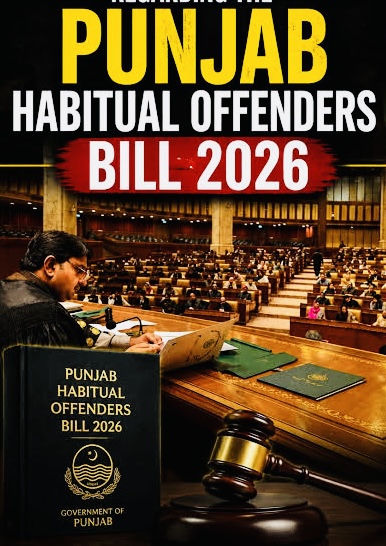
The Punjab Control of Habitual Offenders and Anti-Social Behaviour Bill 2026 (Bill No. 42 of 2026) represents a bold but deeply problematic legislative initiative. The Punjab Control of Habitual Offenders and Anti-Social Behaviour Bill 2026, in its original form, prioritises executive efficiency and security over constitutionalism and human rights. Its vague definitions, committee-centric model, and punitive pre-trial measures create systemic contradictions with Pakistan’s Constitution, domestic legal traditions, the ICCPR, and broader UN human rights norms. This bill represents a significant expansion of executive and bureaucratic powers through intelligence committees, enabling broad preventive and restrictive measures against vaguely defined “anti-social behaviours” and “habitual offenders” with minimal judicial oversight. It repeals older colonial-era laws (the 1918 Habitual Offenders Act and 1959 Goondas Ordinance) but modernises and intensifies their repressive elements with digital surveillance, electronic monitoring (anklets), biometrics/DNA retention, social media controls, property seizures, and passport and bank freezes. It described it as a “repressive colonial relic,” an assault on fundamental rights, and a tool for potential political victimisation. The bill’s intent—controlling genuine habitual criminals, public nuisances, and threats—is legitimate. Societies need tools against organised crime, drug gangs, extortion, etc. However, the design is fundamentally flawed: it prioritises executive efficiency and “writ of the state” over individual rights, due process, and judicial primacy. It revives and digitises colonial control mechanisms in a constitutional democracy bound by international obligations. The Punjab Habitual Offenders Bill 2026 asks us to trade freedom for a promise of safety, yet it is in that very trade that the state begins to undo itself. In the name of security, it concentrates power beyond the courtroom and into the hands of committees and intelligence agencies, so liberty is not protected by law but managed by discretion. It collapses the boundary between prevention and punishment, attaching restrictions, stigma, and financial ruin to people who have not been fully tried, convicted, or heard. And in doing so, it quietly replaces the rule of law with a rule by file and suspicion, where constitutional rights become negotiable, and citizenship itself feels conditional. A society cannot stay legitimate by eroding the rights that give it legitimacy. The bill was reportedly halted or withdrawn for revisions amid backlash, but its provisions warrant deep scrutiny for constitutional, legal, and international incompatibilities. Legitimate goals of public order can and should be pursued through narrower, judicially supervised amendments to existing laws rather than this expansive new framework. Any revised version must incorporate precise definitions, mandatory independent judicial oversight at every stage, strict proportionality tests, robust data protections, deletion of speech-chilling provisions, and full alignment with Fundamental Rights and international obligations. Without such reforms, the bill risks judicial invalidation, international criticism, and erosion of public trust in the rule of law. It stands as a cautionary example of how securitisation can undermine the democratic foundations it claims to protect. Framed as a modern tool to combat habitual offenders, public nuisances, and threats to the “writ of the state,” the bill repeals colonial-era laws—the Restriction of Habitual Offenders (Punjab) Act 1918 and the Punjab Control of Goondas Ordinance 1959—while significantly expanding executive authority through intelligence-driven mechanisms, digital surveillance, and preemptive restrictions. Though its objectives address genuine concerns like organised crime and social disruption, the bill’s design raises profound questions about its compatibility with Pakistan’s Constitution, domestic legal principles, and international human rights obligations. At the heart of the bill lie its sweeping definitions. Section 6 enumerates “anti-social behaviours” ranging from operating brothels or gambling dens and extortion to using obscene language in public, causing alarm through social media rumours, displaying “hate material,” impeding traffic, or animal cruelty. Crucially, it includes any additional activities declared by a District Intelligence Committee (Section 6(1)(w)). Section 9 permits the declaration of a person as a “habitual offender” on the basis of a single FIR (with challan submitted), multiple arrests for scheduled offences (including broad narcotics and terrorism-related categories), or “credible evidence” of habitual involvement in anti-social activities. These provisions are administered by a tiered system of Intelligence Committees (Provincial, Divisional, and District) dominated by executive officials, police, and federal intelligence representatives (Sections 3–5). These bodies enjoy broad functions, including social media monitoring, oversight of religious and philanthropic entities, and issuance of restrictive orders. Decisions carry a presumption of bona fides, and proceedings remain largely confidential. This architecture creates a parallel administrative regime that sidelines traditional judicial processes. While the bill nods to hearings and appeals, remedies are primarily internal—escalating through committees to a government-nominated Tribunal—before limited judicial involvement. Such structures inherently risk arbitrariness, political misuse, and overreach, echoing critiques of predecessor laws. Core structural issues with vague definitions and executive overreach are: Section 6’s definition of “anti-social behaviour” is extraordinarily broad and vague, encompassing: Using obscene and abusive language in public; Annoying and molesting persons (especially women and girls or minors); Causing fear and alarm via threats, false statements, rumours, or social media; Publishing “provocative content” or “hate material” online; Impeding traffic with barriers; Cruelty to animals; And, crucially, any other activities declared by the District Intelligence Committee (Section 6(1)(w) and 7). Section 9 allows declaration as a “habitual offender” based on a single FIR (even without conviction), multiple arrests for scheduled offences (including broad narcotics and terrorism links), or “credible evidence” of repeated involvement in anti-social and organised activities. These definitions fail the constitutional test of “intelligible differentia” and overbreadth. Pakistani courts have struck down or narrowly construed vague laws that chill rights (e.g., under Articles 8, 9, 14, 19). Such vagueness enables arbitrary application, violating Article 4 (right to be dealt with in accordance with law) and Article 25 (equality). Intelligence Committees (Provincial, Divisional, District—Section 3-5) are dominated by executive officials (Commissioners, Police, intelligence agencies) with co-opted members. They assess threats, monitor social media, enlist religious and philanthropic entities, and recommend and issue orders. Decisions enjoy a presumption of bona fides (Section 4(6)), with weak internal remedies. This creates a parallel administrative justice system with a limited judicial role, contradicting the separation of powers and judicial independence implicit in the Constitution. Article 9 (Security of Person and Liberty): No deprivation except in accordance with law. The bill imposes surveillance, movement restrictions (via anklets), and de facto restrictions without conviction or full due process. Electronic monitoring and surety bonds function as quasi-detention. Article 10 (Safeguards as to Arrest and Detention): While preventive detention is permitted under Article 10(3)-(4) for specific grounds (security, public order, etc.) with Review Board safeguards after 3 months, this bill creates a parallel regime without those constitutional protections. It relies on executive committees rather than proper preventive detention frameworks. Failure to produce before a magistrate promptly, limited access to counsel in practice, and broad grounds go beyond constitutional allowances. Article 10A (Fair Trial): Declaration as habitual offender or imposition of restrictions occurs via a Magistrate on police and prosecutor application after “hearing,” but relies heavily on intelligence inputs. Appeals are internal (to higher committees), then to a government-nominated Tribunal (retired judge + bureaucrats). This undermines independent and impartial tribunal requirements. Article 13 (Protection against Self-Incrimination and Double Jeopardy): Biometrics, DNA (Section 10), handwriting samples, and device confiscation (Section 7(3)(e)) for non-convicted persons raise self-incrimination and privacy issues. Article 14 (Inviolability of Dignity, Privacy) Surveillance, anklets, social media monitoring, device seizures, and DNA retention constitute severe privacy intrusions without adequate justification or proportionality. Article 15 (Freedom of Movement): Electronic monitoring and potential passport impounding and blocking directly restrict this. Article 19 and 19A (Freedom of Speech and Information): Provisions on “false statements,” “misinformation,” “provocative content,” “hate material,” and social media monitoring (Sections 6(j),(n),(r),(t); 5(k)) are classic chilling effects on expression. Vague terms enable suppression of dissent or criticism. Article 24 (Property): Seizure and attachment of property (Section 7(3)(g)) and bank freezes without a full judicial trial violate protections. Article 8: Any law inconsistent with Fundamental Rights is void to the extent of inconsistency. This bill’s core mechanisms likely fail this test, similar to challenges against past Goondas-like laws. Indemnity Clause (Section 15): Blanket good-faith protection for officials discourages accountability, conflicting with the rule of law and Article 5 (loyalty to the Constitution). Cognizable, Non-Bailable Offences (Section 14): For violations of committee orders, this is disproportionate for many “anti-social” acts.
The Punjab Habitual Offenders Bill 2026 promises order, but it purchases it by dismantling the very foundations that make order legitimate. By sidestepping the CrPC 1898 and PPC and moving authority from tribunals to executive committees, it creates a parallel system of prevention without trial — one where restrictions, stigma, surveillance, and financial freezes arrive as punishments before a conviction, inverting the presumption of innocence. Section 20’s attempt to validate past actions under repealed laws risks entrenching prior abuses rather than correcting them, while expansive biometrics, DNA retention, and device data use collide with emerging privacy norms and Article 17 of the ICCPR. Vague powers over speech and movement strain Articles 19 and 12, and broad discretion opens the door to Articles 9, 14, and 26 being bent against minorities, journalists, activists, or political opponents. In short: it chooses rule by committee over rule of law, security over liberty, and suspicion over due process — and in doing so, it weakens the constitutional rights that are supposed to legitimise the state itself. The bill collides directly with several Fundamental Rights enshrined in the Constitution of Pakistan 1973, and has contradictions with Pakistan’s Constitutional Framework. Liberty and Due Process (Articles 9 and 10): Article 9 guarantees security of person and liberty, while Article 10 provides safeguards against arbitrary arrest and detention, including prompt production before a magistrate. Although the Constitution permits preventive detention laws under specific grounds (security, public order) with Review Board oversight, the bill establishes a broader, less safeguarded system of de facto restrictions—electronic anklets, surety bonds, surveillance, passport impounding, and bank freezes—without equivalent protections. These measures impose significant deprivations of liberty without conviction, inverting the presumption of innocence. Fair Trial and Dignity (Articles 10A and 14): Declaration as a habitual offender and imposition of penalties occur on police recommendations with limited hearings. Biometrics, DNA retention (Section 10), and device confiscation raise self-incrimination concerns under Article 13 and privacy violations under Article 14. The indemnity clause (Section 15) further shields officials, weakening accountability. Freedoms of Movement, Expression, and Property (Articles 15, 19, and 24): Electronic monitoring restricts movement. Vague speech-related offences (false rumours, provocative content, hate material) chill expression, conflicting with Article 19’s protections, which courts have historically defended against overbreadth. Property attachments and account freezes bypass robust safeguards. Under Article 8, any law inconsistent with Fundamental Rights is void to that extent. The bill’s vagueness fails tests of intelligible differentia, necessity, and proportionality that Pakistani jurisprudence demands. It’s non-bailable, cognizable offences for order violations (Section 14), compound disproportionality. The impugned bill breaches International Human Rights Standards and also has broader implications and a historical Context. Internal appeals and a bureaucrat-heavy Tribunal offer illusory safeguards. The centralised Habitual Offenders Registry and data retention provisions raise long-term concerns about stigmatisation and mission creep. Pakistan’s ratification of the International Covenant on Civil and Political Rights (ICCPR) in 2010 binds it to higher standards, notwithstanding reservations. The bill struggles against core ICCPR provisions: Article 9 (arbitrary detention) and Article 14 (fair trial/presumption of innocence) are undermined by preemptive restrictions based on intelligence rather than proven guilt. Article 17 (privacy) is breached by mandatory surveillance, DNA storage, and device seizures. Article 19 (expression) and Article 12 (movement) face disproportionate limitations through vague, easily abused criteria. Article 26 (equality) risks discriminatory application against minorities, activists, or political opponents. These measures also engage Universal Declaration of Human Rights (UDHR) Articles 3, 9, 10, 12, and 19. The UN Charter’s emphasis on human rights promotion (Articles 1, 55–56) is indirectly contradicted by a law that prioritises state control over individual protections. Critics rightly note that existing criminal laws already address most targeted behaviours; the bill’s breadth exceeds necessity. The bill turbocharges colonial precedents with digital tools, creating a surveillance state-lite that could stifle dissent, journalism, online speech, and civil society. Its reliance on opaque intelligence committees heightens risks of misuse, a recurring issue in Pakistan’s history of preventive detention and public order laws. While public safety is a legitimate state interest, effective crime control does not require sacrificing due process or judicial independence. Pakistan’s reservations to ICCPR (e.g., on Articles 3,6,7,12,13,18,19,25) are criticised as overly broad and incompatible with the Covenant’s object and purpose by other states. They do not fully shield such a sweeping domestic law. UDHR: Articles 3 (life and liberty and security), 5 (no degrading treatment—anklets and surveillance could be seen as such), 9 (no arbitrary arrest), 10 (fair hearing), 12 (privacy), 19 (expression); UN Charter: Principles of human rights promotion (Articles 1, 55, 56) are undermined by enabling systemic repression; Proportionality and Necessity: Even legitimate crime control must be the least intrusive means. Existing laws (PPC, CrPC, Anti-Terrorism Act, narcotics laws) already cover most scheduled offences. This bill’s breadth is not narrowly tailored; Risks of Misuse: History of colonial Goondas laws, Maintenance of Public Order ordinances, and preventive detention show repeated abuse for political silencing, enforced disappearances concerns, and targeting dissent. Intelligence committee opacity exacerbates risks of abuse.
The Punjab Control of Habitual Offenders Bill 2026 is indeed a violation of the Constitution, domestic law, International Law, ICCPR, and an erosion of the rule of law — a shift from colonial control to digital surveillance. It marks a shift from colonial control to digital surveillance. The Bill dismantles constitutional legitimacy by substituting rule by committee for the rule of law.
The Punjab Control of Habitual Offenders and Anti-Social Behaviour Bill 2026, though born of a legitimate desire to confront organized crime and public disorder, ultimately erects a parallel architecture of executive suspicion that corrodes the very constitutional and democratic foundations it claims to defend. By institutionalizing vague “anti-social” categories, intelligence-committee fiat, pre-trial digital shackles, and indefinite data retention, the legislation does not merely modernise colonial-era controls — it digitizes and disperses them into everyday life, transforming citizenship from a bundle of rights into a revocable privilege contingent on bureaucratic goodwill. This inversion of the presumption of innocence, erosion of judicial primacy, and chilling of expression threaten to replace the rule of law with rule by dossier, risking the quiet normalization of a surveillance-tempered democracy where dissent, eccentricity, or unpopularity can trigger ruinous restrictions. Any revised version must therefore be anchored rigorously in international human rights standards rather than domestic expediency. Core recommendations include: full compliance with ICCPR Articles 9, 14, 17, and 19 by mandating independent judicial authorization (not mere post-facto review) for any preventive or restrictive measures, coupled with strict proportionality and necessity tests as elaborated in UN Human Rights Committee General Comments; precise, narrowly drawn definitions eliminating open-ended clauses and speech-related offences unless they meet the high threshold of direct incitement to violence; time-bound orders with automatic sunset provisions and mandatory periodic judicial renewal; robust data protection aligned with emerging global standards on biometrics and surveillance (including prompt deletion of non-convicted persons’ DNA and digital footprints); and the complete removal of blanket indemnity in favour of accountability mechanisms consistent with the UN’s Basic Principles on the Independence of the Judiciary and the right to an effective remedy. Pakistan should draw upon best practices from jurisdictions that have successfully balanced public safety with rights — such as the European Court of Human Rights’ jurisprudence on preventive measures and the UN’s guidance on avoiding overbroad administrative detention regimes — to ensure that security enhancements strengthen rather than hollow out democratic legitimacy. Any revised version must incorporate strict judicial oversight (Magistrate/court approval at every stage with reasoned orders), narrow/tailored definitions, proportionality tests, time limits, robust appeals to the independent judiciary, data protection safeguards, exclusion of speech-related offences unless meeting high incitement thresholds, and deletion of blanket indemnity. Without these, it risks judicial invalidation under Article 8 and international condemnation. This bill, in its presented form, is a textbook example of over-criminalisation and securitisation that undermines Pakistan’s constitutional framework and human rights commitments. It requires fundamental redrafting to align with the rule of law. The Punjab Control of Habitual Offenders and Anti-Social Behaviour Bill 2026 thus stands at a constitutional crossroads: it can either become a cautionary tale of securitisation eclipsing rights, or a test of Pakistan’s commitment to lawful governance. To realign it with Pakistan’s Constitution, the ICCPR, and the UN Charter, any redraft must be rebuilt on the architecture of international rule-of-law standards. First, adopt the ICCPR’s requirements of legality, necessity, and proportionality: replace vague terms like “anti-social behaviour” with narrowly defined, conduct-specific offences subject to strict judicial approval before any restriction. Second, restore judicial primacy consistent with ICCPR Articles 9 and 14: transfer all declarations, surveillance, anklets, data seizures, and asset freezes from executive committees to independent courts, with mandatory hearings, legal representation, and prompt appeal to a civil judiciary, not a government-nominated tribunal. Third, embed UN data-protection and privacy norms, including the UN Human Rights Committee’s General Comment No. 16 on Article 17: impose time-bound limits on biometrics, DNA, and device data, prohibit indefinite registries, and mandate independent oversight and deletion after acquittal. Fourth, comply with ICCPR Articles 19 and 12 by confining speech and movement limits to the high threshold of incitement to imminent violence, abandoning bans on “rumours” or “provocative content.” Finally, remove blanket indemnities and non-bailable provisions that negate accountability under Articles 5 and 8 of Pakistan’s Constitution. Security without due process is not strength; it is institutional self-erasure. If Punjab intends to protect public order, it must do so by fortifying, not fracturing, the rights that make the state legitimate under both its own Constitution and its international obligations. The Punjab Control of Habitual Offenders Bill 2026 is indeed a violation of the Constitution, domestic law, International Law, ICCPR, and an erosion of the rule of law — a shift from colonial control to digital surveillance. It marks a shift from colonial control to digital surveillance. The Bill dismantles constitutional legitimacy by substituting rule by committee for the rule of law. Ultimately, a state that seeks to control habitual offenders by habitualizing the suspension of fundamental freedoms will discover that it has only habituated its citizens to diminished liberty. True public order flows not from fear of the committee, but from public confidence in a justice system that remains recognisably just.