The writer is an economist, jurist, anchor, geopolitical analyst and the President of All Pakistan Private Schools’ Federation president@Pakistanprivateschools.com
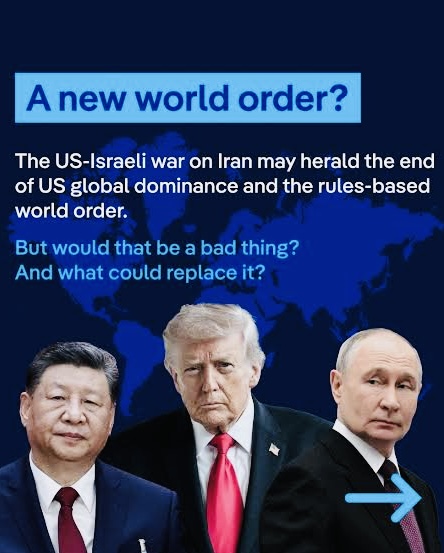
The US-Isreal War on Iran did not topple the dollar, dissolve NATO, or crown a new hegemon. What it did was more corrosive: it exposed that unipolarity has been invoiced, not inherited. In a world already spending $2.1 trillion on defense in 2026, the conflict proved that American deterrence can be absorbed, European rearmament can be auctioned, and middle powers can be indispensable without being allied. Germany’s €144.9 billion total military outlay for 2027, Japan’s $59 billion turn to counter-strike, Turkey’s role as the summit broker, and Pakistan, Indonesia, and Brazil’s refusal to choose sides were not footnotes. They were the architecture. This is multipolarity in practice: not a 1815 Concert of great powers, nor a 1945 UN of rules, but a 2027 “Doha System” of transactions — where supply chains are front lines, airspace is leverage, and order is rented by the crisis. The post-American world order after Iran is therefore not post-power. It is post-guarantee. And the $2 trillion barricade we are building is no longer to keep war out. It is to keep the auction running. The unipolar moment that defined the quarter-century after the Cold War has conclusively ended. By the mid-2020s, the United States retains unmatched military projection power and financial influence, but it no longer commands the economic, diplomatic, or normative hegemony it once did. The unipolar moment did not end with a treaty. It ended with an invoice. At $2.1 trillion in global military spending for 2026, and on track for $2.3 trillion by 2027, the world is no longer being policed by one underwriter. It is being priced by many. The question is not whether American primacy has receded — it has. The question is what replaces it: a 19th-century concert, a 20th-century institution, or a 21st-century marketplace of middle powers brokering order where Washington no longer commands it. Global military spending reached approximately $2.887 trillion in 2025, with rises in Europe and Asia offsetting a dip in U.S. outlays. China, Russia, and regional actors are asserting spheres of influence, while institutions strain under fragmentation. Russia, China, Pakistan, India, and a constellation of middle powers have learned to maneuver within the vacuum, forging pragmatic arrangements that prioritize survival and advantage over ideology. The United States, chastened yet resilient, retains formidable strengths but must now operate as a first among near-equals, its exceptionalist rhetoric sounding increasingly hollow against the hard arithmetic of diffused influence. Yet this new order carries its own disquieting truths. Multipolarity in practice may prove less a harmonious concert of civilizations than a fragmented arena of constant friction, where no single actor possesses the legitimacy or capacity to enforce global public goods. Alliances will be transactional, norms regional, and crises more frequent precisely because no one power can bear the full cost of resolution. This is not yet full chaos, nor a clean return to 19th-century balance-of-power politics. It is a messy, contested multipolarity—sometimes called “multiplexity”—where power diffuses among great powers, rising economies, and agile middle powers. The central question is whether this yields dangerous disorder or a workable “concert” of mutual restraint and selective cooperation. The 1945 UN system was more institutionalized and universalist, born from the ashes of total war and shaped by U.S. leadership. The Security Council’s P5 veto reflected raw power realities, while the General Assembly and specialized agencies embodied aspirational multilateralism. Successes include decolonization, peacekeeping (with caveats), nuclear non-proliferation norms, and frameworks for global health and trade. Failures are glaring: paralysis on great-power conflicts (Korea, Vietnam, Ukraine, Middle East), the 1990s unipolar drift, and inability to reform for new realities like climate or digital governance. By its 80th anniversary in 2025, the UN faces calls for decentralization, democratization, and digitalization amid multipolarity. History offers imperfect but illuminating parallels: the 1815 Concert of Europe and the 1945 United Nations system. A hypothetical 2027 “Doha System,” centered on pragmatic diplomacy in the Global South (perhaps anchored in forums like the Doha Forum or Qatar-mediated processes), could emerge as a third model. The Concert of Europe (post-1815 Vienna Settlement) was an informal great-power directorate of conservative monarchies—primarily Britain, Russia, Austria, Prussia, and later France. It prioritized territorial stability, balance against French-style revolution, and periodic congresses for crisis management. It delivered nearly four decades without a general European war, suppressing liberal uprisings where convenient and accommodating shifts (e.g., Belgian independence) when necessary. Its strengths were flexibility, shared ideological commitment to the status quo among elites, and great-power consensus. The 1815 Concert of Europe managed multipolarity by elite consensus. Five empires, closed rooms, and a shared fear of revolution kept the lid on war for nearly 40 years. It worked because interests were limited and publics were silent. The 1945 UN system managed bipolarity, then unipolarity, through rules and institutions. Article 5, Bretton Woods, the dollar, and the U.S. Navy turned ideology into infrastructure. It worked because one power paid most of the bill and lent legitimacy to the ledger. A potential 2027 “Doha System” — named not for a treaty, but for a venue — would manage multipolarity through transactional brokerage. No single guarantor. No shared ideology. Just forums, funds, and fleets rented to the highest or most urgent bidder. Qatar’s $15.4 billion defense budget, Turkey’s $25 billion, Saudi Arabia’s $83 billion, and the UAE’s $23 billion in 2026 are not merely national accounts. They are liquidity for a world where mediation, arms transfers, port access, and airlift capacity are the new reserve currencies. Weaknesses included exclusion of smaller states, reactionary domestic policies, and ultimate erosion by nationalism, industrialization, and the Crimean War’s rupture of the Russo-Austrian-British alignment.
A potential 2027 “Doha System”—speculatively named for Qatar’s mediation role in conflicts (e.g., DRC processes or broader forums)—would differ markedly. It would be less Eurocentric or U.S.-led, more transactional and regionally anchored. Doha-style diplomacy emphasizes neutral brokerage, economic incentives, and inclusive dialogues involving middle powers and the Global South. It might feature ad-hoc summits, minilateral coalitions (BRICS+, SCO, G20 outreach), and issue-specific pacts on trade, energy, migration, and tech standards rather than grand ideological charters. Its viability hinges on whether great powers tolerate restraint and whether middle powers can enforce norms through economic leverage and swing diplomacy. Multipolarity risks arms races, proxy conflicts, spheres of influence, and fragmented globalization (“slowbalization” or re-globalization led by Asia). Yet incentives for concert exist: nuclear deterrence, economic interdependence, shared threats (climate, pandemics, AI risks), and war fatigue. Success depends on pragmatic rules—respect for core sovereignty, managed competition, and functional cooperation—rather than universal liberal order. Unipolarity was $962 billion U.S. spending outspending the next ten combined in 2025. Multipolarity in practice looks different: China: $259 billion, 2026 — hypersonics, naval expansion, Belt and Road port leases that function as logistical pre-positioning. Russia: $158 billion, 2026 — a wartime economy that has converted 6% of GDP into munitions and deterrence. Germany: €144.9 billion total in 2027, 3.1% of GDP — the end of the debt brake and the Zeitenwende made fiscal. By 2029: €162 billion. Japan: $59 billion, 2026 — Tomahawks and counter-strike doctrine, 2% of GDP, because the Pacific is no longer an American lake. India: $81 billion; Saudi Arabia: $83 billion; UK: $82 billion; France: $49 billion; Israel: $49 billion — all top-15, all rising. This is not a ranking. It is a dispersal. No one state can underwrite deterrence from the Baltics to the South China Sea. So deterrence is being subcontracted. In a concert, you need conductors. In a market, you need brokers. Middle powers are not passive. They act as “swing states,” multi-aligning to maximize autonomy, extract concessions, and shape outcomes. Pakistan, Turkey, Indonesia, and Brazil exemplify this. Middle Powers as the Swing States of 2027; the 21st century’s swing states are not nuclear giants. They are middle powers with geography, demography, and leverage: Pakistan: $7.9 billion, 2026 est. — Nuclear, CPEC’s western corridor, and the fulcrum between Gulf capital, Chinese infrastructure, and Afghan instability. It cannot set the price of order, but it can raise the cost of disorder. Pakistan: Nuclear-armed (100-120 warheads), population 250+ million, GDP $400+ billion. It balances deep China ties (CPEC/BRI), historical U.S. relations, and Islamic world leadership. Defense spending priorities remain high amid regional tensions (e.g., with India). Its swing potential stems from geography (connecting South/Central Asia), nuclear status, and role in Afghan/Indian Ocean dynamics—though economic fragility limits leverage. Turkey: $25 billion, 2026 — NATO’s second-largest army, controller of the Bosporus, drone exporter, and mediator from Ukraine grain to Gaza ceasefires. Ankara was the reason Trump attended the July 7 NATO summit. It is also the reason the F-35 ban may lift. That is swing-state power: the ability to be indispensable to all sides. Turkey: A NATO member with independent Eurasian; African; Middle East outreach. Military spending reached $30 billion in 2025 (18th globally), supporting operations and domestic industry. Economy faces pressures but leverages location, drones, and mediation (e.g., grain deals, regional conflicts). Under assertive foreign policy, Turkey swings between Western alliances, Russian energy/tourism, and Global South ties, amplifying its influence beyond traditional metrics. Indonesia: $9.8 billion, 2026 — G20, ASEAN anchor, nickel and EV supply chains, and the maritime chokepoint state for 40% of global trade. It does not choose blocs. It taxes them with access. Brazil: $23.5 billion, 2026 — South Atlantic power, BRICS convener, and agricultural superpower. Indonesia: The world’s fourth-most-populous nation (270+ million), largest Muslim-majority democracy, and a fast-growing economy (projected upper-middle income trajectory, GDP exceeding $1.3 trillion). As a G20 member and recent BRICS addition, it practices “dynamic equilibrium” or hedging in the Indo-Pacific. It engages the U.S. (comprehensive strategic partnership), China (Belt and Road), and ASEAN centrality. Its archipelagic position and nickel/resources make it vital for supply chains. Low military spending as % of GDP (0.7-0.8%) reflects focus on development, but modernization is underway. Indonesia’s pragmatism positions it as a stabilizer. Brazil: As a BRICS core member with vast resources and the largest South American economy (GDP around $2+ trillion nominal range in recent data), Brazil pursues “active non-alignment.” It balances trade with China (a top partner), Western ties, and regional leadership. Under varying governments, it champions Global South voices on climate (Amazon), trade, and reform of institutions like the UN Security Council. Its swing role lies in bridging Latin America and multipolar forums without full alignment. In a world of food and energy weaponization, Brasília’s abstentions are more valuable than many alliances’ commitments. These states do not want to replace America. They want to be paid not to have to choose. That is the essence of a “Doha System”: order through options, not obligations. These states share traits: large populations or strategic territory, multi-alignment (ties to U.S., China, Russia without exclusivity), G20/BRICS/SCOs involvement, and preference for sovereignty-focused order over ideological blocs. Collectively, they amplify Global South agency, complicate great-power binaries, and can tip balances on issues like trade rules, climate finance, or conflict mediation.
The true test of this post-American era will not be whether America “lost” dominance, but whether humanity can manage the dangerous liberty of a world in Multipolarity. The age of multipolarity has arrived not with triumph, but with a sobering question: in a world of many poles, who will prevent the darkness between them?
In the end, the Iran War did not merely accelerate the decline of American unipolarity; it revealed its quiet obsolescence. What emerged was not a tidy handover to a new hegemon, but a messy, competitive multipolarity where power is exercised through shifting coalitions, economic leverage, and technological sovereignty rather than carrier groups and moral sermons. The post-American era will likely feature overlapping systems: residual Western alliances, China-centric economic networks, BRICS+ and SCO platforms, and agile middle-power brokerage. Middle powers gain from this: they extract concessions without full commitment. But it risks fragmentation—more veto players, slower collective action on globals like proliferation or climate, higher miscalculation odds. “Order rented by the crisis” can stabilize short-term but breeds volatility if no credible backstop exists. Empirically, post-2026 dynamics echo pre-war trends: rising defense burdens, regional blocs (AUKUS, QUAD, European initiatives), economic security merging with hard power, and BRICS+ and Global South hedging. Iran retained leverage via asymmetric tools and endurance, validating “porcupine” strategies. Yet regime decapitation strikes and economic hits showed enduring US/Israeli qualitative edges. This setup favors adaptable actors with diversified leverage—technological depth, energy resources, manufacturing scale, diplomatic agility. Pure revisionists face coalitions; pure status-quo powers pay premiums. The $2T+ barricade isn’t just walls; it’s insurance, signaling, and industrial policy rolled together. Long-term questions remain: Does transactional multipolarity self-stabilize via mutual deterrence and trade gravity, or does it erode norms enough to invite bigger shocks? History suggests both—1815 Vienna bought decades; 1930s fragmentation didn’t. Your piece nails the corrosion of inherited unipolar assumptions. The invoice arrived; now everyone haggles over the terms. The resulting system is messier, more expensive, and likely more resilient than nostalgia for hegemony or fears of collapse imply. Truth-seeking demands watching whether this yields competitive stability or endless rent-seeking auctions. A “Doha System” could succeed where others falter by being flexible, interest-based, and inclusive of rising actors—avoiding the Concert’s exclusivity and the UN’s great-power veto rigidity. Risks remain high: escalation in flashpoints (Taiwan, Ukraine, Middle East, South Asia), weaponized interdependence, and governance gaps. Optimism lies in pragmatism. Middle powers like Pakistan, Turkey, Indonesia, and Brazil have incentives to prevent total fragmentation; great powers cannot afford perpetual crisis. The 21st-century concert, if it emerges, will be messier, more regionalized, and driven by economics and technology as much as military power. Its success depends on whether leaders choose managed multipolarity over zero-sum chaos. This transition tests whether humanity can evolve global governance for diffuse power—or repeat history’s cycles of overreach and collapse. The swing states may prove decisive arbitrators. The 1815 Concert collapsed when nationalism outran elite management. The 1945 system is strained because the paymaster is overextended and the rules look rigged. The 2027 system risks being a bazaar: functional in peacetime, catastrophic in crisis. Because when every supply chain is a front line — chips, LNG, fertilizer, cables — you cannot broker your way out of a shooting war. Germany’s €500 billion infrastructure fund, Japan’s 2% doctrine, and NATO’s 5% GDP target for 2035 are admissions that the premium for peace is now permanent. The post-American order is not post-power. It is post-guarantee. America remains entangled, but it is no longer indispensable. NATO remains, but it is being managed with charts in the Oval Office, not Article 5 in a treaty hall. And middle powers are not the chorus. They are the market makers. So the answer to “chaos or concert?” is: neither, yet. We are in the interregnum — a “Doha System” of dealmakers, debt, and deterrence, held together by the fear that no one can afford for it to fail. The $2 trillion barricade is being built by Washington, Berlin, Beijing, and Riyadh. But the gates are being kept by Islamabad, Ankara, Jakarta, and Brasília. That is multipolarity in practice. Not a new order. A new auction. And the lot for sale is stability itself. The Iran War will not be remembered as the day America left the world, but as the day the world stopped waiting for America to keep it. Unipolarity has not been buried by defeat; it has been amortized by cost. The $2.1 trillion barricade of 2026, Germany’s €144.9 billion turn in 2027, Turkey’s summit brokerage, and the quiet leverage of Pakistan, Indonesia, and Brazil reveal the new geometry: power is dispersed, but responsibility is not. We are not living in a 1815 Concert of settled empires, nor in a 1945 UN of a single underwriter. We are living inside a 2027 “Doha System” — a market of deterrence where middle powers set the price of access, great powers buy time with budgets, and no one can afford to let the auction collapse. That is multipolarity in practice: order without a guarantor, stability without a script, and peace priced daily in missiles, mediation, and missed choices. The post-American world is not post-American power. It is post-American guarantee. And until someone is willing to underwrite the bill again, the $2 trillion barricade will stand — not as a fortress against war, but as a tollbooth for a world that no longer believes peace can be kept for free. The true test of this post-American era will not be whether America “lost” dominance, but whether humanity can manage the dangerous liberty of a world without a singular referee—one in which great power rivalry coexists with civilizational resurgence, and where the absence of hegemony forces states to confront, perhaps for the first time, the uncomfortable necessity of strategic maturity. The age of multipolarity has arrived not with triumph, but with a sobering question: in a world of many poles, who will prevent the darkness between them?