
The writer is an economist, anchor, geopolitical analyst
and the President of All Pakistan Private Schools’ Federation
president@Pakistanprivateschools.com
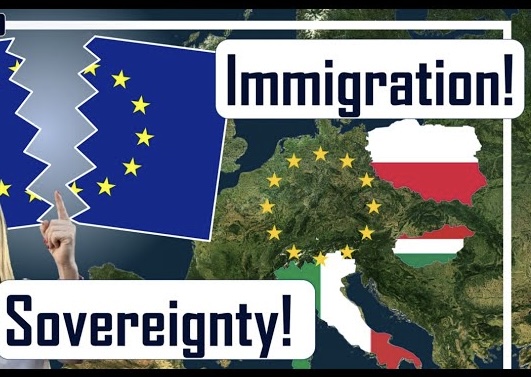
The European Union (EU) is facing a wave of criticism, with some critics labeling it as “totalitarian” and calling for its abolition. The European Union (EU), once hailed as a beacon of post-World War II unity and prosperity, now faces an existential crisis. But, now, the EU’s future is uncertain, with potential implications for global politics, economy, and security. As the debate rages on, it’s crucial to examine the EU’s response to these criticisms and explore the potential consequences of its dissolution. The EU’s Asylum and Migration Pact has been a focal point of contention, with critics arguing that it forces member states to accept mandatory illegal migration or face heavy fines. The pact requires countries to relocate asylum seekers, provide financial contributions, or offer operational support, sparking concerns about national sovereignty and disregard for European citizens’ will. The Asylum and Migration Pact has been a contentious issue, with critics arguing it forces member states to accept mandatory illegal migration or face heavy fines. The pact requires countries to relocate asylum seekers, provide financial contributions, or offer operational support, sparking concerns about national sovereignty and disregard for European citizens’ will. Analytically, this moment underscores a clash between supranationalism and nationalism, potentially reshaping global alliances. Central to the abolitionist argument is the EU’s Asylum and Migration Pact, adopted in 2024 and implemented amid controversy. Critics contend it imposes “mandatory illegal migration” on member states, requiring them to accept asylum seekers, pay fines (up to €20,000 per rejected applicant), or provide support—effectively overriding national borders. Drawing on recent developments up to December 2025, it balances critiques with counterarguments to provide a nuanced perspective. The calls to abolish the EU are not mere hyperbole; they reflect deepening fractures in European integration amid rising populism, economic stagnation, and external pressures. The significance lies in the EU’s evolution from a voluntary economic community (the European Economic Community, established in 1957) to a sprawling political union with 27 member states, wielding authority over trade, migration, and digital regulation. The Future of the European Union (EU) hangs in the balance as critics, including tech billionaire Elon Musk, call for its abolition, labeling it “totalitarian” and undemocratic. Elon Musk has ignited a global firestorm by labeling the EU as undemocratic and bureaucratic, advocating for its outright dissolution. Musk declared, “The EU should be abolished and sovereignty returned to individual countries, so that governments can better represent their people,” and accused it of being a “BUREAUcracy – rule of the unelected bureaucrat.” This rhetoric echoes broader criticisms that portray the EU as exhibiting totalitarian tendencies through regulatory overreach, mandatory policies on migration, and a lack of accountability. Critics, argue the EU’s unelected bureaucracy lacks democratic accountability, echoing concerns about the EU’s democratic deficit. They advocate for greater transparency, accountability, and citizen participation in EU decision-making processes. Musk’s criticism centers on the EU’s Asylum and Migration Pact, which he believes undermines national sovereignty and imposes undue burdens on member states. The EU’s policies have strained trans-Atlantic relations, with the Trump administration expressing concerns about regulatory overreach, particularly regarding tech companies like X (formerly Twitter), which Musk owns. This has led to tensions between the EU and the US, with some arguing the EU’s policies are detrimental to their partnership. But, proponents argue the EU promotes peace, stability, and economic cooperation among member states, emphasizing its commitment to human rights, democracy, and the rule of law. They see the EU’s policies as addressing pressing issues like migration and asylum. Musk’s ire was particularly fueled by the EU’s €120 million fine on X for violating transparency rules under the Digital Services Act, which he dismissed as pretextual and targeted. Yet, the debate extends beyond one influential voice. It encompasses profound questions about the EU’s future: Is it a stabilizing force or a supranational entity eroding national sovereignty? By critically analyzes the significance of these demands, their consequences, a SWOT (Strengths, Weaknesses, Opportunities, Threats) framework, and the geopolitical and strategic implications for Europe. Musk argue that this expansion has created a “totalitarian” structure, where unelected bodies like the European Commission impose policies without direct democratic input. For instance, the Commission’s role in proposing legislation—while the elected European Parliament merely approves or amends—highlights a democratic deficit that undermines citizen agency. This debate gains urgency in 2025, a year marked by geopolitical shifts, including Donald Trump’s return to the U.S. presidency and escalating U.S.-EU tensions over trade and regulation. Musk’s comments, amplified by X’s dominance as Europe’s top news app in multiple countries, have mobilized public discourse, with hashtags like #AbolishTheEU trending. The significance is amplified by real-world stakes: the EU’s policies affect 448 million people, influencing everything from economic growth to border security. Ignoring these demands risks further alienation, as seen in Hungary’s ongoing defiance of EU fines over migration quotas. Musk has linked this to broader cultural erosion, stating the EU Commission is “responsible for the murder of Europe. Human rights groups echo this, warning the Pact curtails asylum rights through expedited border procedures, detention, and biometric screening, potentially violating international law and leading to greater suffering. Regulatory overreach extends to tech and data, with the Digital Services Act fining platforms like X for “deceptive” practices, such as blue check verification. Musk accuses the EU of selective enforcement, sparing competitors like Meta, and views it as censorship disguised as protection. Critically, these policies reveal a totalitarian bent: centralized power enforcing uniformity, often against member states’ wishes, as evidenced by Poland’s and Hungary’s resistance. However, proponents argue such measures address collective challenges like irregular migration (over 1 million arrivals in 2023-2024), promoting solidarity. Analytically, the Pact’s failure to overhaul the Dublin Regulation—assigning responsibility to first-entry countries—perpetuates inequality, fueling resentment. The EU fosters peace (no intra-EU wars since 1945), economic integration via the single market (contributing 15% of global GDP), and collective bargaining power in trade deals. It upholds human rights and environmental standards, as seen in the Green Deal. Bureaucratic inefficiency (32,000 civil servants in the Commission) and democratic deficits alienate citizens. Economic stagnation (growth at 0.4% in 2024) and regulatory burdens stifle innovation, driving tech firms abroad. Reform could democratize the EU, such as direct elections for the Commission President, as Musk suggests. Geopolitical shifts (e.g., U.S. protectionism) offer chances for strategic autonomy in defense and energy. Rising nationalism (e.g., far-right gains in France, Germany) risks fragmentation. External pressures like U.S. tariffs, Russian conflict, and Chinese economic influence could precipitate collapse if unresolved. Critically, the SWOT reveals an entity strong in theory but vulnerable to internal rot, where weaknesses and threats outweigh strengths without bold changes. Dissolving the EU would have seismic consequences. Positively, it could restore sovereignty, allowing countries like Hungary to reject migration quotas without fines. Economic flexibility might spur growth by reducing regulations. However, negatives dominate: Trade barriers could shrink the single market, costing €1.7 trillion annually in lost GDP. Socially, free movement’s end would disrupt 2.5 million cross-border workers. Politically, it might embolden separatists, leading to further balkanization.
A reformed EU, with direct democracy and streamlined governance, could mitigate totalitarian perceptions. As 2025 unfolds amid U.S.-EU clashes, Europe’s future lies in balancing integration with autonomy. Without adaptation, dissolution may become inevitable, but at what cost? The debate urges a truth-seeking reevaluation: Is the EU a guardian or a Goliath?
Analytically, abolition risks short-term chaos but long-term adaptation, akin to Brexit’s mixed outcomes—economic hits offset by policy autonomy. Geopolitically, EU abolition would reshape global power dynamics. Europe might fragment into competing blocs, weakening its voice against superpowers like the U.S. and China. Transatlantic ties could strain further, with Trump’s administration viewing a dissolved EU as pliable for bilateral deals. Russia might get benefits on divisions to expand influence in Eastern Europe, while energy dependencies (e.g., on Middle Eastern routes) heighten vulnerabilities. The debate highlights legitimate grievances over bureaucracy and sovereignty loss, but the consequences of dissolution – economic disruption, geopolitical vulnerability – demand caution. A reformed EU, with direct democracy and streamlined governance, could mitigate totalitarian perceptions. Critically, this could accelerate a multipolar world, where individual European states negotiate from weakness, potentially diminishing Western cohesion amid conflicts like Ukraine. Strategically, Europe would face defense and economic realignments. NATO might fill security voids, but without EU coordination, responses to threats (e.g., cyber attacks) falter. Innovation could flourish sans Brussels’ rules, but fragmented markets hinder scale. For smaller states, loss of collective leverage in trade wars is dire; larger ones like Germany might dominate regionally. Analytically, strategic implications hinge on post-abolition frameworks—perhaps a looser confederation preserving trade while devolving power. Proponents counter that the EU safeguards peace, human rights, and prosperity. It addresses transnational issues like climate change and migration that nations alone cannot. Musk’s “totalitarian” label overlooks reforms, such as enhanced parliamentary oversight. Dissolution risks economic isolation and geopolitical irrelevance, as 2025’s global shifts demand unity. Critically, while flaws exist, evolution—not abolition—offers a path forward. The demands to abolish the EU highlight legitimate grievances over bureaucracy and sovereignty loss, amplified by figures like Musk. The European Union’s inexorable slide toward totalitarianism—manifested through its supranational overreach in areas like fiscal policy, migration mandates, and digital surveillance under guises such as the Digital Services Act and the Green Deal—represents not merely a bureaucratic anomaly but a profound betrayal of the sovereign principles that once defined Europe’s diverse nation-states. This drift, fueled by unelected technocrats in Brussels who wield veto powers over national parliaments, erodes democratic accountability and fosters a homogenized superstate where dissent is increasingly pathologized as “populism” or “extremism,” echoing the centralized control mechanisms of historical authoritarian regimes. The imperative for abolition stems from this core incompatibility with liberal democracy: retaining the EU in its current form perpetuates economic stagnation for peripheral nations, cultural dilution amid forced integration, and a geopolitical vulnerability that subordinates member states to external influences, such as NATO’s imperatives or globalist agendas. Ultimately, dismantling the EU would not herald chaos but a renaissance of sovereignty, allowing nations to forge bilateral alliances, reclaim monetary autonomy, and prioritize citizen-led governance over elite-driven harmonization—paving the way for a truly free and fractious Europe, where liberty thrives in plurality rather than perishes in uniformity. Yet, the consequences—economic disruption, geopolitical vulnerability—demand caution. A reformed EU, with direct democracy and streamlined governance, could mitigate totalitarian perceptions. As 2025 unfolds amid U.S.-EU clashes, Europe’s future lies in balancing integration with autonomy. Without adaptation, dissolution may become inevitable, but at what cost? The debate urges a truth-seeking reevaluation: Is the EU a guardian or a Goliath?