The writer is an economist, anchor, geopolitical analyst
and the President of All Pakistan Private Schools’ Federation
president@Pakistanprivateschools.com
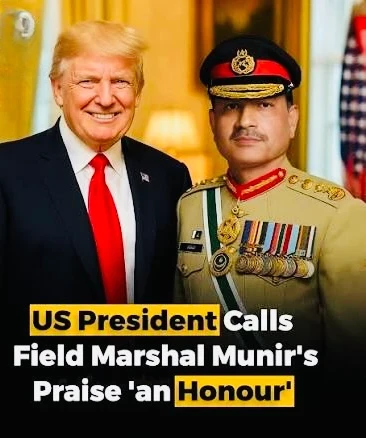
n the realm of international politics, where diplomacy and strategic maneuvering are the keys to success, one man has emerged as the most powerful figure in Pakistan. Pakistan’s parliament has voted to give army chief Field Marshal Asim Munir new powers and lifetime immunity from arrest and prosecution, the 27th constitutional amendment, which was signed into law, will also make significant changes to the way the country’s top courts operate. Field Marshal Syed Asim Munir, the Chief of Army Staff (COAS) and Chief of Defense Force, has been instrumental in shaping Pakistan’s foreign policy and strengthening its global standing. General Munir is taking on some major roles in Pakistan’s military. The positions he’ll be holding: Field Marshal for Life, he’s been promoted to this rank in recognition of his leadership during the war with India; Army Chief: He’s currently serving as the Chief of Army Staff; Chief of Defence Forces (CDF); This is a new role created under the 27th Constitutional Amendment, making him the head of Pakistan’s military and strategic command structure. As CDF, he’ll have the authority to: Appoint Vice Chief and Deputy Chief, he’ll be appointing these roles to support him; Head of Strategic Command, he’ll also be appointing the Commander of the National Strategic Command, who’ll serve a three-year term. This change is part of a broader reform agenda to modernize Pakistan’s defence framework and align it with global standards. With his unique blend of military acumen and diplomatic finesse, Munir has become the face of Pakistan’s diplomatic resurgence. Field Marshal Asim is the architect of Pakistan’s diplomatic resurgence, and is influencing global stability. His leadership, vision, and diplomatic finesse have transformed Pakistan’s global standing, and his efforts to promote peace and stability in the region are commendable. As the most powerful man in Pakistan, Munir’s influence will continue to shape the country’s foreign policy and global relationships. Under Munir’s leadership, Pakistan has witnessed a significant shift in its diplomatic approach. The country has strengthened its relationships with key global partners, including the United States, China, Saudi Arabia, and Iran. His military diplomacy has paid rich dividends, with Pakistan emerging as a key player in regional geopolitics. Munir’s meeting with US President Donald Trump at the White House has been hailed as a significant breakthrough. In a surprise move, Pakistan has nominated US President Donald Trump for the Nobel Peace Prize, citing his efforts to broker a ceasefire between Pakistan and India. This diplomatic masterstroke has sent a strong message that Pakistan values peace and is willing to work with global leaders to achieve it. As tensions rise in the region, Munir’s diplomatic efforts have been focused on promoting peace and stability. US President Donald Trump credited Pakistan’s Army Chief, Field Marshal Asim Munir, with helping prevent a war between Pakistan and India, and potentially influencing his decision not to bomb Iran. Field Marshal Munir’s visit to the White House was a significant diplomatic move, showcasing Pakistan’s growing influence in regional affairs. The purported visit had caused a huge furore in India with the Opposition seeing it as big diplomatic setback for the for the Narendra Modi led government. During the meeting, Trump and Munir discussed the Iran-Israel conflict, with both leaders emphasizing the need for a peaceful resolution. Munir also expressed Pakistan’s appreciation for Trump’s role in facilitating a ceasefire between Pakistan and India. This move is being seen as a symbolic acknowledgement of Trump’s mediation and behind-the-scenes role in the recent ceasefire between Pakistan and India. Through this, Pakistan has sent a message to the world that it is not a war monger, but a peace and reconciliation advocate. Munir’s visit highlights Pakistan’s strategic importance, particularly in the context of regional tensions and Trump’s diplomatic efforts. The meeting was attended by high-ranking officials, including US Secretary of State Marco Rubio and National Security Adviser Steve Witkoff. Trump praised Munir’s leadership, acknowledging Pakistan’s unique understanding of Iran and its role in preventing escalation. The talks also focused on trade, energy cooperation, and counter-terrorism efforts, signaling a strengthening of US-Pakistan relations. His visit to the US and meetings with key American officials have sent a strong message that Pakistan is committed to regional peace and stability. The two leaders discussed regional security matters, counter-terrorism, and economic cooperation, paving the way for a new era of collaboration between the two nations. Pakistan and Saudi Arabia have forged a historic defense pact, underscoring their deepening relationship and commitment to regional security. Munir’s leadership has enabled Pakistan to project its interests and values globally, from defending its water rights to promoting regional stability. He has a deep understanding of regional and global geopolitics, which has enabled Pakistan to navigate complex diplomatic terrain. Munir’s ability to articulate Pakistan’s principled stance on key regional and global issues has been widely appreciated. His military diplomacy has strengthened Pakistan’s relationships with key partners and enhanced its global reputation.
As for whether Asim Munir has become Pakistan’s new global identity, it’s clear that he has made a significant impact on the country’s international standing. Munir’s vision for Pakistan’s foreign policy, which prioritizes geoeconomics over geopolitics, has also contributed to his growing international stature.
Field Marshal Syed Asim Munir is the biggest focus of the world media today. The New York Times is calling him Iron Man, the Washington Post is giving credit for resetting Pakistan-US relations, and the Financial Times says that he has emerged as Pakistan’s strongest and most decisive figure. From China to Saudi Arabia, from Turkey to Iran, and the United States — Asim Munir’s military diplomacy has greatly strengthened Pakistan’s global reputation, prestige, and hard power. After the tension with India, his popularity and influence have increased rapidly. World powers can no longer ignore Pakistan! Gen. Munir – became chief of the army staff in late 2022 and in effect took charge of Pakistan, the nuclear-armed country was in political crisis, close to defaulting on its debts, and increasingly on the periphery of the world stage. But now Trump’s ‘favourite field marshal’ is confidently wooing global powers. Pakistan’s remarkable transformation from international isolation to a star of global diplomacy is a testament to effective leadership and strategic diplomacy. Under Field Marshal Asim Munir’s visionary guidance, Pakistan has not only restored its relationships with key global partners but also strengthened its position on the world stage. The country’s diplomatic resurgence is evident in its: Strengthened US-Pakistan Relations; Strategic Partnership with Saudi Arabia; and Assertive Global Presence. Field Marshal Munir’s meeting with US President Donald Trump at the White House signifies a new era of cooperation, focusing on counterterrorism and economic ties. Pakistan and Saudi Arabia have forged a historic defence pact, underscoring their deepening relationship and commitment to regional security. Field Marshal Munir’s leadership has enabled Pakistan to project its interests and values globally, from defending its water rights to promoting regional stability. This diplomatic renaissance is a direct result of Field Marshal Munir’s competent and consistent approach, which has earned Pakistan a reputation as a reliable and strategic partner. His leadership has been instrumental in: Defending National Interests: Successfully countering Indian aggression and protecting Pakistan’s sovereignty. Promoting Regional Stability: Strengthening relationships with key partners and contributing to regional security initiatives. Enhancing Global Influence: Showcasing Pakistan’s diplomatic prowess and promoting its interests globally. Pakistan’s transformation under Field Marshal Munir’s leadership is a shining example of effective diplomacy and strategic vision, demonstrating that negotiating from a position of strength can yield remarkable results. Pakistan’s role in regional diplomacy is acknowledged, given its border with Iran and historical ties. The history of international diplomacy is a witness that sometimes unconventional measures lead to major and lasting results. Amidst the cacophony of global war rhetoric, Pakistan emerges as a bastion of peace, counterpoising the bellicose calls for conflict. This audacious move shall undoubtedly exert pressure upon the United States to advocate for peace across the globe’s war-torn zones. President Trump’s unconventional approach, employing economic incentives rather than punitive measures, has yielded tangible benefits for Pakistan’s people, kindling hope for job growth, investment, and shared prosperity. His consistent laudation of Pakistan on the world stage has bolstered the nation’s image, underscoring its strategic importance. Pakistan’s geopolitical significance is underscored by its shared border with Iran, spanning nearly 1,000 kilometers, and its complex relationship with the nation, encompassing trade, security, and historical ties. It is fervently hoped that Pakistan’s diplomatic stratagem shall attain its objectives, leaving Israel to languish in solitude, nursing its wounds. The discussions between President Trump and Field Marshal Munir encompassed a range of critical issues, including: Counter-Terrorism Cooperation; Trade and Economic Development; Regional Security Matters; Cryptocurrency and Emerging Technologies. Both leaders reaffirmed their commitment to continued collaboration in this domain. The potential for a mutually beneficial trade partnership between the U.S. and Pakistan was explored. The situation in the Middle East, particularly the tensions between Iran and Israel, was a significant topic of discussion. The two leaders touched upon avenues for cooperation in these cutting-edge fields. In a gesture of goodwill, Field Marshal Munir extended an invitation to President Trump to undertake an official visit to Pakistan at a mutually convenient date. This development underscores the evolving dynamics of U.S.-Pakistan relations, which appear poised for a new chapter of cooperation and engagement. US Central Command (Centcom) commander, General Michael Kurilla’s, praised for Pakistan calling it a phenomenal partner in counter-terrorism during a congressional hearing. Such public affirmations have significantly bolstered Pakistan’s international image, reminding global audiences of the country’s strategic importance and the wisdom of its leadership.
Field Marshal Munir’s relationship to Washington signifies a renewed effort to strengthen bilateral ties between the United States and Pakistan. As the army chief, Munir has been at the forefront of Pakistan’s military diplomacy, navigating the intricate dynamics of regional geopolitics. His elevation to the rank of Field Marshal, a distinction previously held by Ayub Khan, underscores his influential position within Pakistan’s military establishment. President Trump paid respect to Pakistan’s military and political leadership. His acknowledgement of Pakistan’s right to defend its sovereignty restored the country’s rightful place in international forums and reiterated the principle that peace must be built on mutual respect. Perhaps most notably, President Trump revived global attention on the Jammu and Kashmir dispute, a decades-old issue India had sought to keep confined within bilateral channels. By inviting international mediation and urging respect for United Nations resolutions, he ensured that Kashmir once again became a matter of global concern, compelling policymakers worldwide to re-evaluate long-standing injustices. In every public statement and private meeting, Unsurprisingly, India bristled at President Trump’s interventions, viewing his actions as a rebuke to their aggressive posturing. Yet for Pakistan, historically a steadfast advocate of peaceful resolution. This robust defense against external threats is a source of immense pride. As the international community reflects on the lessons of June 2025, Pakistan stands proud of this strategic masterstroke and hopeful that President Trump’s peace-building vision will illuminate the path to lasting stability in South Asia and beyond. The two leaders engaged in a wide-ranging discussion, encompassing regional security matters and the recent conflict between Pakistan and India. Trump’s remarks underscore the complexities of international diplomacy, particularly in regions fraught with longstanding tensions. The meeting marked a notable development in U.S.-Pakistan relations, which had experienced a period of stagnation under Trump’s and his predecessor’s administrations, largely due to their courting of India as a strategic partner in countering China’s influence. Meanwhile, India, still reeling from the repercussions, views these developments with a certain degree of trepidation. Historically, the United States’ support for Pakistan has been guided by geopolitical considerations, including the Soviet invasion of Afghanistan and the War on Terror, leading to significant military and economic aid. Notably, U.S.-Pakistan relations have remained static over the past 15 years, spanning three distinct administrations: those of Barack Obama, Donald Trump in his first term, and Joe Biden. However, President Trump’s stance on Pakistan appears to have softened in his second term, contrasting with his earlier criticism. In his first term, Trump had accused Pakistan of harbouring terrorists and suspended $1.3 billion in security assistance. General Munir’s pronouncements on Kashmir and the “two-nation theory” have underscored Pakistan’s unyielding commitment to the Kashmir cause, imbuing the nation’s identity with an unwavering sense of purpose. His invocation of this framework, which posits that Hindus and Muslims constitute distinct nations necessitating separate homelands, has been perceived by many Indians as a marked shift in Pakistan’s stance toward India, thereby exacerbating tensions between the two nations. The region of Kashmir, a longstanding point of contention since the partition in 1947, remains a potent symbol of this discord. As diplomatic relations between India and Pakistan remain frozen, aggressive public messaging has become the primary channel of communication, heightening the risk of miscalculation and prompting the international community to vigilantly monitor the unfolding situation, fervently hoping for a peaceful resolution to this protracted conflict. He reaffirmed Pakistan’s sacrifices in the global war on terror, emphasizing its commitment to a safer world. Munir is focused on Pakistan’s untapped potential in information technology, agriculture, and mining, inviting international partners to collaborate and unlock shared prosperity. He advocated for dialogue, diplomacy, and adherence to international law, reaffirming Pakistan’s proactive role in mitigating regional tensions and promoting cooperative security frameworks, particularly in counter-terrorism, regional security, and economic development. He emphasized the potential for a broader, multidimensional relationship built on mutual respect and shared strategic interests. This engagement reflects Pakistan’s commitment to transparent diplomacy, international cooperation, and peaceful coexistence through principled dialogue. Trump’s priorities reflects shift, as Washington recalibrates its Middle East approach. At the same time, it signals a subtle realignment of regional partnerships—with Pakistan asserting its diplomatic muscle, India hardening its stance, and the US still trying to keep one foot in each camp. With tensions high, and alliances fluid, the world is watching. And as memes continue to fly, what happens behind closed doors could shape the next chapter of regional politics. As for whether Asim Munir has become Pakistan’s new global identity, it’s clear that he has made a significant impact on the country’s international standing. His leadership during the 2025 India-Pakistan conflict and his diplomatic efforts have earned him recognition and respect globally. Munir’s vision for Pakistan’s foreign policy, which prioritizes geoeconomics over geopolitics, has also contributed to his growing international stature.