The writer is an economist, anchor, geo-political analyst
and the President of All Pakistan Private Schools’ Federation
president@Pakistanprivateschools.com
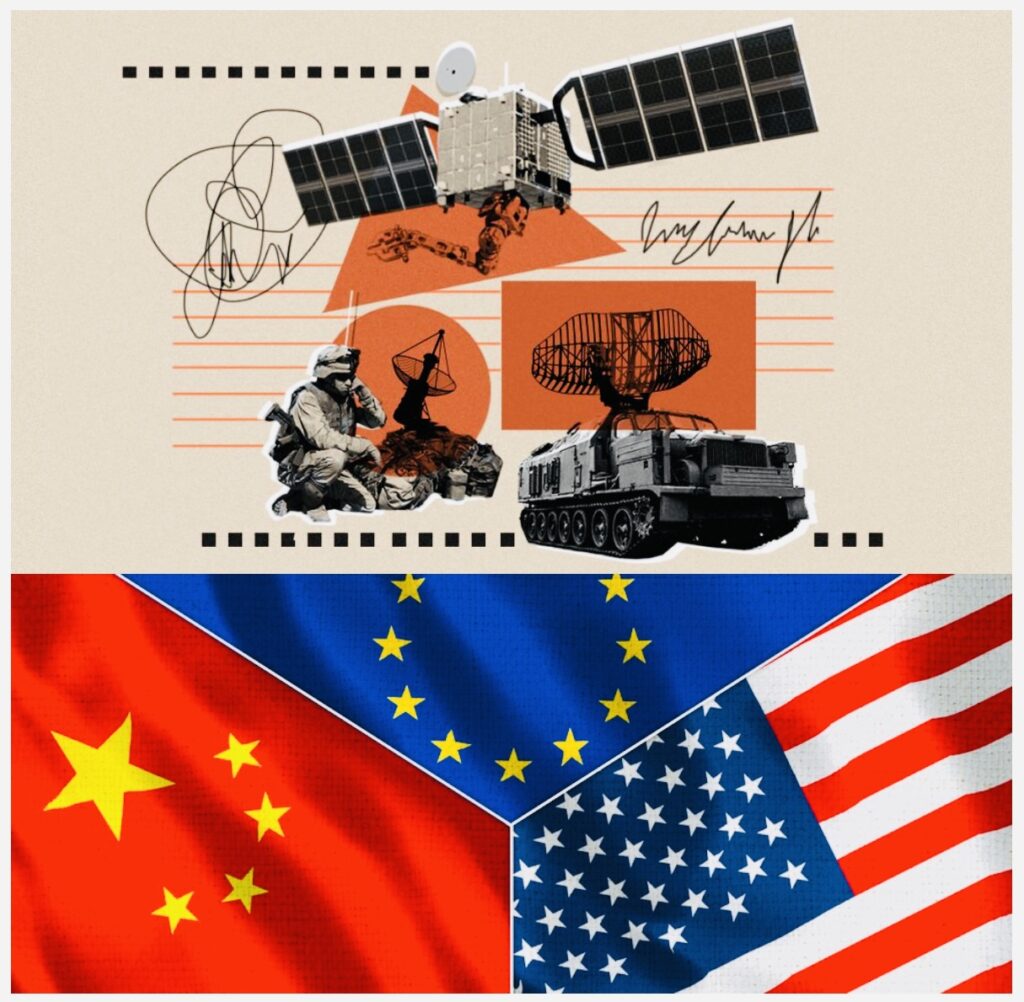
In an era where space is no longer the final frontier but a contested domain of power projection, the geopolitical landscape is increasingly defined by advancements in missile defense, orbital weaponry, and commercial space launches. The assertion that “Europe is lagging behind, whereas the US is investing billions of dollars in missile defense systems and commercial launches, while China is testing weapons in orbit and expanding its military program” captures a stark reality as of 2025. Why the lag? Fragmentation among EU states, bureaucratic red tape, and a focus on civilian applications over militarization hinder agility. Europe’s missile defense gap is a pressing concern. Europe’s lagging behind the US and China in missile defense systems and space-based military capabilities has significant implications for global and regional geopolitics. The US and China are currently leading the charge in missile defense systems, with China rapidly expanding its military program and testing weapons in orbit. This shift in global power dynamics could lead to a realignment of international relations, potentially diminishing Europe’s influence. The continent’s inability to keep pace with the rapid advancements in missile technology, particularly in hypersonic missiles, poses a substantial threat to its security and stability. The European Sky Shield Initiative, a German-led effort to develop a joint air defense system, is a step in the right direction, but more needs to be done to address the continent’s vulnerability to missile threats. This disparity is not merely technological but carries profound implications for global security, economic dominance, and strategic alliances. Drawing on recent developments, this article provides a comprehensive analysis, critiquing the strategies, shortfalls, and potential consequences of this tripartite dynamic. While the US leverages its industrial might and private sector innovation to maintain hegemony, China’s rapid militarization of space raises alarms about escalation. Europe, meanwhile, grapples with fragmented efforts and bureaucratic inertia, risking irrelevance in what could become a bipolar space order. The global landscape of missile defense systems and space exploration is rapidly evolving, with significant investments and advancements being made by major world powers. Europe, however, appears to be lagging behind in this critical area. The US is investing heavily in missile defense systems, with a focus on developing advanced technologies to counter emerging threats. The country’s defense budget includes significant allocations for research and development of new missile defense systems, such as the Ground-based Midcourse Defense (GMD) system and the Aegis Ballistic Missile Defense system. China is rapidly expanding its military program, with a focus on developing advanced missile systems, including hypersonic missiles and anti-satellite capabilities. The country has conducted several successful tests of its DF-17 hypersonic missile and has developed a range of anti-satellite capabilities, including the SC-19 direct-ascent anti-satellite missile. Europe, on the other hand, is struggling to keep pace with the US and China in terms of missile defense capabilities. While some European countries, such as France and the UK, have developed their own missile defense systems, the continent as a whole lacks a cohesive and comprehensive approach to missile defense. One of the key challenges facing Europe is the lack of deep-strike capabilities, which would allow the continent to deter and respond to missile threats. The US has traditionally provided much of the deep-strike capability for NATO, but this may not always be available in the future. To address this gap, European countries need to invest in developing their own deep-strike capabilities, including ground-launched cruise missiles and ballistic missiles. This would require significant investment in research and development, as well as production and deployment. The implications of Europe’s missile defense gap are significant, particularly in terms of the continent’s security and stability. If Europe is unable to develop its own missile defense capabilities, it may be forced to rely on the US for protection, which could limit its ability to act independently in the face of emerging threats. Europe’s reliance on the US for missile defense could also undermine the continent’s ability to develop a cohesive foreign policy and security strategy. Europe’s lagging behind the US and China in missile defense systems and space-based military capabilities has significant implications for global and regional geopolitics. The continent’s inability to keep pace with the rapid advancements in missile technology, particularly in hypersonic missiles, poses a substantial threat to its security and stability. Europe’s lack of advanced missile defense systems makes it vulnerable to potential threats from Russia and other nations. This vulnerability could embolden adversaries to test Europe’s defenses, potentially leading to increased tensions. As a key player in NATO, Europe’s inability to defend itself could undermine the alliance’s credibility and effectiveness. This could lead to questions about the US’s commitment to European security and potentially create fissures within the alliance. Europe’s lagging behind in missile defense systems poses a significant threat to its security. The continent’s reliance on US missile defense systems could limit its ability to respond to emerging threats independently. This could lead to increased aggression and a heightened risk of conflict in the region. Europe’s inability to defend itself could limit its autonomy and independence. This could lead to a loss of sovereignty and a diminished ability to make decisions that align with its own interests. Europe’s defense spending has been criticised for being inadequate. The continent’s failure to invest in advanced missile defense systems has left it vulnerable to emerging threats.
As orbital tensions mount, the true test is not technological prowess but strategic foresight—lest the stars become battlegrounds. Europe’s missile defense gap is a pressing concern that requires immediate attention. The continent needs to invest in developing its own deep-strike capabilities and work together to develop a comprehensive approach to missile defense.
Europe’s reliance on US missile defense systems could limit its ability to respond to emerging threats independently. This dependence could also create tensions within NATO and undermine the alliance’s credibility. To address these challenges, European countries need to work together to develop advanced missile defense systems. This cooperation would require significant investment in research and development, as well as production and deployment. Europe needs to increase its investment in advanced missile defense systems. This could involve developing new technologies, such as directed energy weapons, and improving existing systems. European countries need to work together to develop a comprehensive approach to missile defense, integrating existing systems and developing new capabilities. Europe needs to develop its strategic autonomy by reducing its dependence on the US, and involve developing its own missile defense systems and improving its military capabilities. European countries need to work together to develop a comprehensive and cohesive approach to missile defense. This would require significant cooperation and investment in research and development, as well as production and deployment. The US has positioned itself as the pacesetter in both military and commercial space endeavors, channeling unprecedented funds into systems that blend deterrence with economic growth. In fiscal year 2025, the Missile Defense Agency (MDA) and related programs have seen massive infusions, underscoring a doctrine of layered defense against evolving threats from hypersonic missiles to orbital attacks. Key investments include the Defense of Guam initiative, funded at $1.5 billion in the FY2025 budget, which fortifies Pacific assets with Aegis Ashore systems in Romania and Poland. This is part of a broader $24.4 billion allocation under the One Big Beautiful Bill Act (OBBBA) for integrated air and missile defense, reflecting bipartisan consensus on countering peer adversaries. President Trump’s May 2025 announcement of a $175 billion “Golden Dome” missile shield, developed by Lockheed Martin and slated for operational status by 2029, epitomizes this ambition—a nationwide architecture blending ground-based interceptors, space sensors, and AI-driven command systems. Critics, however, question the efficacy and cost, noting historical overruns in programs like the Ground-based Midcourse Defense (GMD), which has a spotty intercept record against simulated ICBMs. The RTX Corporation’s delivery of the 500th Evolved Sea Sparrow Missile (ESSM) Block 2 in October 2025 highlights industrial scaling, with plans to double production by mid-2026. On the commercial front, the US space economy is booming, with the global sector hitting $613 billion in 2024, driven largely by American firms. Executive orders in August 2025 aimed at fostering competition have streamlined regulations, enabling companies like SpaceX and Blue Origin to dominate launches. The FAA’s 2025–2045 Aerospace Forecast predicts exponential growth in commercial launches, with investments from firms like Linde supporting cryogenic fuels for reusable rockets. Space stocks have surged, with Rocket Lab up 80% and AST SpaceMobile over 100% in 2025, fueled by satellite constellations for global connectivity. Yet, this dual-use approach—where commercial tech bolsters military capabilities—invites scrutiny: Is the US subsidizing private monopolies under the guise of national security, potentially stifling innovation elsewhere? Critically, these investments sustain US primacy but at a fiscal cost. With defense spending topping $1 trillion annually, including space allocations, sustainability is debatable amid domestic priorities like infrastructure. Moreover, overreliance on private entities risks supply chain vulnerabilities, as seen in past delays with Boeing’s Starliner. China’s space program, under the People’s Liberation Army (PLA), exemplifies a state-driven model prioritizing military dominance, often shrouded in opacity. By mid-2025, China operates over 1,189 satellites—a 927% increase since 2016—enabling robust command, control, and reconnaissance. This expansion includes a 12-fold growth in communication satellites over eight years, supporting global operations. Orbital weapons testing has intensified, raising escalation risks. In March 2025, US Space Force officials reported Chinese satellites engaging in “dogfighting” maneuvers—on-orbit tactics simulating combat to disrupt adversaries. The September 2025 Victory Day Parade unveiled the DF-5C and DF-61 ICBMs, capable of global strikes with hypersonic glide vehicles, alongside an electromagnetic rail gun firing smart bombs at Mach 5. China’s nuclear arsenal has doubled to 600 warheads since 2019, projected to exceed 1,000 by 2030, including orbital bombardment systems tested in 2021 and footage released in August 2025. These displays, as per Reuters, signal deterrence against US alliances in East Asia. China’s approach blends innovation with aggression, but lacks transparency, fueling Western paranoia. State media like Global Times portrays these as defensive, yet the dual-use nature—civilian satellites enabling military strikes—violates arms control norms. Economically, this rapid buildup, estimated at 20% annual growth in space spending, strains resources amid domestic slowdowns. Geopolitically, it challenges the 1967 Outer Space Treaty, potentially sparking an arms race that could render low-Earth orbit unusable due to debris. Europe’s space and defense posture contrasts sharply, marked by incremental progress amid structural hurdles. The European Space Agency (ESA) operates on a modest €7.88 billion budget for 2025, pooling resources from 22 member states but yielding fragmented outcomes. The EU Space Programme advances Galileo navigation, Copernicus Earth observation, and Space Situational Awareness (SSA), with expansions in 2025 for commercial integration. In missile defense, the European Sky Shield Initiative (ESSI), launched in 2022, integrates systems like Patriot missiles across 21 nations but progresses slowly. Gaps persist in intercepting long-range threats and space-based monitoring, with Europe lagging 3-10 years behind the US in key technologies. A September 2025 Defense News report highlights critical capability gaps in missile shields and space threat tracking, exacerbated by reliance on US systems under NATO’s European Phased Adaptive Approach (EPAA). Economic multipliers from defense spending (0.6-1 GDP boost) are offset by budget strains, while startups eye gaps but lack scale. Critically, Europe’s post-Cold War pacifism and aversion to “militarizing space” (per SIPRI analyses) may be idealistic but strategically naive, leaving it dependent on US umbrellas amid Russian threats. This dependency could erode sovereignty, especially if US isolationism resurges. The tripartite imbalance underscores a new space race with existential stakes. China’s bid to surpass US leadership by 2045, per Progressive Policy Institute reports, leverages state capitalism to integrate military and commercial spheres, potentially dominating orbital resources like lunar helium-3. The US counters with alliances, but its “America First” policies risk alienating Europe, pushing it toward pragmatic ties with China amid trade wars. Europe’s lag amplifies vulnerabilities without autonomous capabilities, it could become a battleground in US-China proxy conflicts, as warned by RAND in April 2025. Biases abound—Western sources often amplify Chinese threats to justify budgets, while Beijing’s narratives downplay aggression. Substantiated claims, however, reveal real asymmetries: China’s satellite swarm could blind US forces in a Taiwan scenario, while Europe’s ESSI might falter against mass drone swarms. Politically incorrect but evidenced: Europe’s welfare-state priorities may undermine its defense edge, fostering a “free-rider” dynamic on US tech. Future scenarios include a bifurcated space economy—US-led vs. Sino-centric—or multilateral norms if Europe mediates. Absent reform, orbital debris from tests could trigger Kessler Syndrome, rendering space inaccessible. The US’s billions fuel innovation but invite overextension; China’s tests signal resolve but risk isolation; Europe’s lag demands urgent unification. To compete, Europe must boost ESA funding, harmonize defenses under ESSI, and partner with US startups while engaging China diplomatically. Failure risks a world where space becomes a zero-sum arena, with Europe as spectator. As orbital tensions mount, the true test is not technological prowess but strategic foresight—lest the stars become battlegrounds. Europe’s missile defense gap is a pressing concern that requires immediate attention. The continent needs to invest in developing its own deep-strike capabilities and work together to develop a comprehensive approach to missile defense. Failure to do so could undermine Europe’s security and stability, and limit its ability to act independently in the face of emerging threats.